A clear path is not the same thing as a plan
A clear path is not the same thing as a plan
|


Before each move, note what is open now and where the worker, crate, or arrow will end; preview if unsure.
A clear path is not the same thing as a plan
On November 23, After Hue announced its Steam release. The official store page describes a puzzle-platform game in which switching color changes the state of obstacles: one barrier becomes passable, while another part of the route may stop working. The store page also offers a demo. That is a useful puzzle lesson even outside a platformer. “This move is open” answers only a local question. A plan has to describe the board after the move as well.
Arrow puzzles make the distinction easy to miss. An arrow has an unobstructed exit, so you tap it. A worker has room to move, so you issue the command. Both actions can be legal and still leave the next position worse. The important question is not only whether the route is clear now, but which routes, objects and options remain afterward.
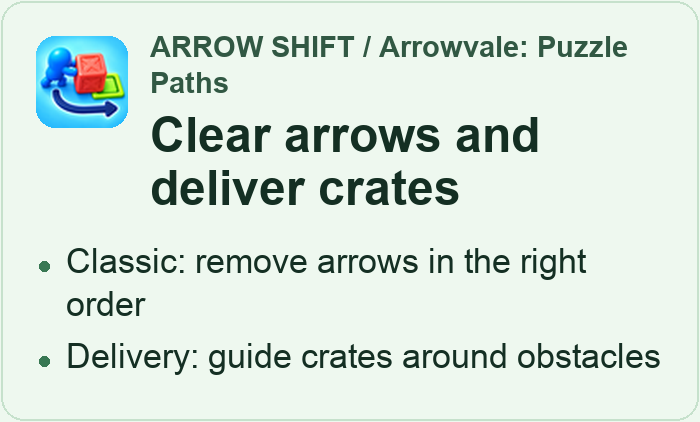
The two official listings in our portfolio separate those jobs into two modes. The Android listing for ARROW SHIFT says Classic asks you to check whether an arrow’s path is clear and remove tangled arrows in the correct order. In Arrow Delivery, direction and length move a worker around walls and push crates to targets. That Android page also names move preview, undo and hints. The iOS listing for Arrowvale describes Classic as clearing arrows that have an open exit, while Arrow Delivery uses direction and distance to move a toy worker and push crates. Its listing separately names command preview, undo and hints. The store identities and some surrounding features differ, so those extra details should not be treated as interchangeable.
For one round, keep a two-line state note before every committed move:
- Open now: What can legally leave or move?
- State next: Where will the worker, crate, obstacle or remaining arrow be when the action ends?
If the second line is vague, use the preview before committing. If the move fails, pause before hitting undo repeatedly. Name the missing state: the arrow length was miscounted, the crate occupied the return lane, a wall changed the endpoint, or an early removal closed a sequence you still needed. Undo then becomes a correction to a specific model of the board, not a way to erase an unexplained mistake.
After Hue and Arrow use different rules, and this is not a claim that the games play alike. The shared planning habit is narrower: a route changes when you act on it. The board you need to understand is often the one that does not exist until the current move is over.
Affiliation note: ARROW SHIFT / Arrowvale is part of our product portfolio. This article is based on the official listings and is not an independent paid review or a claim of hands-on testing.
To try the two-line method on an arrow board, open or download ARROW SHIFT on Google Play and open or download Arrowvale: Puzzle Paths on the App Store. Use the storefront you can actually access, choose one board, and write the expected end state before the first move.
Sources: After Hue release announcement, November 23, 2026; After Hue on Steam; ARROW SHIFT on Google Play; Arrowvale on the App Store.
Comments
0 public responses
All visitors can read comments. Sign in to join the discussion.
Log in to comment