AI Is Not Here to Do Homework. It Is Here to Force Schools to Rewrite Homework.
At Stanford, Sam Altman admitted a prediction error: three and a half years after ChatGPT, education has not meaningfully redesigned itself. The real risk is not that students use AI, but that schools keep training them for a pre-AI world.
AI Is Not Here to Do Homework. It Is Here to Force Schools to Rewrite Homework.
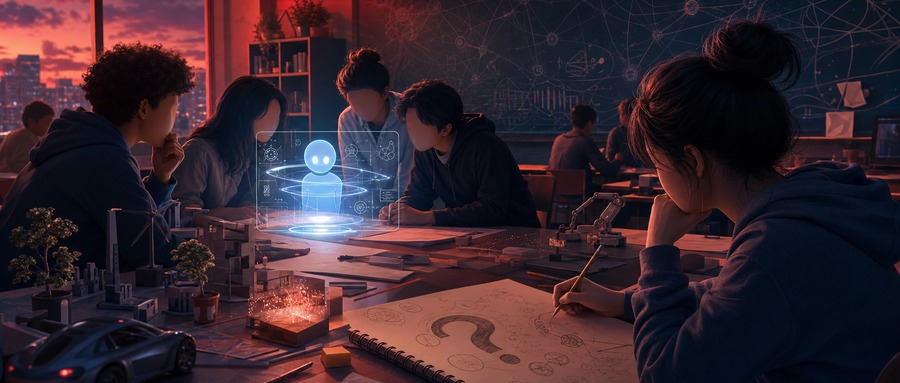
In a Stanford CS153 classroom, Sam Altman was asked a simple question: how does he see education?
He did not give the usual polished answer about opportunity, access and personalized learning. He said education “clearly has to super adapt,” and that he was worried because he thought it would have adapted by now. When ChatGPT launched, he expected roughly a year of chaos: students would cheat, schools would panic, and then the system would redesign itself. Three and a half years later, he said he struggled to point to any significant systemic change in education at large.
Then came the sharper warning: if we keep teaching and evaluating students as if we were in a pre-AGI world, it will not work. It will lead to an atrophy of learning how to think. If schools do not change how they teach, learn and evaluate, he said, people’s critical thinking skills will significantly atrophy.
That is not just a tech CEO complaining about schools. It is a warning from inside the shift itself: the world has changed faster than the institutions responsible for preparing children for it.
The problem is not that students use AI. The problem is that assignments are still pre-AI.
The easiest institutional reaction to generative AI is control.
Ban direct copying. Require disclosure. Detect machine-written text. Create approved-tool lists. Restrict younger students from using open-ended content generation without adult guidance. All of that matters, especially around privacy, exams, copyright and academic integrity.
But control does not answer the deeper question.
If an assignment can be completed by ChatGPT in twenty seconds, and a student only needs to copy, lightly edit and submit, the first thing to question is not the sudden collapse of student morality. It is the assignment. AI has exposed a weakness that was already there: too much schoolwork treats the submitted artifact as proof of learning. A correct-looking essay becomes “writing.” A formatted answer becomes “understanding.” A rehearsed solution becomes “ability.”
AI changes what is worth practicing.
Before ChatGPT, asking students to write a short research summary at least forced them to search, organize and express. Now, if the task is still just “write 1,500 words,” it can collapse into prompt engineering and polishing. Before coding assistants, asking students to write a program at least revealed whether they understood syntax and algorithms. Now the code can be generated. What matters is whether the student can explain the algorithm, choose the right data structure, design tests, catch edge cases and correct the model when it is confidently wrong.
In a Stanford Engineering interview on educational technology, Russ Altman described a practical classroom adjustment: in a programming course, working code is now worth less, while quizzes that test whether students understand why an algorithm works and why a data structure is appropriate are worth more. That is the right direction. AI does not mean schools should stop teaching fundamentals. It means schools must be clearer about why a task exists in the first place. Is it training manual production, or judgment?
China’s education problem will not be softened by AI. It will be amplified.
In China, the stakes are even higher.
China has strong administrative capacity and the ability to move an entire school system quickly once a direction is set. In 2025, Chinese education authorities issued guidelines on general AI education and generative AI use in primary and secondary schools. The documents are not naive. They mention AI literacy, critical thinking, human-AI collaboration, data security, age-appropriate use, teacher responsibility and the risk of over-reliance. They say primary students should not independently use open-ended content generation, junior students should learn to analyze the logic of generated content, and senior students should connect AI use with technical principles and inquiry-based learning. Teachers should not treat generative AI as a substitute for their core teaching role or use AI outputs directly to evaluate students.
The policy direction is sensible.
The harder problem is not in the documents. It is in the exam structure.
China’s high-stakes exams, especially the zhongkao and gaokao, are deeply tied to fairness and mobility. For many families, they remain the clearest route upward. The problem is that when nearly all incentives point toward a small number of high-stakes scores, schools, teachers, parents and students learn to optimize for what is measurable in the short term. OECD’s overview of education in China has long identified the need to reduce the role of standardized testing and reform the gaokao as a major issue. A 2025 review of gaokao’s social impact describes it not merely as an exam but as a public-policy instrument that shapes schools, families and society.
AI will intensify this contradiction.
If real selection still rewards speed, memorization, template mastery and standard answers, AI education may become a decorative layer. Schools will run AI literacy classes, science festivals and showcase projects, while the decisive parts of schooling remain lecture, drill and test. Students will quickly learn the hidden rule: AI is for display; exam preparation is for survival.
That is not transformation. It is the old system wearing a new interface.
Inequality is the second risk. Elite urban schools will get better teachers, better devices, better industry connections and more authentic projects. County and rural schools may get a platform login, a few model lessons and more compliance requirements. If AI education means “the resource-rich move first,” it will widen educational inequality in a new form.
The real reform is assessment power.
The hardest part of schooling is not the timetable. It is assessment.
As long as the final judgment mainly rewards a clean, rankable and quickly graded result, most classroom reform will remain fragile. Schools can talk about project-based learning, interdisciplinary inquiry and AI-supported exploration, but if none of it carries real weight, it will be pushed to the margins.
Talent for the AGI era cannot be defined as the ability to answer already-defined questions. Students need at least five capacities:
- turning vague problems into researchable questions;
- judging the reliability of information and model outputs;
- using AI to extend their reach without outsourcing their thinking;
- building, collaborating and iterating under real constraints;
- retaining personal judgment, responsibility and taste.
These capacities cannot be measured well by multiple-choice questions alone. Nor can they be captured by one decisive exam. They require process evidence: drafts, prompts, source trails, model-output critiques, peer discussion, failed experiments, revisions and oral defense.
This does not mean abolishing exams. In a country as large as China, abandoning unified assessment overnight would be neither realistic nor fair. A better route is to move from a single endpoint to multiple forms of evidence. Keep standardized exams where they serve fairness, but gradually add weight to project portfolios, research reports, technical prototypes, community problem-solving, AI-use logs and oral defense.
AI can even reduce the cost of this transition. It can help record process evidence, generate preliminary feedback and help teachers identify common misconceptions. But the final authority must remain human. AI can be a microscope. It should not be the judge.
Teachers should become cognitive coaches, not answer police.
A lot of AI-in-education commentary treats teachers as the party to be replaced. That is the wrong frame.
If schooling is only the delivery of standard knowledge, teachers will indeed be squeezed by tools. But if schooling is about judgment, creativity, collaboration, courage and values, teachers become more important. Children are not short of information. They are short of adults who can pull them back from laziness, anxiety, imitation and self-doubt.
Research from Stanford’s SCALE initiative and other education researchers keeps circling the same issue: cognitive offloading. Students can use AI to avoid the very mental work that learning requires. But AI does not automatically weaken higher-order thinking. When students use it skeptically, compare outputs, ask for feedback and test alternatives, it can stimulate analysis, evaluation and reflection. The difference lies in task design and teacher guidance.
So teacher training cannot stop at “how to use AI to prepare lessons.” That is useful, but shallow.
The more important training is how to redesign assignments so that AI can participate without taking over: how to ask students to show prompts, evidence chains and revision reasons; how to identify hallucinations and bias; how to build classroom routines where students argue with the model; how to preserve difficulty, doubt and independent judgment even when a tool can produce fluent answers instantly.
The teacher’s role shifts from grader to learning designer, from answer gatekeeper to coach of thinking.
China can be bolder.
If AI education is treated as one more subject, the opportunity will be missed.
The bolder move is to use AI as external pressure to rewrite the structure of schooling.
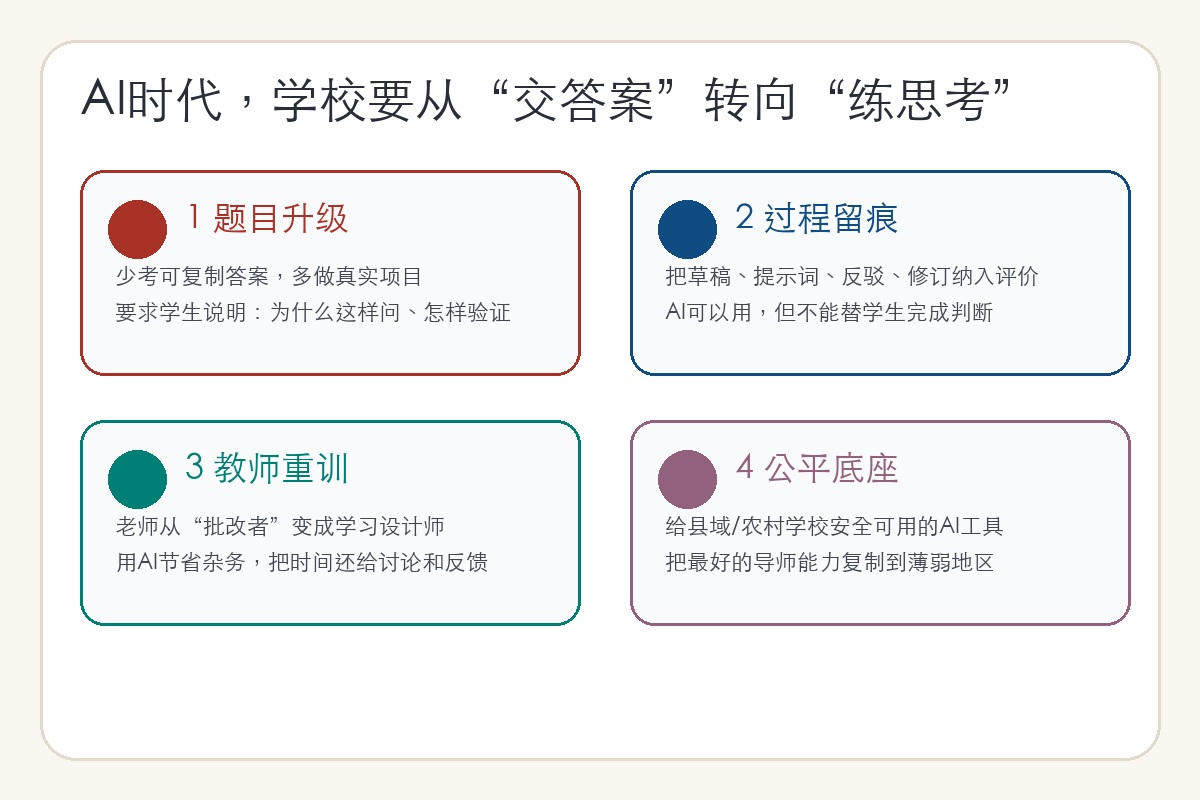
First, create national standards for AI-era assignments. Education authorities could publish reusable task patterns: when AI is allowed throughout, when it is allowed only for checking, when students must first write their own reasoning, and when they must submit model-output comparisons. Schools need more than “use it safely.” They need examples of what new homework looks like.
Second, build student portfolios from high school onward. Each student should complete several real projects over three years: a community problem, a scientific inquiry, an engineering prototype, a writing or media project, and a social investigation. AI use should be transparent. Oral defense should include random follow-up questions. The portfolio should not immediately replace the gaokao, but it can start to carry weight in pilot admissions, strong-base programs, vocational pathways and university comprehensive evaluation.
Third, make county-level schools the main battlefield for AI education equity. Do not turn AI reform into a showcase for famous schools. A national platform can provide safe models, project kits, remote mentors and experimental environments to ordinary schools. If AI does not help weaker regions first, it is not an equity tool. It is another sorting mechanism.
Fourth, use AI to reduce teacher burden, but return the saved time to students. AI can draft notices, organize materials, create first-pass feedback and help with administrative work. The saved time should not become more paperwork. It should become small-group discussion, individual feedback, project mentoring and parent communication.
Fifth, allow some schools to change assessment first. Reform cannot live forever in slogans. Selected cities and counties should be allowed to build “AI-era learning zones” where a meaningful share of assessment is based on projects, defense, collaboration and process evidence, with clear anti-cheating, privacy and fairness safeguards. Run the experiment, measure it honestly, and scale what works.
The thing to protect is the child’s own mind.
AI education can fall into two easy traps.
One is fear: ban, detect, block, and treat AI as a cheating machine. The other is faith: assume that AI tutors will automatically make education fairer, more personalized and more efficient.
Both are too simple.
UNESCO’s guidance on generative AI in education says the important thing plainly: generative AI is not an automatic solution to education’s fundamental problems. Human capacity and collective action remain the determining factors. The World Economic Forum’s Future of Jobs Report 2025 points in the same direction from the labor-market side: analytical thinking remains the top core skill, while AI and big data, creative thinking, resilience, curiosity and lifelong learning are rising fast.
That gives schools a simple but demanding mandate: the stronger the technology becomes, the less acceptable it is to train children as button-pushers.
Students must learn to use AI. Those who cannot will be disadvantaged. But they must also know when not to trust it, when to stop and think, when to ask a human, when to read the original source, when to run the experiment, and when to take responsibility for a judgment.
Altman admitted at Stanford that he was wrong. He expected education to rewrite itself. It did not.
That admission is worth taking seriously. AI has made answers cheap. Schools can no longer make answer delivery the center of learning. The scarce things now are questions, judgment, responsibility, taste, collaboration and courage.
If schools do not change, children may lose more than a few points on an exam. They may lose the habit of thinking for themselves in a world where intelligence is everywhere.
Sources
- Stanford Online, “Stanford CS153 Frontier Systems | Scale, AGI, and the Future of Everything”, 2026. https://www.youtube.com/watch?v=F_7M4Hc-usM
- CS153: Frontier Systems, Stanford University. https://cs153.stanford.edu/
- Stanford Engineering, “The future of educational technology”, 2024. https://engineering.stanford.edu/news/future-educational-technology
- Stanford Engineering, “The future of education”, 2026. https://engineering.stanford.edu/news/future-education
- UNESCO, “Guidance for generative AI in education and research”, 2023. https://www.unesco.org/en/articles/guidance-generative-ai-education-and-research
- World Economic Forum, “The Future of Jobs Report 2025”. https://www.weforum.org/publications/the-future-of-jobs-report-2025/digest/
- China Ministry of Education Basic Education Teaching Steering Committee, “Guidelines for General AI Education in Primary and Secondary Schools (2025)”. https://www.eol.cn/zhengce/wenjian/202505/t20250512_2667827.shtml
- Chinese Society of Education, “Guidelines for the Use of Generative AI by Primary and Secondary Students (2025)”. https://www.cse.edu.cn/index/detail.html?category=31&id=4242
- CCTV, “Education authorities issue guidelines to promote AI education in primary and secondary schools”, 2025. https://news.cctv.com/2025/05/13/ARTIZme0sHlrauomsKYrPppl250513.shtml
- OECD, “Education in China: A Snapshot”, 2016. https://www.oecd.org/content/dam/oecd/en/about/programmes/edu/pisa/publications/national-reports/pisa-2015/Education-in-China-a-snapshot.pdf
- Cheng & Hamid, “Social impact of Gaokao in China: a critical review of research”, 2025. https://doi.org/10.1186/s40468-025-00355-y
- Stanford SCALE AI Repository, “AI in Education Beyond Learning Outcomes: Cognition, Agency, Emotion, and Ethics”. https://scale.stanford.edu/ai/repository/ai-education-beyond-learning-outcomes-cognition-agency-emotion-and-ethics
Comments
0 public responses
All visitors can read comments. Sign in to join the discussion.
Log in to comment