At the door of Xiao Fang Niu
At the door of Xiao Fang Niu, a free braid and a few wet wipes show how quickly public kindness can be turned into private advantage.
At the door of Xiao Fang Niu
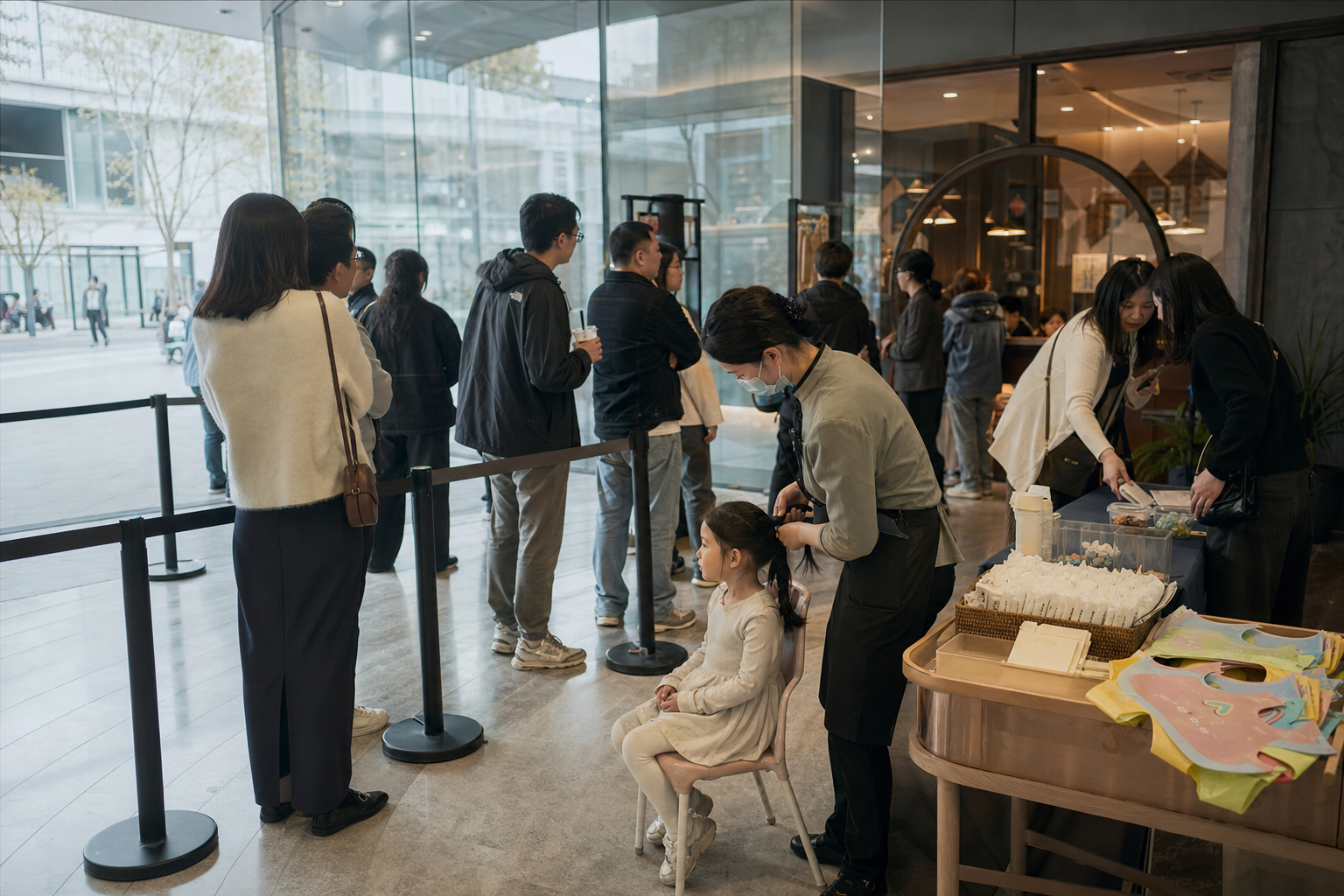
At the door of Xiao Fang Niu, people line up early.
Some are not waiting for the food. They are not waiting for a table either. They are waiting for a child's hair to be braided. The number is called, the child sits down, the worker separates the hair, braids it, ties it off. The adult looks at the finished braid and leaves. No meal. No table. The queue number is thrown away.
The restaurant meant well. Toys near the entrance keep children busy while families wait. During the meal, the staff may offer wet wipes, children's bibs, a children's meal, and small favors that make eating out with a kid less punishing. A parent knows what that means. These things are not expensive. They matter because they appear at the exact minute when everything is about to become difficult.
Then the bargain hunters arrive.
One person comes only for the free braid. Another asks for extra wet wipes. Another treats the children's bibs like giveaways and wants more. The staff can see what is happening. They know some of these people will never sit down to eat. But if the restaurant says no, someone complains. If it gives less, someone complains. If a worker asks whether they are dining, someone still complains. So the staff keep smiling, keep handing things out, keep spending the restaurant's goodwill on people who came only to drain it.
It is a small thing. A packet of wipes. A paper bib. Ten minutes of a worker's hands. Small enough for someone to laugh and say, why make such a fuss?
But small things are good lamps. They show the room.
A city can have glass towers, clean malls, QR codes, polished service scripts, and online complaint forms. Under all that, a very old hand can still reach out for whatever is free. The object changes. The gesture does not.
The strange part is the confidence. The person taking the free service does not look ashamed. If stopped, he sounds injured. Why do you offer it if I cannot take it? Why are you discriminating against my child? Why is your service so poor? A little act of freeloading puts on a coat and calls itself consumer rights.
That is where the ugliness begins to feel familiar.
Lu Xun wrote about spectators, numbness, cheap cruelty, and the old illnesses of public life. Those illnesses did not require dirty streets. They did not disappear because the city became expensive. A person can sit under bright lights, hold the latest phone, and still behave like a petty thief of trust. He may not steal money. He steals the assumption that kindness will be used in good faith.
We like to say society has progressed. In many ways, it has. People no longer stand in the same lines for the same rations. Now they stand in line for free braids at a family restaurant. The costume has changed. The appetite has not.
It would be too easy to say these people are simply born bad. That lets them off. The sharper fact is that many of them know exactly what they are doing. They know they did not come to eat. They know the wipes are meant for diners and the braiding is meant to comfort children who are waiting for a meal. But another rule speaks louder inside them: take it if no one can stop you. If someone does stop you, complain.
That rule does not smash windows. It does not shout slogans. It only wears down shame a little each day. Two extra packets today. A free braid tomorrow. A public kindness converted into a private trick. After enough of this, society learns to lock up the small mercies. Restaurants add conditions. Hospitals hide supplies. Schools stop keeping extras around. Communities put everything behind a counter. The people who needed help honestly are the ones who lose it.
When goodwill is abused, the first thing lost is not money. It is trust.
Picture the mother who really brought her child to eat, still waiting. Picture the child with food on his shirt, but no bib left. Picture the worker at the entrance, knowing the person in front of her is only taking, yet still forced to smile and pass the item over. Modern service culture can be absurd in this way. The complaint channel protects the shameless. The polite worker protects the business. The rulebook protects the person who knows how to make trouble.
I am wary of phrases like national character. They are heavy and often lazy. They flatten everyone into one accusation. Still, there are old habits that survive modernization: grabbing small advantages, fearing any personal loss, treating public goods as things to be pocketed, turning every boundary into an insult, turning every concession into a new entitlement. These habits did not vanish when people learned to scan QR codes.
They moved.
From the market stall to the mall entrance. From a handful of vegetables to a stack of wet wipes. From ration coupons to children's bibs. Different props, same hand.
The bitter joke of a developed city is not that it still contains backward behavior. It is that the behavior can now speak in modern language. The queue is digital. The complaint is online. The service script is standardized. Even the freeloader has learned better words. He does not say, I came to take something for nothing. He says, this is part of your service. He does not say, I never planned to eat. He says, I am just trying the experience. He does not say, I know you fear bad reviews. He says, I am defending my rights.
Nice words make a useful hiding place.
But the hand is still there. Reaching for the wipes. Reaching for the bibs. Reaching for the braid in a child's hair. Reaching, most of all, for the trust a decent society leaves out in the open.
Maybe the restaurant will change the rule. Hair braiding only after ordering. One bib per child. Wet wipes by the table, not by the handful. When that happens, someone will call the restaurant stingy. But often the stinginess starts somewhere else. We eat away another person's generosity, then complain that the bowl has become too small.
At the door of Xiao Fang Niu, the real diners keep waiting. The child who got the free braid walks away. The braid swings lightly as she goes, a neat little thing on the back of her head. Behind it, for a second, you can see the old darkness tied to the bright signs of a modern city.
Comments
0 public responses
All visitors can read comments. Sign in to join the discussion.
Log in to comment