Boardgame Nights adds Mahjong Solitaire: separate pace from move confirmation
Boardgame Nights launched on Steam on November 27 with 16 games, including Mahjong Solitaire . Steam’s accessibility information marks the collection as playable at your own pace and lists background-volume controls; the store description
|


Pause for three seconds between moves and log pace separately from confirmation.
Boardgame Nights adds Mahjong Solitaire: separate pace from move confirmation
Boardgame Nights launched on Steam on November 27 with 16 games, including Mahjong Solitaire. Steam’s accessibility information marks the collection as playable at your own pace and lists background-volume controls; the store description also names colorblind mode, reduced motion, and larger text. Those are collection-level statements, not proof that every cue works identically across all 16 games.
The useful distinction is not simply whether a game contains mahjong tiles. A timer answers when the player must act. A sound, animation, or board change answers whether the last action registered. A game can remove time pressure while still relying heavily on audio confirmation. It can also play a satisfying sound after a move without requiring the player to follow a beat.
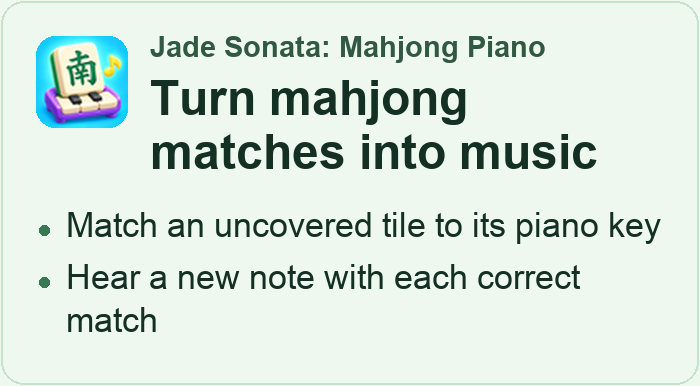
Jade Sonata: Mahjong Piano is part of our product portfolio. This product-related guidance is based on public Google Play and App Store descriptions, not an independent hands-on review. The listings describe finding an uncovered tile, pressing the piano key with the same symbol, clearing one tile, and playing the next note of an original melody. They also state that there is no timer or beat deadline. Standard mode offers three mistake opportunities; relaxed practice allows unlimited mistakes.
Try a four-move pace-and-confirmation log at normal volume. Before each key press, write one answer under “pace”: must I act now? After the press, record three separate observations under “confirmation”: did the tile disappear, did a lower layer change, and did the next note sound? Deliberately wait three seconds before the next move. The pause tests the absence of timing pressure; the after-move notes test how success is communicated.
Do not score the melody or decide that a pleasant phrase proves the route was best. If the board clearly shows the removed tile and newly available layer, the note can be treated as additional feedback. If a move seems confirmable only by sound, log that as a specific question. This task is different from muting a whole round or copying a replay: it keeps sound on and separates two jobs that games often blend together.
To make the four-move log, download Jade Sonata: Mahjong Piano on Google Play or download it on the App Store. Use normal volume and leave a deliberate three-second gap between moves.
Source
More from WayDigital
Continue through other published articles from the same publisher.
Comments
0 public responses
All visitors can read comments. Sign in to join the discussion.
Log in to comment