China's AI Globalization: The Product Has Left Home. Now What Story Does It Carry?
China’s global expansion has moved from utilities to games, hardware and now AI models. The next test is not simply selling capability abroad, but making products that carry a story people everywhere want to inhabit.
China's AI Globalization: The Product Has Left Home. Now What Story Does It Carry?
A little over a decade ago, many Chinese teams went abroad with products whose names barely mattered.
What mattered was whether an app could free space on an overloaded Android phone. Whether it could brighten a backlit selfie. Whether it could make a slow connection feel a few seconds less slow.
That was the utility-app era: cleaners, photo editors, browsers, keyboards, video tools. The features were modest, the users were far away, and the teams won through distribution, relentless testing, and a thousand small improvements. They carried a very Chinese internet capability into global markets: make something work in messy, real-world conditions.
Then games took the spotlight. Then hardware. Now models are arriving, and culture is coming with them.
This is not a tidy succession. Utilities, games and hardware are all still expanding. But each wave has changed the question Chinese companies face in front of global users. Are they simply people who can make things well? Or are they brands worth remembering?
AI makes that distinction urgent. The next phase of Chinese globalization is not only about getting products overseas. It is about what people will remember when they begin using Chinese-made models, devices, content and services at scale.

From utilities to models, the export unit is no longer just a feature.
First, sharpen a small blade
The important lesson from the early utility wave is not “user acquisition.” It is a refusal to be vague.
Those products were not downloaded because users cared where the team came from. Phones were full, storage was scarce, networks were unreliable, cameras were mediocre. Chinese teams broke those problems into tiny pieces: launch a little faster, ship a smaller package, identify junk more accurately, support more devices.
They did not begin with an inspiring brand manifesto and wait for customers to understand. They gave people back ten minutes, a little storage, one less annoyance.
That is still one of China’s deepest product strengths: operating in complicated, non-standard environments and making services usable, affordable and dependable. You can see traces of it in cross-border commerce, local services, short video, smart devices and logistics.
Utilities also have a ceiling. They solve a problem without necessarily leaving a memory. A user can be grateful and still delete the app when a cheaper replacement appears.
Globalization had to move from completing a task to occupying time, imagination and trust. Games marked that turn.
Games taught a different lesson: people enter culture through experience
Black Myth: Wukong made many global players look again at Chinese games. Not because it was the first game to bring Sun Wukong overseas.
Sun Wukong had travelled long before that. What felt different was the order of things. The game did not treat tradition as a souvenir shop. It did not rush to explain every reference, and it did not paste “Eastern atmosphere” over a familiar template. It built an action world with enough gravity—combat, scale, creatures, music, ruins—that players could enter before they needed a glossary.
Only after being pulled in did many want to ask where the architecture, gods, fragments of scripture and melancholy came from.
This is more than a brief spike. China’s National Press and Publication Administration reported that self-developed Chinese games generated US$18.557 billion in overseas revenue in 2024, up 13.39% year on year. Games have become one of the most mature and commercial routes through which Chinese content travels.
That order matters.
Culture is not a manual waiting to be translated. It is something people feel while doing something else. This is one reason American entertainment has had such global force for so long. It does not always begin by announcing a set of values. It lets an audience enter a hero, a city, a profession, a victory or a failure. By the time the credits roll, a worldview has often travelled too.
Chinese companies have often been trained to speak in a more concrete register: specifications, value for money, conversion, results. That discipline is not wrong. It helped win many markets. But in high-trust, high-ticket, long-cycle categories, a feature list is not enough. People are also buying a sense of who they can become and what they want to be associated with.
Hardware turned “good value” into trust
Anker, DJI and Insta360 do not have identical playbooks. They do share one achievement: they did not stop at “made in China, competitively priced.”
Anker turned charging, energy storage and consumer electronics into a coherent product system. DJI moved aerial devices beyond enthusiast gadgets and into imaging, agriculture and industrial work. Insta360 made immersive shooting and action footage feel like a form of expression that ordinary people could pick up.
The valuable translation was not merely from Chinese supply chains into English-language marketing. It was from supply-chain capability into a durable promise: this will work when I open the box; there will be support if it does not; the next version will understand my use case better.
That is where a brand starts. A brand is not an expensive package around a product, and it is not a grand commercial. It is the moment a user is willing to lend you their reputation—recommend you to a friend, take you on a trip, build you into a workflow.
American companies often seem better at attracting capital and assigning large valuations to a future. There are structural reasons: capital markets, global finance, and a mature content industry, not just superior storytelling. Still, Chinese companies have their own recurring mistake. They compress the entire story into a feature list and say too little about where the product is taking people.
Features get the purchase. Direction earns the return visit.
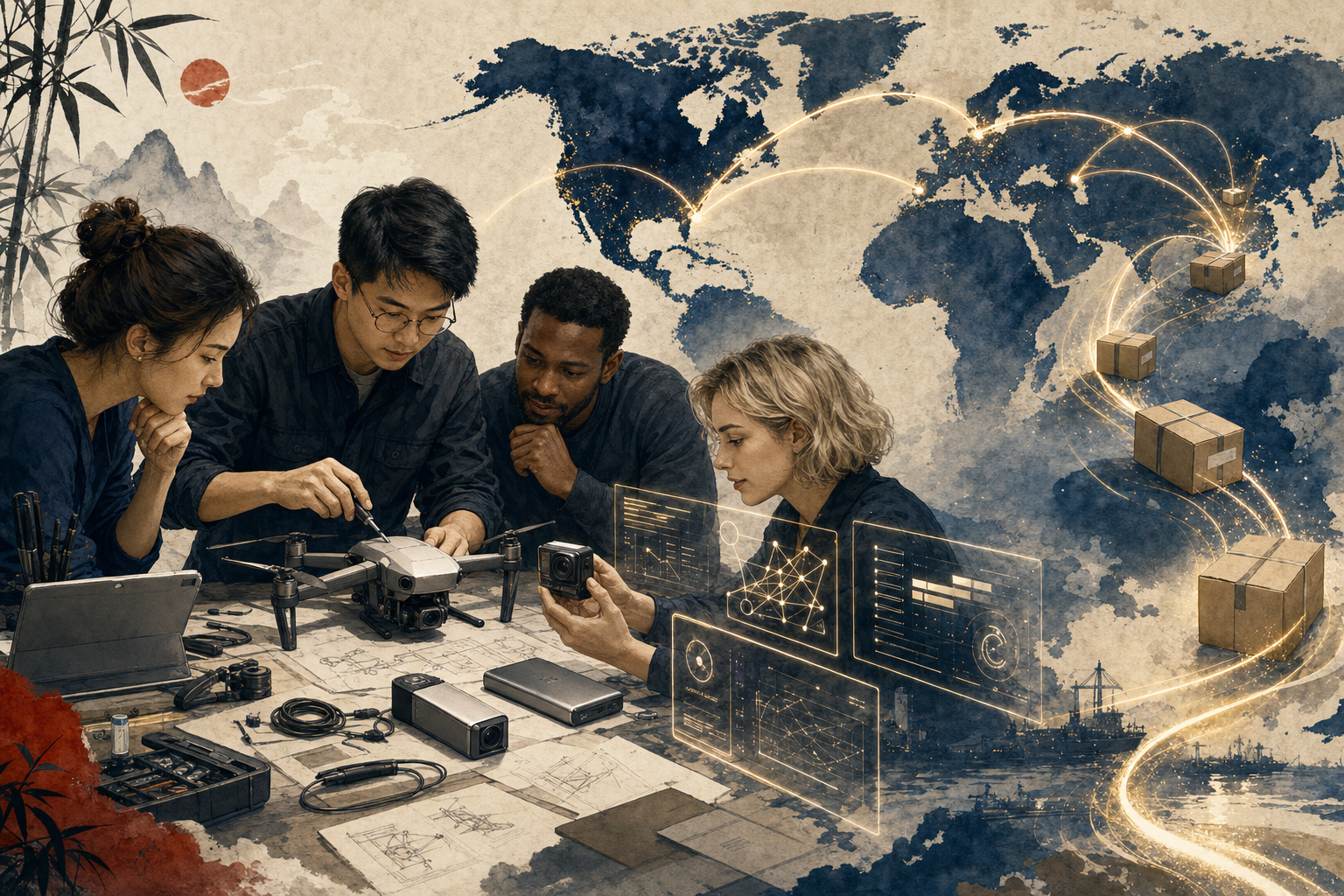
Product quality is the ticket into a market. A repeatable experience is the moat.
AI models are not just APIs
The model era makes the question sharper.
A model can look like cloud capacity: type something, get something back; connect an API, save a few hours; generate an image, reduce production time. But once it enters companies, schools, creative work and everyday decisions, it stops being mere infrastructure. It begins to participate in language, taste, knowledge and habits of judgment.
That is why Kimi, Zhipu, Qwen, DeepSeek and other Chinese model teams cannot define their global role solely through lower prices, faster responses or stronger benchmark scores. Those matter. In developer and enterprise buying, price, latency, open-weight availability, deployment and reliability are serious competition.
But no organization hands a model its workflows, content assets and team habits for the long term just because it is inexpensive. That relationship rests on three harder things.
First: solve complicated problems in the real world.
China’s opportunity is not simply to reproduce another chat box. It is to turn experience from commerce, manufacturing, logistics, mobility, content production and digital payments into capabilities a model can call on. Global users do not lack chatty AI. They lack systems that can find an order anomaly, move a meeting forward, connect factory knowledge, or make multilingual content feel natural.
Second: let users see themselves in the product.
A global model cannot treat its users as a stream of tokens. It needs to understand local expressions, industry vocabulary, creative traditions and boundaries. “Chinese elements” do not mean dragons, ink paintings or Lunar New Year pasted onto an interface. They mean turning China’s distinctive lived knowledge of efficiency, coordination, production, relationships and daily life into methods that make someone elsewhere think: this is genuinely useful.
Third: be willing to show its values.
This is not a call for slogans. It is a practical question. When a product meets an ambiguous decision, what does it favor? Creators or maximum engagement? Privacy or frictionless data collection? Independent judgment or keeping people inside a system? The closer AI gets to everyday life, the less credible it is to pretend it has no values.
Stanford’s 2025 AI Index captures the intensity of the race: frontier performance is moving quickly, private investment remains highly uneven, and business adoption is broadening. That is all the more reason not to mistake model capability for product meaning. Capability is becoming abundant. Trust, context and a reason to return are not.
Cultural globalization should not rush to “represent China”
Interest in China has plainly grown. Some people arrive through games and animation and then look for the original stories. Some see short videos, products and city life and want to visit. Others are curious about supply chains, digital payments and AI and want to understand the market firsthand. China recorded 26.94 million foreign visitor arrivals in 2024, up 95.5% year on year. That does not mean people have accepted a ready-made narrative; it does suggest that the desire to see the country firsthand is returning.
That curiosity is valuable. It does not mean anyone has already accepted a finished “China narrative.” The worst response would be to turn cultural globalization into a one-way lecture.
The work that travels furthest usually has two layers. The first is an emotion that people anywhere can enter: growing up, losing something, adventure, regret toward family, the stubborn wish to make a decent life. The second is texture that Chinese creators can make unusually specific: the light on a street, the restraint inside a relationship, the aftershock of history, the tempo of a factory floor.
Without the first layer, international audiences cannot get in. Without the second, there is no reason the work needs to start in China.
The same is true for brands. Do not lead by proving that “we are strong.” Let users experience a moment of “I did not know this could work this way.” Do not use culture as wrapping paper. Put it into choices, characters, interactions, service and visual judgment.
A strong Chinese AI-video product should not merely generate ink-wash or historical-fantasy imagery. It should help an Indonesian shop owner explain a product clearly, help a Brazilian creator turn an idea into something shareable, help a European designer finish an expression faster. What users receive is capability and respect. Only then will they become curious about where this product came from.
That is when culture has actually travelled.

The strongest cultural export does not explain itself first. It gives people a reason to step inside.
The work for founders is not another slogan
For a startup team now, a sense of mission does not need to live on a wall. It can show up in every harder, more honest decision.
Will you make an “international version” after the product is finished, or include people from different cultures in defining it from day one? Will you win a user with the lowest price, or take the time to build service, community and trust? Will you use Chinese culture as a visual symbol, or turn decades of Chinese engineering, organization and everyday knowledge into a solution the world can use?
Those choices decide whether a product is a shipment or a global brand.
China no longer lacks factories, engineers, distribution methods or one-off hits. What is scarce now are teams that can hold product capability, human feeling and long-term value in the same hand.
They do not need to manufacture a grand national story. They need to tell the one in front of them truthfully: solve a user’s problem beautifully; make an experience shaped in China open enough for the world; deliver with enough consistency that people come back.
When users keep using it, keep repeating it and keep carrying it elsewhere, the story will find its own language.
Comments
0 public responses
All visitors can read comments. Sign in to join the discussion.
Log in to comment