Don't Trap a Child Under Your Ceiling
A spilled milk tea in a shopping mall, a boy scanning the faces of strangers, and a question about what discipline is really teaching.
Don't Trap a Child Under Your Ceiling
A cup of milk tea hit the floor in a shopping mall.
The older brother had bumped into the younger one by accident. Ice and brown tea spread across the tile. Then the father grabbed the older boy by the ear. He didn't say a word. He just kept twisting and pulling. The mother stood there, helpless, looking at her son's face. The boy didn't make much noise. He kept looking at the people walking past—one face, then another.
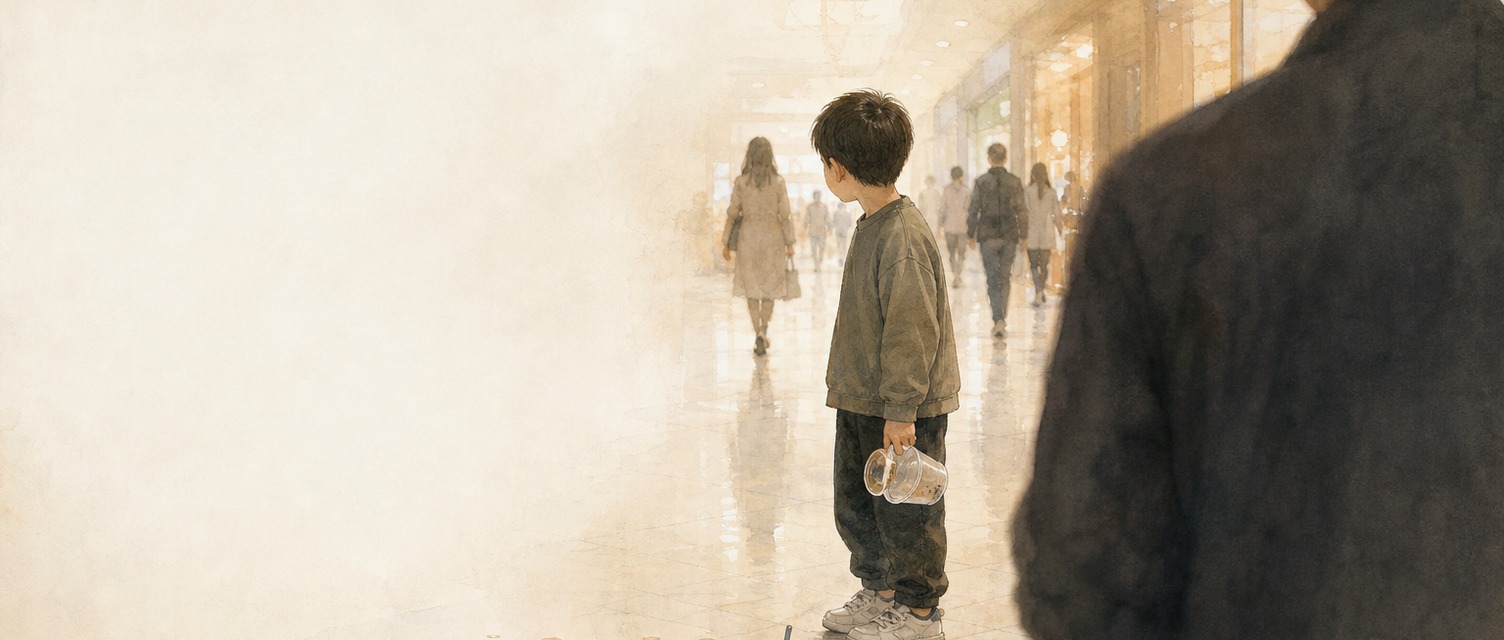
I haven't forgotten his eyes.
I don't know whether that moment will become a psychological scar. Nobody can diagnose a child's future from a few minutes in a mall. His temperament, what his family is like the rest of the time, whether someone comforted him afterward, whether his father ever apologized—those things matter, and they are more complicated than a bystander's verdict.
But I do know he learned more than “be careful where you walk.” He may also have learned that the most dangerous thing about making a mistake is not the broken thing, but the loss of control of someone close to you. He may have learned that public shame can hurt more than pain. That his body and his dignity can be handled by whoever is stronger.
This isn't an article telling parents exactly how to raise a child. I don't have the standing to hand out a universal answer. My child is still very young. I am still young myself. I haven't lived enough lives to pretend otherwise.
I only want to put a question on the table: where, exactly, are we trying to lead our children?
One Spilled Drink, One Child Being Seen
People will say: it was only an ear twist. Kids need discipline. Parents are exhausted. Parents lose their temper.
All true. Raising a child is exhausting. No parent is calm and eloquent every day. Children do need to be stopped sometimes. If you knock something over, you help clean it up. If you hurt someone, you apologize. If something is dangerous, an adult must stop it right away.
The issue isn't whether there are boundaries. The issue is what the boundary is for. Is it there to help a child understand consequences—or to make a child submit through fear?
A grown man silently twisting a child's ear in public is not really teaching anything in that moment. It is a display of power: who is bigger, who has authority, who gets to make someone else small. The child may become quiet in the short run. But what he learns may not be responsibility. He may learn to hide, to please, to lie, or to save his anger for someone weaker.
The American Academy of Pediatrics advises against physical punishment, threats, humiliation, and shaming. Its policy statement says such approaches can suppress behavior briefly but do not teach long-term self-control or responsibility. The World Health Organization's 2025 report on corporal punishment treats it as both a public-health and child-rights issue, summarizing associations with worse mental, behavioral, cognitive, and educational outcomes, along with damaged family relationships.
That research cannot predict the life of the boy I saw. It does, however, ask us to stop treating “being hit works” as a cost-free piece of common sense.
A Parent's Ceiling Should Not Become a Child's Ceiling
What troubles me even more is the demand hiding behind a lot of harsh discipline: your words and actions must fit your parents' wishes; you must not go beyond what they can imagine.
It is like living under a dome.
If you grow up in a county town and are taught that obedience is the highest virtue—that you must always act according to your parents' ideas—you may never get beyond the mental borders of that town. This isn't an argument that leaving a small town is the only version of success. It is about the habit of asking, first: “Will this make the adults angry?” instead of “Is this right? Can I do it well?”
The same thing happens in a big city. If a child must always follow the map drawn by their parents, they may never get beyond that city, that industry, or the limits of that generation. If the largest context you give your child is the size of yourself, how can they absorb what is newer than you?
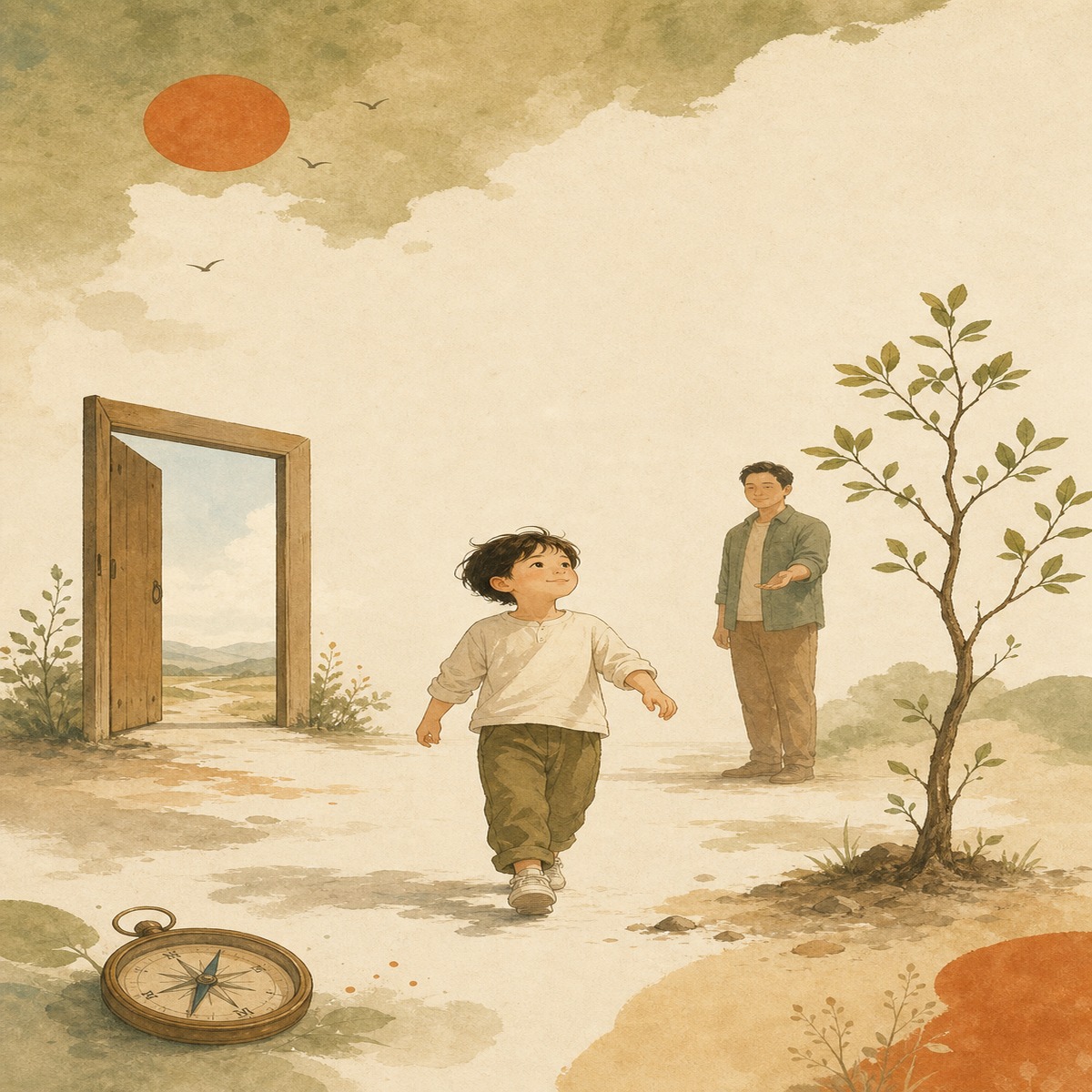
Parents can give their children a map: what kindness looks like, what honesty requires, what it means not to harm others, what responsibility costs. But a map is not a cage.
Real boundaries are about morality and kindness—respect for other people, for oneself, and for reality. They are not “you may not do this because I don't like it.” Real encouragement is not empty praise either. It is allowing a child to have thoughts their parents never had, to try things their parents never tried, and to come home after a fall and talk honestly about what happened.
A child becomes capable of surpassing a parent not because every step was chosen for them in advance, but because a safe relationship lets judgment, curiosity, and responsibility grow.
My Father Didn't Hit Me. He Made Me Remember the Consequence.
I came from a rural village. As a child, I did foolish things too.
Once, we were playing with firecrackers. I put one inside a neighbor's ceramic water jar. The jar shattered. I thought I was going to be beaten, or at least shouted at for a long time.
My father didn't scold me. He rolled one of our new jars over to my uncle's home and said, “This child broke yours. We'll replace it with our newest one.” Then he went back to his work.
I didn't come away thinking I had gotten away with it. The opposite happened. I understood something very concrete: I had damaged someone else's property, and the damage had to be made right. My father took care of the immediate responsibility, but he did not erase the consequence. I could not treat another person's loss as a joke from my childhood.
That kind of discipline didn't shrink me. It put responsibility in front of me and left my dignity intact.
When I go back to the village, I remember seeing another way of growing up. Some children were beaten severely for the smallest thing. Some were even punished by having their ears pinched with pliers. Years later, I can't use a few lives to declare a clean chain of cause and effect. But I do see people who still watch faces before they speak, who don't dare say much, who have trouble imagining a life beyond the village.
I also see my own good fortune more clearly. My parents did not treat obedience as the highest goal. They did not build me a lower ceiling.
Discipline Is Not Making a Child Afraid of You
When parents hit or yell, the feeling underneath may not be cruel. They may be afraid their child will go astray, get hurt, or fail. The anxiety is real. The love may be real too.
But the first thing a child feels is not the parent's distant intention. It is the hand, the voice, and the look in front of them.
If every mistake begins with fear of being hit, yelled at, or publicly humiliated, a child can become better at hiding rather than better at taking responsibility. Before trying anything meaningful, they may keep asking: Will I be rejected? Will I make my parents angry? Will I be embarrassed?
That is not prudence. It may be a parent's fear moved into a child's body.
Of course parenting cannot be only “do whatever makes you happy.” Indulgence without limits is not freedom. If a child breaks something, they should help repair it. If they hurt someone, they should make amends. If they do something dangerous, the consequence should be clear. But consequences do not require humiliation, and rules do not require fear.
This is what I hope I can offer my son: I won't demand that every word and choice match my preference. I will allow him to walk toward places I have never been. When he makes a mistake, I will first help him see what happened, then help him carry the part he needs to carry. When he brings me an idea I never had, I will try not to crush it with “useless,” “impossible,” or “don't make trouble.”
The boundaries I can give him are probably just two: morality and kindness. Don't hurt others. Don't casually abandon your own sense of right and wrong.
Who he becomes should not be capped by my own ability.
Let Them Go Further Than We Did
Raising the next generation is not reproducing ourselves.
There is a contradiction in enclosing a child within the limits of our own understanding while expecting them to become exceptional. If we do not let them go beyond our boundary, how can we expect them to surpass us?
We often blame schools, teachers, or the environment when children struggle. Those things matter. But a child's first experience of power, dignity, and rules usually happens at home. Parents teach them whether mistakes can be spoken about or must be hidden; whether disagreement can be discussed or must be swallowed; whether love is a prize with conditions or a relationship strong enough to survive friction.
I don't know what happened to the boy in that mall afterward. Maybe his father calmed down, held him, and apologized. Maybe his mother told him on the way home that spilled milk tea is not the end of the world. Maybe it was one bad minute in a family, not the whole story.
I hope so.
Still, I hope everyone who passed by remembers the way he looked toward the crowd. The next time we feel the urge to push a child back into place with anger, perhaps we can pause and ask: am I teaching responsibility—or am I only teaching this child to fear me?
Children are not here to prove a parent's authority.
One day, they should be able to go somewhere their parents never went.
Sources
- World Health Organization, Corporal punishment of children: the public health impact (2025)
- American Academy of Pediatrics, Effective Discipline to Raise Healthy Children (2018)
- Gershoff & Grogan-Kaylor, Spanking and child outcomes: Old controversies and new meta-analyses, Journal of Family Psychology (2016). Much of the included evidence is correlational; it should not be used to make a certain causal diagnosis about any one child.
Comments
0 public responses
All visitors can read comments. Sign in to join the discussion.
Log in to comment