Game Footage May Be the Cheapest Mine for Physical AI
General Intuition’s bet is not just that games are useful for AI. It is that gameplay, with action labels, may become the missing bridge between virtual worlds and embodied intelligence.
Game Footage May Be the Cheapest Mine for Physical AI
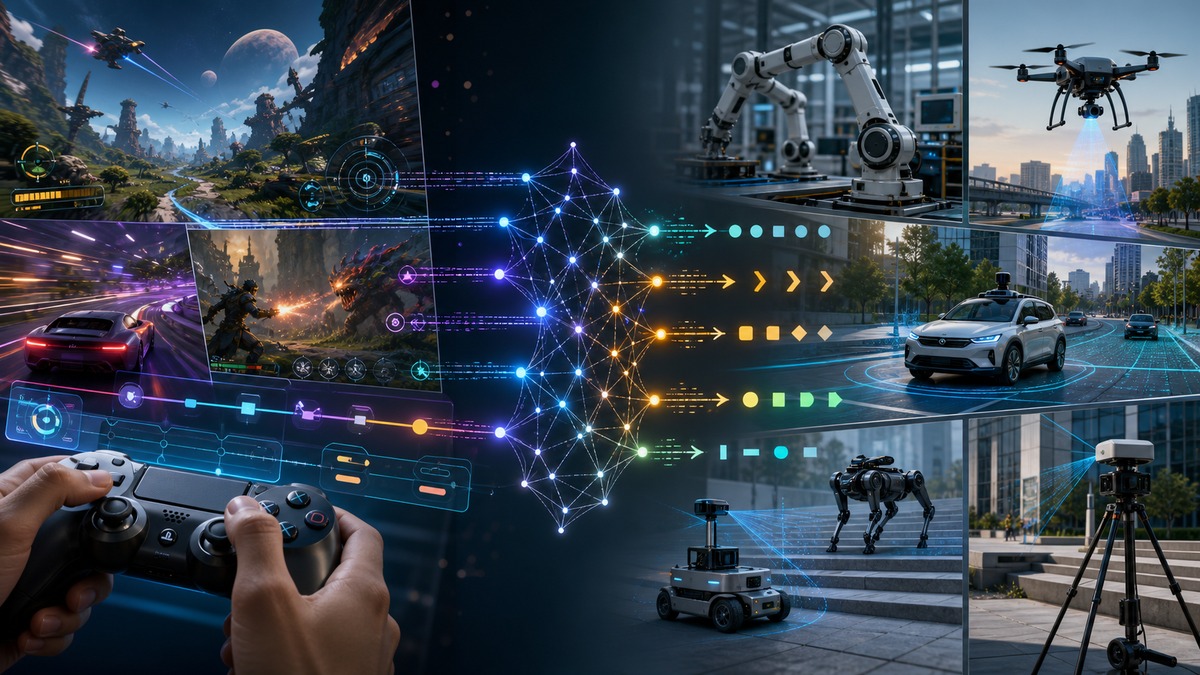
Some funding news disappears the moment you close the tab. General Intuition’s round does not.
The company, spun out of the gaming clip platform Medal, has raised $320 million at a reported $2.3 billion valuation. In TechCrunch’s visit to its New York office, 31-year-old Dutch founder Pim de Witte showed an agent playing a Fortnite-like game and a quadruped robot powered by what he described as the same brain. The striking part was not that the agent could play for a long time, or that the robot could walk. It was the claim underneath the demo: a model trained to understand action in virtual space might transfer into physical embodiment.
That is the kind of idea that makes people stop and say, wait, this actually changes the map.
Robotics has always had a data problem. Real robot data is slow, expensive, risky, and painfully narrow. A robot arm has to fail in front of a real table. A drone has to fly in a real environment. A self-driving system needs miles of reality. General Intuition’s bet is different: before paying the full price of the physical world, mine the worlds humans already play in.
The video is not the secret. The action behind the video is.
Training agents from games is not new. OpenAI’s Minecraft Video PreTraining work used a small amount of labeled contractor data to train an inverse dynamics model, then labeled 70,000 hours of online Minecraft video. The resulting model learned skills such as chopping trees, crafting planks, and making a crafting table. DeepMind’s AlphaStar used human StarCraft II replays for imitation learning before multi-agent reinforcement learning. Games have been AI laboratories for years.
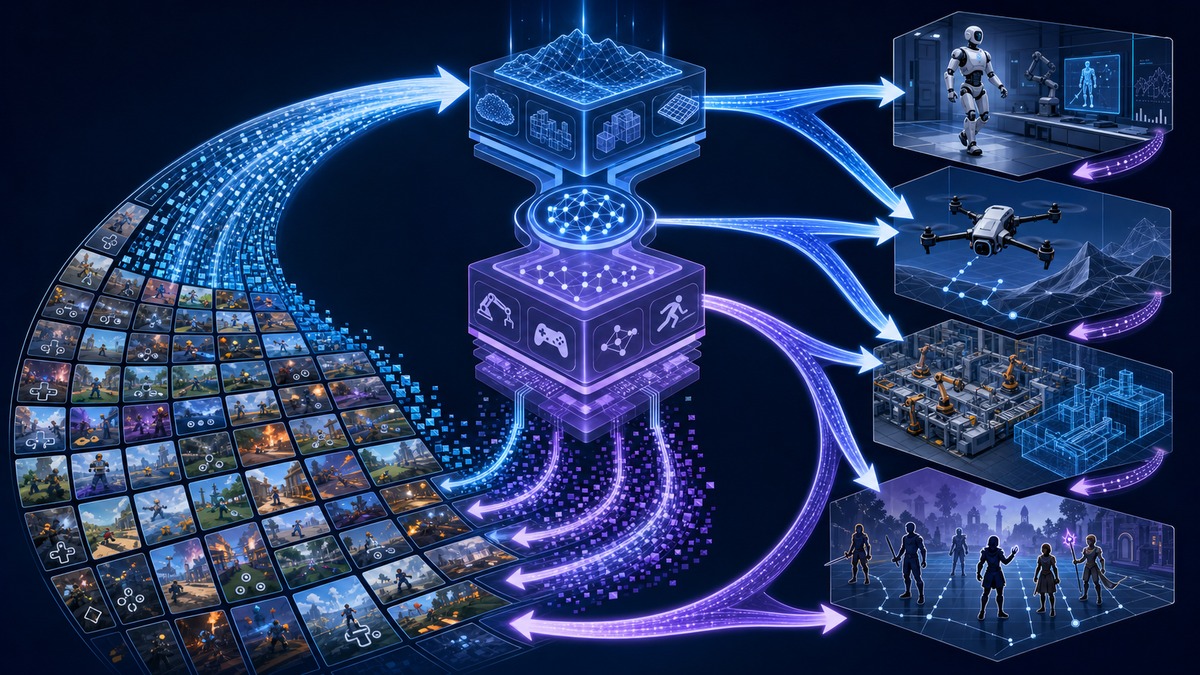
General Intuition’s difference is Medal. According to TechCrunch, Medal produces roughly 2 billion clips per year from 10 million monthly active gamers across tens of thousands of games. These clips are not just passive video. They contain records of what the player did: the key press, the mouse movement, the turn, the jump, the shot, the failure.
That layer matters. Video tells a model what happened. Action labels tell it how the world changed because someone did something. A player enters a room, ducks behind cover, jumps across a gap, turns toward a sound, or fails in a strange corner case. The model can connect perception, action, and consequence.
That is close to the central problem of embodied intelligence: if I do this, what happens next?
De Witte has argued that competitors trying to infer actions from video alone are missing the crucial ingredient. General Intuition wants spatial-temporal pretraining with action. It wants a model that does not merely recognize a wall, a ladder, or a shadow, but learns that walls block motion, ladders change vertical position, and shadows move with time.
Why games can point toward the physical world
A game is not reality. That caveat matters. Game physics is simplified. A character does not really feel weight, friction, sensor noise, hardware failure, or pain. No serious robotics company can pretend that gameplay alone solves embodiment.
But games offer something the physical world struggles to provide: cheap, dense, goal-directed interaction.
Players are not wandering randomly. They chase enemies, avoid danger, search for resources, use terrain, learn maps, exploit elevation, and recover from mistakes. Every clip is a compressed loop of visual input, action choice, and environmental feedback. For a model that must learn to act, that is far richer than static images or text.
OpenAI once wrote that complex video games begin to capture the messiness and continuous nature of the real world. DeepMind has treated Atari and StarCraft as stepping stones toward broader adaptive agents. Minecraft projects such as MineDojo and Voyager show why open-ended game worlds are useful for exploration, skill accumulation, tool use, and long-horizon goals.
General Intuition pushes that line of thinking into a more commercial direction: games are not just benchmarks where agents win. They are mines for action data, gyms for world models, and possibly a pretraining layer for robots, drones, autonomous systems, factory digital twins, and smarter game characters.
This could reprice the game industry.
If this works, the value of a game company is not just daily active users, skins, subscriptions, esports, or IP licensing. Its deeper asset may be an interactive world plus human action traces.
The more open the game, the larger the player base, the richer the control space, and the longer the replay history, the more it starts to look like a spatial-temporal dataset. What used to be community content or creator economy material could become part of the AI training supply chain.
That changes the relationship between game companies and physical AI companies. A game studio can become a simulation company, a behavior-data company, or a world-model infrastructure company. A robotics startup can use virtual interaction as a pretraining base, then spend smaller amounts of real-world data to align the model with physical constraints.
One TechCrunch detail captures the promise and the caution at the same time: General Intuition said it used only eight minutes of real-world robotics data to fine-tune a model for a quadruped demo. That needs more public proof before anyone treats it as a solved problem. But the direction is clear. Virtual data may do the broad pretraining. Physical data may do the grounding.
The idea is bigger than robotics.
The most exciting part is not just embodied AI. It is the expansion of what we think training data can be.
Large models have eaten text, code, images, and video. Much of that data teaches them to describe the world from the outside. Gameplay with action labels is different. It contains intention, decision, failure, feedback, timing, and causality.
That could help train computer-use agents, game NPCs, automated QA systems, 3D content tools, digital humans, simulation engines, and models that reason about “if I do A now, how does the world change next?” Language models explain. Action models participate. Game data sits between the two.
The hard problems are real. Who owns the data? Did players authorize this use? How do you unify action spaces across games? How much game physics transfers? What happens when a robot meets touch, gravity, battery limits, slippery floors, and broken hardware? A funding round does not answer these questions.
But strong ideas are not ideas without risk. They are ideas that reveal a new road.
The door just opened.
If the text internet trained models that can talk, write, code, and reason, the game internet may help train models that can move, anticipate, and understand consequence.
For embodied AI companies, that means cheaper pretraining. For game companies, it means a new kind of strategic asset. For large model companies, it means a missing layer: action.
The virtual world is no longer only a substitute for reality. It may become one of reality’s training grounds.
So this is not just a $320 million financing story, and not just a young founder with a bold demo. The real point is that every jump, turn, failure, reload, and retry inside a game may become one small brick in how future machines learn the physical world. We used to say games waste time. Now it looks possible that games have been storing time for physical AI.
Sources
- TechCrunch: General Intuition’s $2.3B bet that video games can train AI agents for the real world
- TechCrunch: General Intuition lands $134M seed
- General Intuition official site
- OpenAI: Learning to play Minecraft with Video PreTraining
- DeepMind: AlphaStar and StarCraft II
- Voyager: An Open-Ended Embodied Agent with Large Language Models
Comments
0 public responses
All visitors can read comments. Sign in to join the discussion.
Log in to comment