JoyFox Brings JEV-Style Decisions to Qwen’s 0.8B Model—and Makes Them Deployable
No generated essay: just candidate probabilities. JoyFox brings JEV-style decisions to Qwen 0.8B, with inspectable weights, local deployment, and a clear path to testing what works.
A support ticket arrives. Software needs to decide which team owns it, whether the customer is asking for a refund, and how urgently someone should respond. Asking a language model to write an answer, then extracting those three decisions from its prose, isn’t always the best route.
JoyFox’s Qwen3.5-0.8B-JEV makes a different trade-off. It keeps Qwen’s small text backbone and replaces the output machinery with a decision head that returns probabilities over supplied candidates. The reason to pay attention is practical: the decision model can be downloaded, inspected, and deployed in your own environment, rather than accessed only through a remote interface.[1][2]

JoyFox Qwen3.5-0.8B-JEV: from textual state to candidate decisions
Learning how JEV chooses, not how a chatbot talks
The base is Qwen3.5-0.8B. The teacher version used for the reported comparison is typesafe/jev-1.13-20260917. This is an independent JoyFox release; its model card explicitly disclaims affiliation with or endorsement by TypeSafe, JEV, or the Qwen team.[1]
Inputs contain a state, questions, and permitted candidates. For a customer reporting a duplicate charge, the question might be which team should handle the ticket, with billing, account support, and technical support as options. The application supplies the candidates at runtime rather than freezing every business label into a classifier.[2]
Three question types are supported. choice selects among candidates. noul returns probabilities for false and true. score returns a distribution over ordered levels, along with the expected score and most likely level. The model neither writes the customer’s reply nor executes the refund.[2]
That division of labor matters. Applications receive stable candidate IDs and numbers that fit routing, ranking, triage, and review logic. Whether the chosen answer is correct still requires evaluation. A valid output format isn’t evidence of a valid judgment.
The important change is at the output end
A conventional language model predicts the next token. JoyFox’s implementation reads hidden states at the ends of candidate descriptions and the decision suffix, projects them into keys and a query, scores their dot products, and applies softmax.[2]
The exported text backbone has a hidden size of 1,024, and the decision projection dimension is 128. The two linear projections therefore contain 262,400 parameters, calculated from the published configuration and code. Adding another candidate increases the input to encode; it doesn’t add a new classifier weight vector tied to that business label.[2][3]
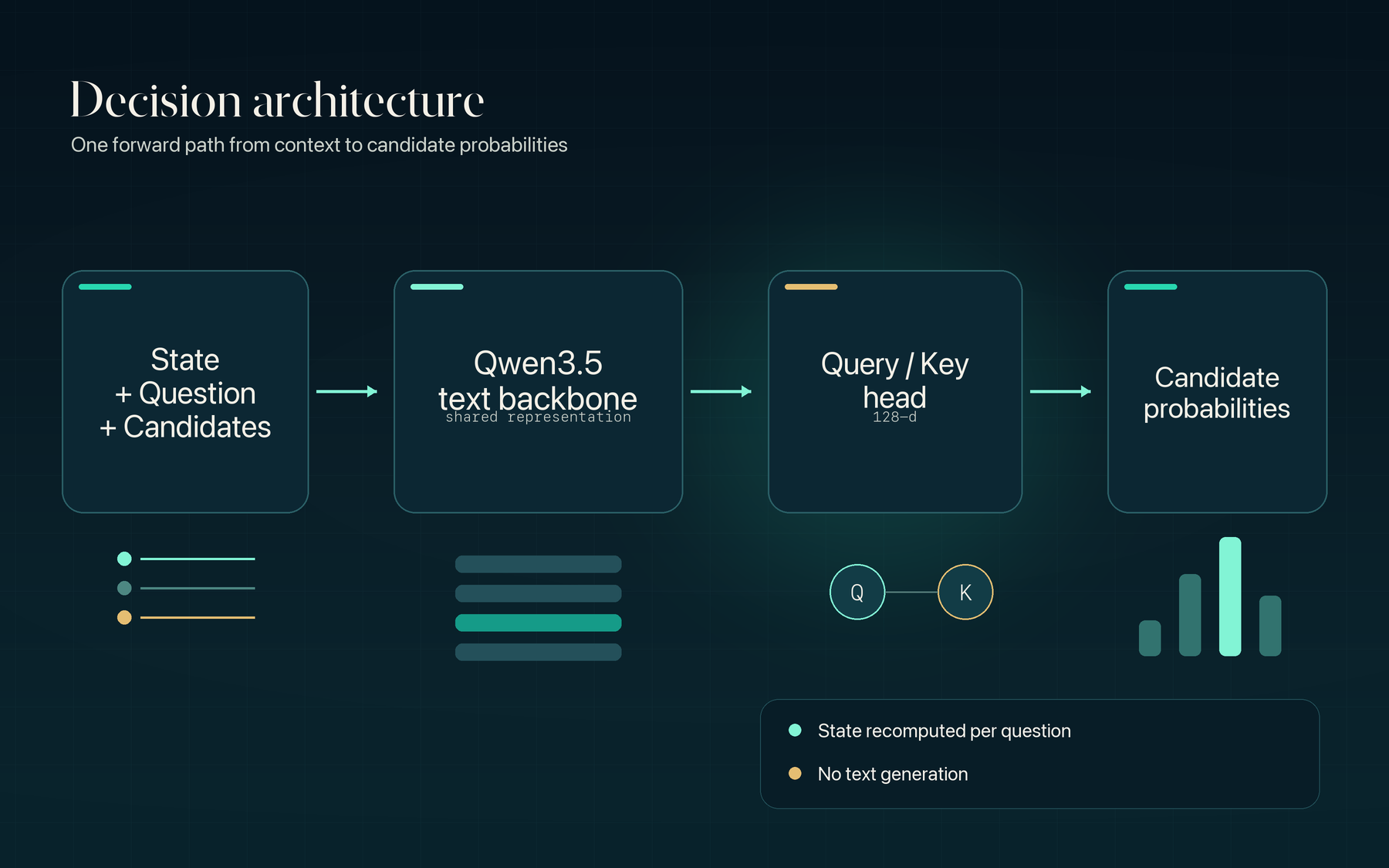
The text backbone and query/key decision head
Questions execute as separate rows, each containing the state, that question, and its candidates. A question cannot read another question’s candidates. The trade-off is that the shared state is recomputed for each row: submitting several questions together does not mean encoding the state just once. The current implementation disables the KV cache.[2]
The release leaves out the original language-generation head, vision tower, and MTP components. It isn’t simply the full Qwen chat model under another name, and the base model’s visual capabilities don’t make this artifact a vision model. The released decision model is text-only.[1]
Distillation can preserve uncertainty—but doesn’t prove calibration
A hard label teaches a student to select billing. A soft distribution can also teach the relative preference among billing, account support, and technical support. Two examples can have the same winning label yet communicate different degrees of ambiguity.
JoyFox describes learning complete probability distributions and presents cross-entropy and Brier distance as reference objectives. One measures log loss against the target distribution; the other measures the squared distance between probability vectors.[1]
The public disclosure has limits. The model card does not provide the complete training-set size, learning rate, training steps, training GPU model, total training time, or the actual weighting of those objectives. The public inference repository is not a complete training pipeline. The mechanism can be explained; a reproduced training recipe cannot be claimed.[1][2]
For a team extending this approach, I would keep two data tracks. Teacher distributions would supply learning targets. Separately held business outcomes and human labels would measure errors, calibrate probabilities, and determine rejection thresholds. The final test set should stay outside repeated model selection. This is a proposed development practice, not an account of unpublished JoyFox training steps.
What 90.40% actually establishes
The author reports an evaluation of 30,612 records containing 52,664 questions. Agreement with the teacher’s highest-probability candidate is 90.40%. Mean KL divergence is 0.07373, Brier distance is 0.03520, and expected-level MAE for scores is 0.16246.[1]
Those metrics ask how closely the student matches the teacher. They do not establish which model gets real business outcomes right. The evaluation was teacher-generated, participated in model selection, and contains no human-verified hard labels. It is not an independent real-world accuracy test.[1]
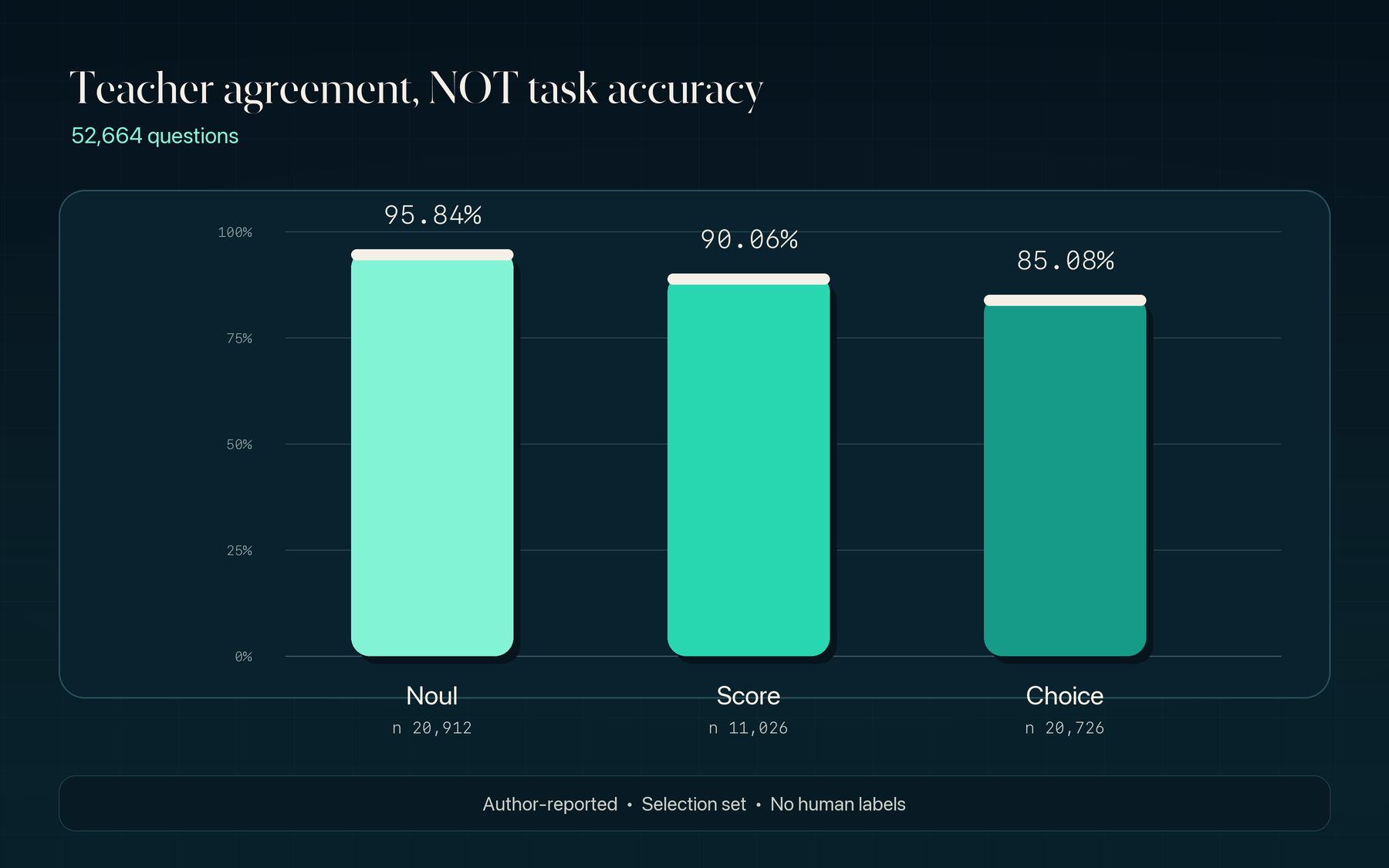
Agreement with the teacher’s top candidate, by question type
The breakdown is more useful than the headline:
- Boolean questions, noul: 20,912 questions; 95.84% agreement.
- Ordered scoring, score: 11,026 questions; 90.06% agreement.
- Dynamic selection, choice: 20,726 questions; 85.08% agreement.
All three are author-reported teacher-agreement figures. The card also identifies dynamic choice questions with eight to ten candidates as a larger fidelity gap.[1]
That makes Boolean triage a sensible early trial and complex candidate selection a priority for stress testing. It is a deployment judgment based on the disclosed differences, not a promise of task accuracy. Renaming 90.40% as “accuracy” and using it to declare the student superior would discard the most important qualification in the release.
The comparison with original JEV needs several separate axes
Release dates are not training time. TypeSafe announced Jev early access on September 15, 2026; a September 20 notice on its website removed the waitlist. JoyFox’s weight repository was created at 15:52:51 Beijing time on September 24, nine calendar days after Jev’s public introduction. The teacher version carries September 17 in its name, seven calendar days before JoyFox’s release. Neither interval measures training duration.[1][3][5]
Inference timing is a different comparison. JoyFox reports single-GPU BF16 measurements with a warm model and one question per request: 78.25 ms mean, 73.70 ms P50, and 97.26 ms P95. At batch size eight, throughput is 70.22 questions or 40.82 records per second. A record may contain multiple questions; those units aren’t interchangeable.[1]
Loading is excluded, and the model card doesn’t identify the GPU. Original Jev’s launch materials report a 70–500 ms end-to-end response range and say public evaluations generally accessed the service from laptops on the US West Coast. JoyFox’s local warm-model timing and Jev’s service range describe different measurement boundaries. They can show the reported scale of latency, not a defensible speedup ratio—or phone and CPU performance.[1][5]
The training approaches differ. TypeSafe describes Jev as a combination of a new architecture, a parallel sampler, and Reinforcement Learning for Calibrated Decisions, or RLCD. JoyFox exposes a Qwen text backbone, a query/key head, and learning from teacher distributions. Imitating outputs does not reproduce the teacher’s architecture or RLCD process, and it does not automatically inherit every calibration claim.[1][2][5]
The data demonstrates fidelity, not a head-to-head win. JoyFox publishes agreement and distribution-distance metrics for three task types. That is useful evidence for deciding what to test next. It does not provide an independent, human-labeled comparison with both models answering the same tasks, and the complete training-data composition remains undisclosed.[1]
The implemented capabilities are concrete but bounded. Runtime candidates, Boolean decisions, and ordered scores have inspectable implementations. Multilingual tags on a model card do not demonstrate that its Chinese decisions outperform original JEV; the published evaluation has no language breakdown. Chinese deployments should test terminology, negation, amounts, omitted context, and ambiguity separately.[1][2]
Deployment control is the clearest gain. JoyFox publishes the text backbone, tokenizer, and decision head, labels the model Apache-2.0, and provides CUDA and CPU inference paths. Hugging Face’s file metadata puts the two safetensors weight files at approximately 1.505 GB combined, using decimal GB. That is neither runtime memory nor the size of a finished mobile application.[2][3]
Original Jev’s public access centers on a hosted service; JoyFox supplies weights and a wrapper to run yourself. The former removes model operations from the integration task. The latter gives developers control over the environment and version. For private deployment, I would start by evaluating JoyFox. For the quickest connection to a managed service, the original API may require less work.[1][2][5]
One capacity difference also cuts against an across-the-board superiority claim. Original Jev’s launch materials specify up to 255 candidates for a choice. JoyFox’s current input validator allows up to 128 candidates per question, still subject to the 1,024-token limit.[2][5]
Version pinning, locally retained weights, inspectable probability calculations, and control of where business text is processed are substantial benefits. They don’t need an unproven “beats everything” headline.
Three deployment traps to avoid
Loading the weights into Ollama, an ordinary GGUF loader, vLLM, or AutoModelForCausalLM does not automatically expose this custom decision head. Use JoyFox’s DecisionEngine wrapper.[1][2]
The inference package requires Python 3.11 or newer, pins transformers==5.5.3, and requires PyTorch 2.6 or newer. The documented installation is to clone joyfoxai/jev-inference and run pip install -e . inside a separate virtual environment.[2]
The loading entry point is short:
from jev_inference import DecisionEngine

engine = DecisionEngine.load(
    "joyfox/Qwen3.5-0.8B-JEV",
    device="cuda",
    dtype="bfloat16",
)
Pass a record containing state and questions to engine.predict(record), or use engine.predict_batch(records) for several records. The CPU path can explicitly use device="cpu" and dtype="float32". These are documented interface examples, not an independently rerun local performance test.[2]
The second trap is length. This release supports 1,024 tokens per state-plus-question-plus-candidates sequence, not 1,024 tokens of user text alone. Over-limit inputs raise errors rather than silently truncating. A longer context value in the base configuration does not override the decision artifact’s supported range.[1][2]
The third is treating the largest probability as proof of reliability. In the code, confidence is simply the largest candidate probability, not a separate correctness verifier. If the candidate set is incomplete, a very confident answer can still be the best of several unsuitable options. Adding or rewriting a candidate can also change the distribution.[1][2]
Why I would put it on a deployment shortlist
For support triage, content classification, task routing, and model routing, JoyFox’s release is worth evaluating. It is a small-model artifact, accepts runtime labels, exposes weights and code, and returns outputs that fit ordinary application logic. Its author also explicitly separates teacher agreement from real-world accuracy.[1][2][3]
I would not begin with the final decision point for payments, account bans, or other irreversible actions. Shadow mode is a better starting point: run alongside the existing workflow, take no action, record disagreements, and check them against human review or observed outcomes.
My acceptance criteria would cover accuracy against real labels, probability calibration, stability under candidate reordering and rewriting, long-input rejection rates, and P95 latency, memory, and cost per thousand decisions on the actual target hardware. Thresholds should reflect the cost of errors, not the appeal of a probability above 0.9.
I recommend an open decision model worth deploying and validating—not a superiority result that hasn’t been demonstrated. The next useful experiment is to give it and original JEV the same real tickets, then inspect the disagreements. Those are where we can learn whether the student has made a new mistake or found the better answer.
Sources and versions
[1] JoyFox model card, Qwen3.5-0.8B-JEV. Weight revision: ae7b7040aeff7802f6f2bcfdd27f08a72d5cd969. https://huggingface.co/joyfox/Qwen3.5-0.8B-JEV
[2] JoyFox inference repository: README, model.py, engine.py, and pyproject.toml. Code revision: 2677b5a3714489847668175de793e2d92fe183f0. https://github.com/joyfoxai/jev-inference
[3] Hugging Face repository file metadata, backbone/config.json, and decision_config.json. https://huggingface.co/joyfox/Qwen3.5-0.8B-JEV/tree/main
[4] Qwen base model. https://huggingface.co/Qwen/Qwen3.5-0.8B
[5] TypeSafe’s September 15, 2026 launch announcement and website notices. https://typesafe.ai/blog/introducing-system-one-models-and-jev
Sources checked on September 24, 2026. Reported evaluation figures are the authors’ disclosures, not independent replications.
More from WayDigital
Continue through other published articles from the same publisher.
Comments
0 public responses
All visitors can read comments. Sign in to join the discussion.
Log in to comment