On-Device AI Will Put the Cloud in the Background
Notes, photos and small editing tasks don't all need a trip to a data center. Local models are becoming the first layer of intelligence inside apps, with the cloud reserved for work that needs it. That changes privacy, waiting time and per-call economics—and makes permissions, memory and battery life part of the product.
In SmartGym, a description of a workout can become a structured routine with sets, repetitions, rest periods and equipment choices. When Apple showcased the feature in September 2025, the consequential detail was where the language model ran: on the device, through the Foundation Models framework, without a cloud inference charge for each request.[1]
That's more interesting than another chat window on a phone. AI is entering the operations people already perform inside apps: understanding an input, organizing it and turning the result into something usable. Users don't have to carry the material to a separate service, wait for an answer, then carry it back.
On-device AI will put the cloud in the background. That means a change in the order of everyday interactions and in who handles private information first—not an end to data-center expansion. Devices can take on more of the small tasks close to the user. Cloud systems will still train models, perform demanding reasoning and handle work requiring external resources. The default route is changing: process on the device first, then escalate when there's a reason.
Models are adapting to phones
The obvious way to put a language model on a phone is to reduce its size and numerical precision. That saves memory and computation, with possible losses in capability. The deeper engineering work involves how a model reads its weights, uses memory and allocates computation to different tasks.
Apple's third-generation foundation models, disclosed in June 2026, illustrate the shift. AFM 3 Core is a dense model with 3 billion parameters. AFM 3 Core Advanced has 20 billion total parameters in a sparse architecture, activating roughly 1 billion to 4 billion depending on the task. Apple's design keeps the full weights in flash storage, loads selected components into working memory, maintains shared components and periodically reselects experts during generation.[2]
The sparse architecture separates total model capacity from the computation needed for a given request. Coordinating flash storage and working memory creates a way to accommodate a larger set of weights. There's still a hardware threshold: Apple specifies that Core Advanced is optimized for its most capable Apple silicon systems, without promising the same capability on every older phone.[2]
Open models offer another route. Google's Gemma 4 documentation estimates static model-loading memory of about 1.1GB for the E2B mobile version and 2.5GB for E4B, using LiteRT-LM. Those estimates don't include all supporting software or context memory. The KV cache, which retains information used during generation, can grow as a conversation gets longer.[3]
The figures make local inference tangible. They also expose its limits. A short note and a day of meeting transcripts impose different workloads. Downloading and loading a model doesn't establish that an app can run it comfortably for extended periods, much less understand an entire personal archive at once.
Chipmakers are tackling the same bottlenecks. Qualcomm's September 2026 explanation of its next-generation Hexagon architecture brings together expanded shared memory, low-precision computation and transformer acceleration. MediaTek's Dimensity 9500 announcement emphasizes the NPU 990, low-bit model processing and faster model loading.[5][6] These are vendor disclosures and performance claims, not measurements of generation speed on every retail phone. Their shared emphasis is revealing: the competition now reaches into memory organization and data movement, beyond peak arithmetic capacity.
An NPU is a neural processing unit. Local AI doesn't imply that the NPU performs every operation. Qualcomm's own account separates CPU orchestration, NPU acceleration and AI capabilities on the GPU.[5] For an app developer, compatibility among the model, runtime and device can matter more than the biggest number on a chip's promotional page.
Everyday intelligence moves inside the app
A notes app extracting tasks from a few paragraphs doesn't need to answer every question about the world. A photo app working with the current image doesn't necessarily need to transmit the original to a remote service. Many promising local-AI tasks have a bounded scope and inputs already present on the device.
Apple's Foundation Models framework gives developers access to the system's on-device model, with guided generation and tool calling.[1] On Android, ML Kit's generative APIs use Gemini Nano through the AICore system service for tasks including summarization, rewriting, proofreading and image description. That managed system-model path is distinct from downloading Gemma weights and embedding them in an application.[4]
Frameworks reduce duplicated infrastructure work. Developers don't all have to begin with model training, conversion and hardware adaptation before trying a text-organizing feature. They can spend more attention on the task: whether the input is sufficient, which fields must survive, how users edit the result and what happens when the model fails.
System models still come with operating limits. Google's current ML Kit documentation specifies per-app quotas, battery-use quotas and a requirement that inference run in the top foreground application.[4] A feature that summarizes text in an open app isn't evidence of an assistant quietly processing everything around the clock.
The more credible opportunity is to make a small operation dependable. A product could organize a recording locally, flag names and dates for review, then let the user correct them. It could retrieve relevant passages from a document and call a cloud model only for deeper analysis. These are proposed workflows, not claims that either framework automatically supplies the complete product.
Keeping data nearby is the start of trust
Local inference has a direct privacy benefit: the raw input need not be uploaded for that inference. Keeping a sensitive photo, private note or business document away from another remote system removes one data path that has to be trusted.
The scope of a privacy promise has to be checked against the app's actual data flows. Even with a local model, the app may synchronize files, send diagnostic logs or switch to a cloud service when local capabilities aren't sufficient. Google's local-processing statement covers the input, inference and output of its ML Kit generative APIs. Other app operations need separate scrutiny.[4]
The useful questions are specific. What can it read? What index does it build? Can that index be deleted? What gets uploaded? Does the user see when processing moves to the cloud? For products handling private information, those answers belong in the interface and permissions—not only in marketing copy.
Local execution doesn't fix model mistakes, either. A summary can omit a condition. A document can contain text that tries to induce an extra action. Even if nothing leaves the device, sending the wrong message, changing a calendar entry or deleting a file can still cause harm.
Read access and action authority need separate boundaries. Permission to understand an email isn't permission to send it. Permission to inspect a bill isn't permission to pay it. Sending, deletion and financial actions should retain explicit confirmation. The closer an assistant gets to private information, the more important that separation becomes.
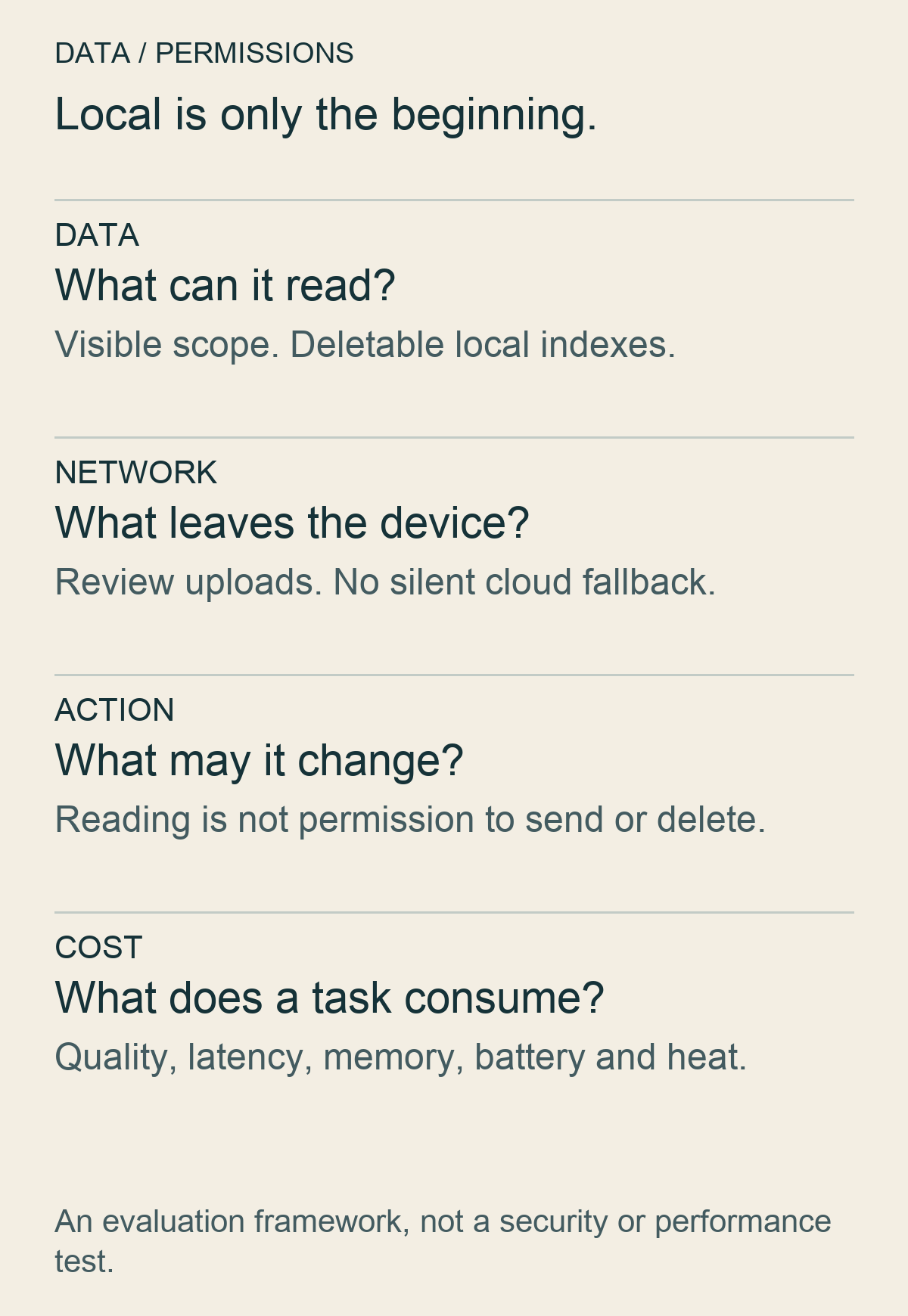
An evaluation framework, not a security certification or device-performance test.
Cloud processing can also be designed for stronger privacy. In June 2026, Apple disclosed an expansion of Private Cloud Compute involving Google and NVIDIA for demanding workloads, with requirements including stateless computation, restrictions on privileged access and verifiable transparency.[7] That's a security design for device-cloud cooperation. The data still leaves the device. It shouldn't be described as local processing, or treated as proof that risk has disappeared.
Speed means fewer unnecessary waits
Local inference still takes time to load a model, process an input and generate an output. Heat and memory pressure can slow a device down. What it shortens is the path spent transmitting to a remote service, waiting there and receiving the result.
For a brief editing or organizing task, that wait can shape the whole experience. An app can begin processing information it already has while the interaction continues. Once the required model and material are present, losing a connection needn't make the feature disappear. Offline operation has prerequisites: the model, language resources and files must be available, and the task can't depend on live retrieval.
Performance has to be measured across the operation. Intel's OpenVINO GenAI documentation separates model-loading time, time to the first token, time per subsequent output token and generation throughput.[9] A phone app also needs checks for sustained memory use, battery consumption and temperature. The fastest response in a short demonstration says little about comfort in daily use.
A local model isn't always faster. A powerful remote system may finish a long analysis sooner than a phone. The practical advantage is avoiding unnecessary round trips and keeping frequent small operations available—not promising that a handset will always beat a server.
Avoiding a cloud call changes the economics
When cloud models charge by usage, each automatically triggered operation can become a cost. As a feature gets more use, developers face product decisions: is this generation worth paying for, should requests be capped, or should a cheaper model do the work?
Local inference creates room to make different choices. Apple's description of Foundation Models and Google's description of ML Kit both emphasize that local calls don't incur an additional server-inference charge per request.[1][4] The product still costs money to build and maintain. Adaptation, evaluation and model distribution require work; users supply battery energy, memory and storage. But the marginal-cost structure of frequent small tasks changes.
The energy argument also needs a clear denominator. In its 2026 Key Questions on Energy and AI report, the IEA estimates that global data-center electricity demand grew 17% in 2025, while electricity use in AI-focused data centers grew 50%. Those are data-center growth figures, not the electricity bill of a particular chatbot.[8]
Moving suitable tasks onto devices can avoid the corresponding server requests and data transfers. Total energy savings depend on model efficiency, device conditions and output quality. A local process that repeatedly runs and heats up a phone may be a worse bargain than one effective remote request.
Lower costs can also invite more use. The IEA describes improving efficiency alongside expanding adoption and more energy-intensive reasoning and agentic tasks.[8] Local AI can become the main point of interaction while cloud compute continues to grow.
For app businesses, that creates a route away from merely reselling model calls. The value is in getting a user's work done: accurate organization, results placed in the right application and recoverable mistakes. Where the model runs is one part of that product.
The handoff becomes a product decision
A sensible device-cloud workflow starts with the original material. The device transcribes, extracts information, retrieves relevant passages and reviews sensitive content. Tasks that can finish locally stop there. If stronger reasoning is needed, the product determines the necessary upload scope and authorization before sending material to the cloud. Results return to the app, with confirmation before consequential actions.
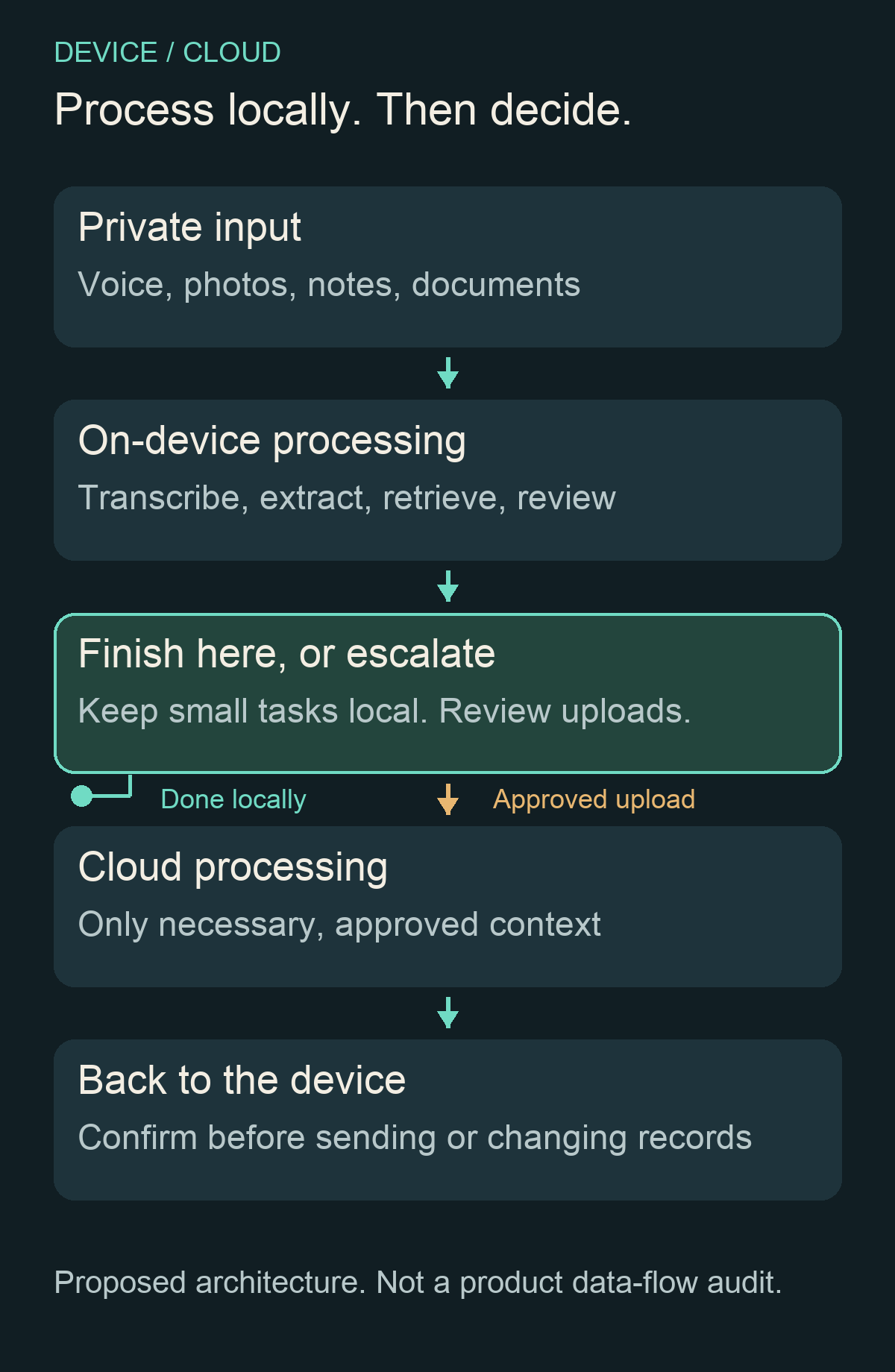
A proposed architecture, not an audit of an existing product's data flow.
This division of labor isn't automatically reliable. A local summary can lose a contractual exception. Extraction can misread a currency unit. Privacy filtering can miss an identifying detail. A tidy cloud input isn't necessarily a correct input. Difficult tasks need retrievable originals, source references and, where appropriate, another verification step. Preprocessing isn't a universal purifier.
The same distinction matters when discussing vast personal archives. A device can hold many files, build permission-aware indexes and retrieve a small relevant set for the current task. It doesn't have to place the whole archive in a model's context. Holding data, retrieving data and understanding it accurately are different capabilities.
The next meaningful device upgrade will include qualities that don't fit neatly into a specification sheet: whether an app reads only what the task needs, which features remain useful offline, when it asks the cloud for help and whether the user retains the final step before an important action.
A useful private assistant shouldn't require a person to hand their entire life to a remote server first. It should be able to organize a draft on the device, show the material it proposes to upload and stop before “Send,” waiting for an explicit confirmation.
Sources
[1] Apple: Foundation Models framework and app examples, September 29, 2025
[3] Google: Gemma 4 overview and mobile memory estimates
[4] Google: ML Kit generative APIs, AICore and operational limits
[5] Qualcomm: Hexagon NPU architecture for mobile agents, September 10, 2026
[6] MediaTek: Dimensity 9500 announcement, September 22, 2025
[7] Apple Security Research: Expanding Private Cloud Compute, June 8, 2026
[8] IEA: Key Questions on Energy and AI, executive summary, April 2026
[9] OpenVINO GenAI: Performance metrics
Sources checked through October 12, 2026. Vendor disclosures establish technical directions; the proposed workflows and outlook aren't device-test results.
More from WayDigital
Continue through other published articles from the same publisher.
Comments
0 public responses
All visitors can read comments. Sign in to join the discussion.
Log in to comment