The Next AI Companion Will Not Live in a Chat Box
AI companionship is leaving the chat box. JD JoyAI, Vidu S1, and Whispers from the Star point toward realtime video characters, persistent relationships, and worlds users can change.
The Next AI Companion Will Not Live in a Chat Box

After watching JD’s JoyAI-VL-Interaction, Vidu S1, and Cai Haoyu’s Whispers from the Star, the interesting part is not simply that video models are getting better. The more important shift is that AI companionship is starting to leave the white chat box.
Most AI companions today still feel like messaging apps. You say something. It replies. The character card may be detailed, the voice may be warm, and the memory may be long, but the interaction is still turn-based. Real-time video tries to change the emotional physics of the product. It wants the user to feel that the character is watching, listening, waiting, and sometimes choosing not to speak.
That is why human companionship may become one of the largest consumer AI markets. Productivity tools save time. They do not automatically turn that saved time into relief, intimacy, or meaning. As more work, learning, shopping, and creation are handed to AI systems, more people will need somewhere to put their emotions. A companion does not have to be a real human. It has to be timely, continuous, and safe enough to become part of someone’s day.
JD JoyAI: the hard problem is knowing when to speak
JD’s open-source JoyAI-VL-Interaction is the most technically transparent example in this wave. It is not a virtual girlfriend product. It is an 8B-scale, vision-first, real-time video-language interaction model. The project materials describe a system that can watch a webcam or livestream and respond in real time.
The key idea is not that it can answer questions about video. Many models can do that. The key idea is that the model is trained to decide whether to speak, stay silent, or delegate a harder task to a background model, API, or agent. That decision happens every second inside the model rather than being bolted on as an external rule.
This matters for companionship because presence is mostly timing. If you are about to cut your finger while cooking, the companion should interrupt. If you are merely quiet, it should not chatter to fill the silence. If the question is hard, it should keep watching the scene while another model works in the background. Good companionship is not constant output. It is tact.
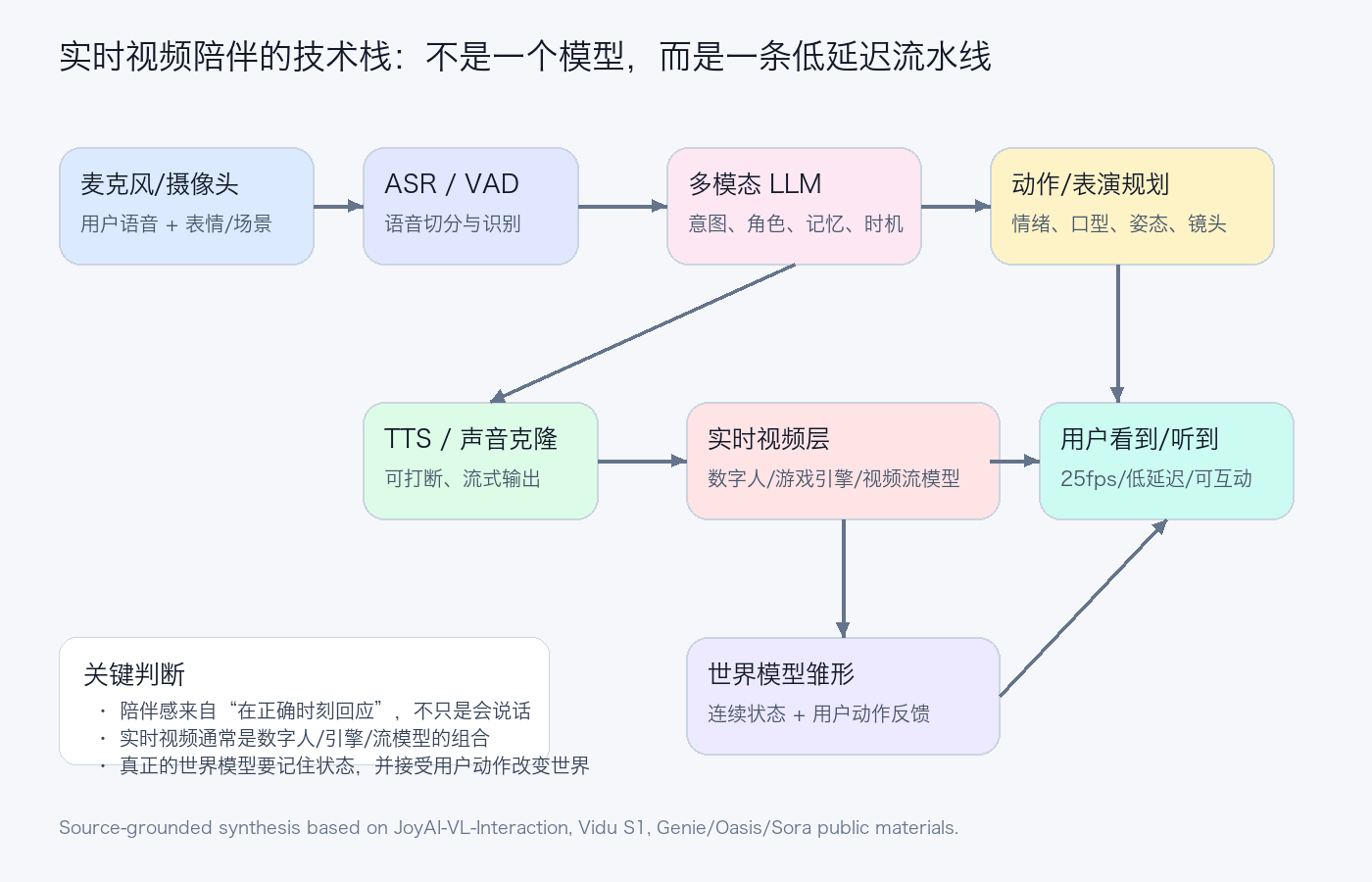
The public architecture points to a practical real-time stack: efficient video encoding to keep token costs under control, pluggable ASR and TTS, inference and Web UI services, plus background agent services on standard vLLM infrastructure. This is not a consumer romance app yet. It is closer to a live visual interaction substrate for livestream commentary, cooking guidance, monitoring, translation, and eventually companionship.
Vidu S1: turning video generation into a video call
Vidu S1 is closer to the user-facing form of the idea. Its official page describes “real-time, interactive next-gen video content creation.” Users can choose a pre-made character or create one from an image, select or clone a voice, allow microphone and camera access, and start a live call.
The public claims are concrete: 540P, 25FPS real-time generation, up to 42FPS, voice-driven interaction, long interactive sessions, customizable human, anime, or pet characters, and API access. This is not the older text-to-video workflow where a creator writes a prompt and waits for a clip. It treats generated video as a stream.
That product shift is large. Old video models behave like editing software. S1 wants the character to be online. Online means low latency, interruption, state continuity, and the feeling that the visual object is spending time with the user.
It is also worth being careful. The public page does not disclose the full underlying implementation. The most realistic architecture is probably hybrid: identity consistency from image/video generation, streaming TTS or voice cloning, lip and expression driving, lightweight motion planning, and heavier video generation where necessary. The user experiences real-time video, but the system is likely a finely split low-latency pipeline rather than one giant model generating every frame from scratch.
Cai Haoyu’s Whispers from the Star: more game than chatbot
Cai Haoyu’s Anuttacon project, Whispers from the Star, matters because it places AI companionship inside a game structure. Public demos and reports describe a player interacting with Stella through text, voice, and in some descriptions video. Her replies, emotion, actions, and story direction are affected by the player’s input.
This is closer to a survival game with one emotionally central NPC than to Replika. The point is not just flirtation. The point is a long-distance relationship framed by danger, narrative, and consequence. The player speaks, and the character’s state changes. That is a much stronger emotional loop than a static chat screen.
There is a phrase around the project that should be handled carefully: “real-time generated video.” Based on currently available public information, it is not safe to say that every frame is generated from a video model in real time. A more plausible stack is a game engine rendering the world in real time, with AI controlling dialogue, emotion, decisions, lip sync, animation triggers, and branching story. The visuals can be real-time and the character can respond in real time, even if the pixels are not all being generated by a diffusion video model.
That does not make it less important. For companionship, a game engine may be more useful than pure video generation. It preserves space, objects, tasks, and long-term state. The “world model” that matters for users is not just beautiful motion. It is whether the world remembers what you did.
Why world models and companionship are converging
OpenAI described Sora as a step toward video generation models as world simulators. Google DeepMind’s Genie 3 makes the idea more explicit: given a text prompt, it can generate interactive worlds that a user can navigate in real time at 24 frames per second, maintaining consistency for a few minutes at 720p. Decart’s Oasis shows a related path in a Minecraft-like world: keyboard input changes a video experience generated by a model at live frame rates.
These systems are not yet mass-market emotional companion products. But the direction is obvious. Companionship is not only a speaking character. It is a character inside a world that the user can influence.
If an AI only says “I understand,” it is a chatbot. If it sees what is happening, knows when to stay quiet, remembers the last conversation, and changes its behavior inside a continuous world, it starts to feel like a companion. If the room, city, or planet around that character can be shaped over months, the product stops being a chat app and becomes a virtual living space with an emotional entrance.
The market is already paying
This is not just a concept market. TechCrunch, citing Appfigures, reported that as of July 2025 there were 337 active, revenue-generating AI companion apps across the Apple App Store and Google Play, with 128 released in 2025 alone. The category had reached 220 million global downloads. In the first half of 2025, downloads reached 60 million, up 88% year over year, and revenue reached $82 million. Appfigures estimated the category was on track to exceed $120 million for the full year, with $221 million in cumulative consumer spending.
This definition excludes general chatbots and focuses on apps where users interact with synthetic characters meant to embody personalities: friends, lovers, fantasy figures, girlfriends, boyfriends, and other personas. Two things are clear: users pay for emotional relationships, and the market is still early. The top 10% of apps account for 89% of category revenue.
Sensor Tower’s 2025 AI Apps report gives the broader context. In the first half of 2025, generative AI apps neared 1.7 billion global downloads and almost $1.9 billion in in-app purchase revenue. Asia’s generative AI app downloads grew 80% from H2 2024 to H1 2025. a16z’s Top 100 Consumer Gen AI list continues to include Character.AI as one of the durable companionship players. Companionship is not a weird corner of consumer AI. It is one of the stable categories.
The demand side is not mysterious. WHO has treated loneliness and social isolation as a global public-health concern. Market researchers such as Technavio point to mental wellness, private emotional support, and social companionship as key drivers for AI companion apps. Forecasts vary, but the underlying need is hard to dismiss: people want to be answered, seen, and given a safe emotional outlet.
The opportunity is bigger than a better virtual lover
The fastest short-term monetization will probably come from AI girlfriend, AI boyfriend, and anime-character products. They have clear fantasy loops and high willingness to pay. But the larger market should not be trapped inside the phrase “virtual lover.”
Companionship has many shapes. An older user may want a patient daily assistant. A stressed young worker may want someone to absorb a midnight breakdown. A child may need a safe and bounded learning companion. A player may want an NPC who remembers shared history. A creator may want a partner that watches the frame and gives real-time feedback while they rehearse.
All of these converge on the same technical requirements: real time, multimodal perception, memory, restraint, safety, and increasingly video.
How I would judge the race
In the short run, judge the character. Does the persona pull people back? Does the voice feel alive? Does the first paid loop work? In the middle run, judge the system. Can the company combine voice, vision, memory, safety, and latency at a cost that scales? In the long run, judge the world. Does the user come to chat, or do they return to a place where someone is waiting?
JD’s JoyAI shows that the real-time visual interaction substrate can be opened and studied. Vidu S1 turns real-time video characters into an obvious product interface. Whispers from the Star places companionship inside a game world where choices matter. They look like different products, but they are moving toward the same endpoint: AI companionship will migrate from text boxes to visible characters, persistent relationships, and worlds that can be changed.
This will not happen just because models get smarter. It will require restraint and safety. The more human the interaction feels, the less acceptable it is to optimize only for addiction. But the direction is already visible. AI first helps people do things. Then it starts to keep them company. The first improves efficiency. The second absorbs the emptiness efficiency leaves behind.
Sources
- JD JoyAI-VL-Interaction GitHub and technical materials: 8B real-time vision-language interaction, speak/silence/delegate decisions, and time-aligned interaction data.
- Vidu S1 official page: realtime interactive video calls, 540P 25FPS generation, voice-driven control, customizable character and voice.
- OpenAI “Video generation models as world simulators,” Google DeepMind Genie 3, and Decart Oasis: public materials on video generation and interactive world models.
- TechCrunch / Appfigures: AI companion app downloads, revenue, and category concentration in 2025.
- Sensor Tower State of AI Apps 2025, a16z Top 100 Gen AI Consumer Apps, WHO social connection materials, and Technavio AI Companion App Market forecast.
Comments
0 public responses
All visitors can read comments. Sign in to join the discussion.
Log in to comment