Turning agent workflows into reusable product infrastructure
The useful idea is not a prettier automation board. It is a way to turn a successful agent run into something repeatable, auditable, and cheap enough to run in batches.
Turning agent workflows into reusable product infrastructure
The useful part of the presentation was not the demo screen itself. It was the problem behind it: an agent can complete a task once and still fail to repeat the same path tomorrow. That is acceptable for exploration. It is not acceptable for product workflows, batch jobs, or team operations.
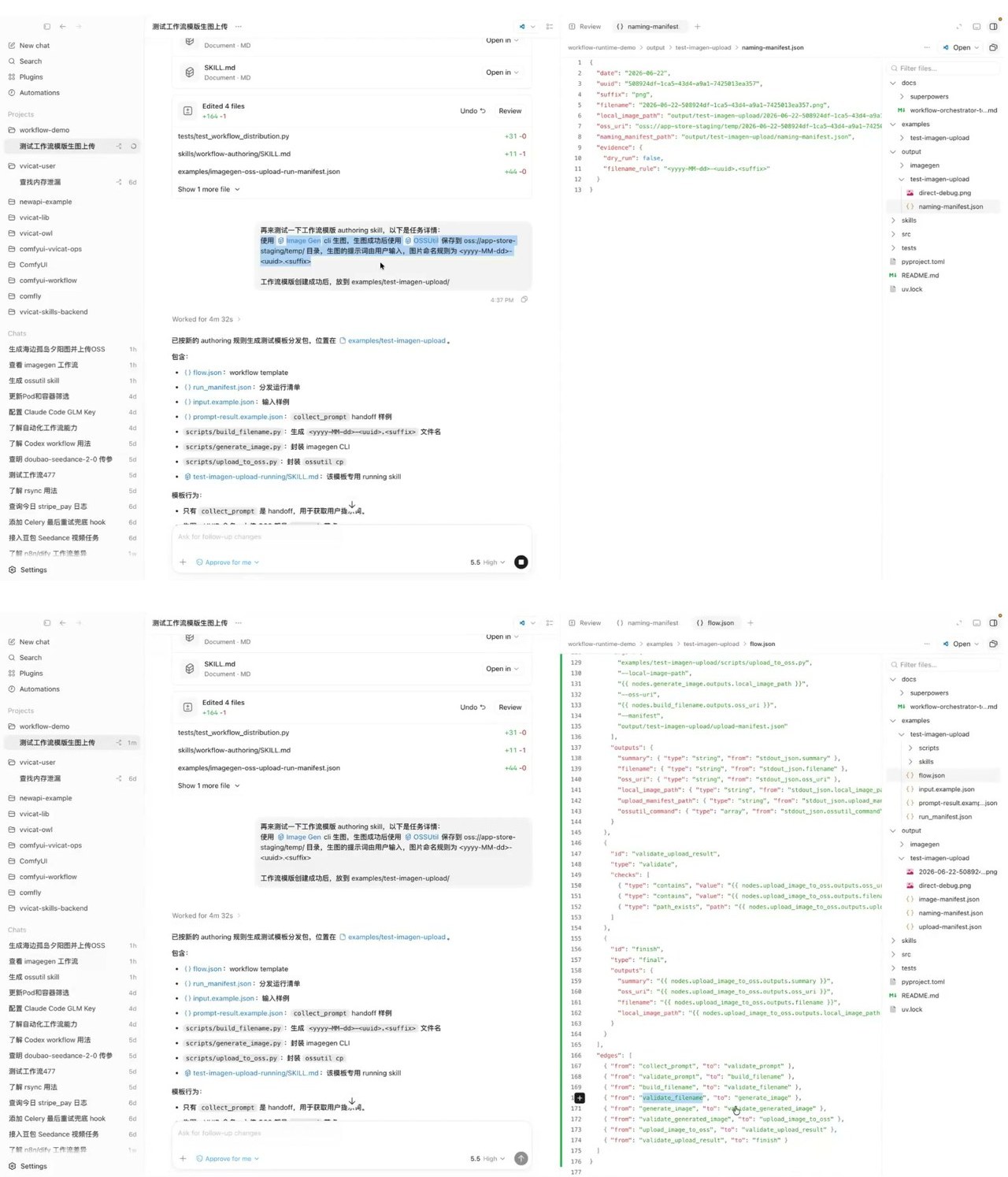
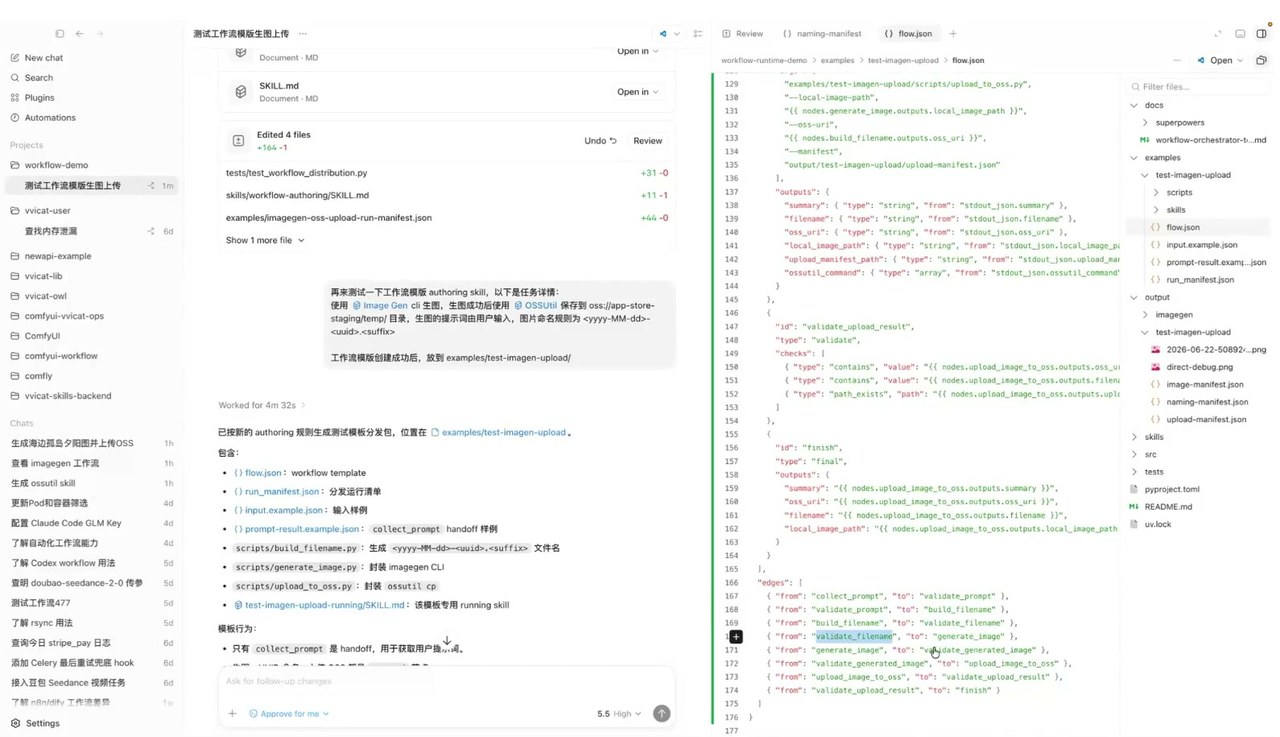
The proposed approach is to compile dynamic Skill orchestration into a static workflow template. The template is JSON. It describes a DAG: where inputs come from, which nodes run commands, which nodes hand control back to the agent, how validation works, and where state is stored.
The problem it solves
Agent flexibility is both the feature and the bug. In one run, the agent may correctly understand how Skill A should call Skill B. In another context, it may improvise a new script and skip the checks written into the Skill. For a single task, that may be fine. For hundreds of assets, weekly reports, or project bots, it becomes slow, expensive, and hard to audit.
A static workflow template preserves the path after it has been proven. The first run can involve exploration. The second run should not repeat the exploration. Deterministic steps can run through CLI commands or scripts. Language-heavy steps can still return to the agent. The model remains useful, but it no longer gets to improvise every part of the flow.
What product shape fits it
The natural product is an Agent Workflow Orchestrator. It does not need to look like a traditional enterprise workflow suite. It is closer to a packaging layer for agent work: a user tests prompts and tools locally, then compiles the process into a distributable package that a platform can parse and run.
A media generation platform is an obvious fit. An operator finds a reliable prompt and tool chain for generating images or videos, packages it, and uploads it. The platform can then replay the workflow without asking a model to reinterpret the whole process every time. Project robots are another fit: pull analytics, config changes, revenue data, and model-call statistics, then produce the same weekly structure.
Strengths and weaknesses
- Strength: repeatability.A graph constrains the run. Model hallucination does not disappear, but the blast radius is smaller.
- Strength: auditability.Inputs, outputs, state changes, and pauses can be stored as run records instead of being buried in chat history.
- Strength: batch execution.The agent does not need to reread and reinterpret the full Skill for every item in a large batch.
- Weakness: more setup.This is too heavy for one-off work. If the task is short or unlikely to repeat, plain agent prompting is cheaper.
- Weakness: the graph model must grow up.Command nodes are not enough. Real product work needs API nodes, MCP nodes, human approval, retries, rollback, and clearer contracts.
- Weakness: state recovery is hard.Once a workflow waits for a human or a model response, resume logic and state design become the product, not an implementation detail.
Comparable tools in the market
Traditional workflow systems such as Airflow, Prefect, Dagster, and Temporal are strong at backend orchestration, data pipelines, retries, and long-running processes. They are reliable, but they are not built around agents reading Skills and deciding when to call local tools.
Automation products such as n8n, Zapier, and Make are good at connecting SaaS actions. They are easier to operate, but they are less natural for local repositories, developer tools, model-specific Skills, and auditable agent state.
Agent frameworks such as LangGraph, Dify, Coze, and CrewAI sit closer to the model layer. They are useful for stateful AI apps and multi-agent flows. The gap is packaging a workflow discovered inside a developer agent session and making it runnable by a product platform.
That is where this idea has room. It should not try to replace every workflow engine. Its best position is between agents, Skills, CLI tools, and the product systems that need repeatable execution.
Comments
0 public responses
All visitors can read comments. Sign in to join the discussion.
Log in to comment