What AI Makes Cheap: The Linotype Lesson We Still Haven’t Learned
Linotype made printed words cheap. AI is making many cognitive steps cheap—and making judgment, responsibility, and operating rights more valuable.
What AI Makes Cheap: The Linotype Lesson We Still Haven’t Learned
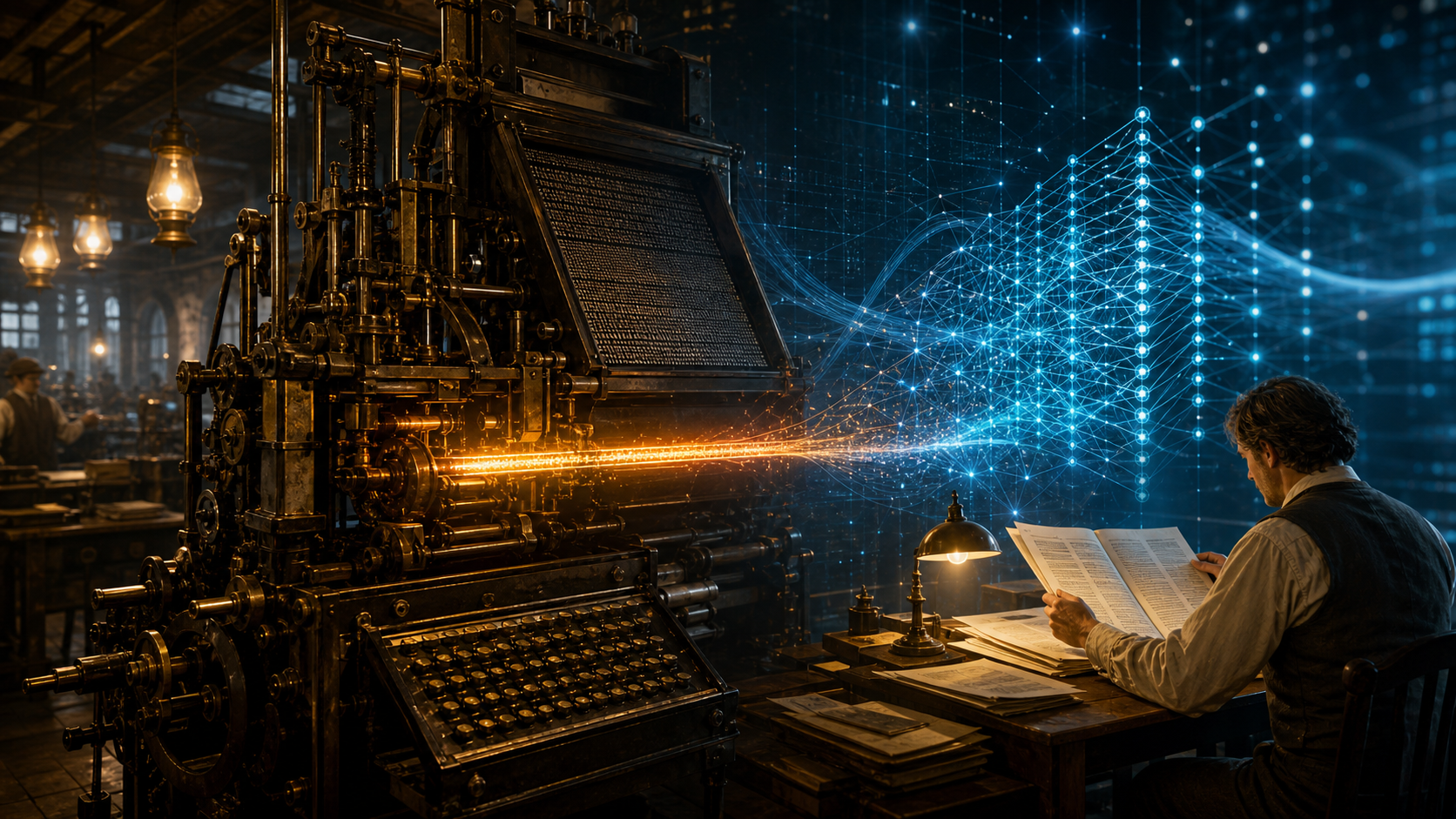
A Linotype machine began with molten lead. It poured the metal into a row of matrices, cooled it, and delivered a complete line of type. The machine was hot, loud, and wonderfully overbuilt. Yet its decisive move was simple: it stopped requiring a compositor to place every letter, one at a time.
That sounds like a productivity improvement. It was really a change in the economic physics of publishing. Newspapers grew thicker. Magazines multiplied. Books became cheaper. Advertising found national audiences. Once printed words were no longer scarce, the industries and habits built around words had to be remade.
AI is often discussed through one anxious question: Will it replace me? Fair question, but too small. The question with more explanatory power is: What does AI make cheap?
Not intelligence as a whole—specific pieces of cognitive work
Railroads made distance cheaper. Goods no longer had to be sold near where they were made, and national brands and national advertising could emerge. Linotype made printed words cheaper, turning newspapers from scarce products into everyday infrastructure.
AI is lowering the cost of the repeatable, separable parts of cognitive work: first drafts, research triage, format conversion, code scaffolding, meeting notes, rewrites for different audiences, search paths, and help with expression. It hasn’t put thought itself inside a machine. It has made a great deal of preparatory mental work cheaper and easier to repeat.
The counterintuitive consequence is that cheaper resources are rarely used less. They are used more. When print got cheaper, people did not consume fewer words; they got a flood of them. As asking, drafting, comparing, and organizing get faster, teams won’t produce fewer ideas. They’ll produce more options, more decision points, and more material that needs human review.

Cheap drafts make judgment more valuable
If a presentation can generate ten versions in minutes, presentation skill has not been “solved.” The real questions get sharper: Which version is factually sound? Which claim survives scrutiny? What needs to be cut? Who is willing to own the final call?
For a long time, getting to a first draft consumed most of the work. Now the draft is increasingly raw material. When raw material gets cheap, scarcity moves—to framing, selection, verification, taste, context, and responsibility. Great editors, researchers, product leaders, and lawyers don’t become irrelevant because a tool can produce sentences. Their contribution concentrates in the decisions that cannot be fixed by simply generating again.
This is also where AI is most easily misused: treating it as an accountable decision-maker. It is better understood as a very fast, very well-read assistant that needs supervision. It can propose. It can’t bear consequences. It can clear a path. It can’t choose the destination.
The right workers to protect are the ones with operating rights
The history of hot-metal typesetting offers a more useful detail than the familiar line about machines taking jobs. The International Typographical Union knew the machine was coming. Its members sent people to inspect it, sketch it, and bring back examples. They understood that hand composition would not last forever. Their early position was not simply to smash the machine. It was to insist on a condition: bring the machine into the shop, but let typesetters operate it.
That was no fairy-tale victory. Jobs were lost before employment grew again; later, paper tape, computers, phototypesetting, and PostScript pushed the process further into software, and the old trade still disappeared. But the history leaves a durable question: when a new system arrives, who gets the right to use it? Who helps design the workflow? Do cost savings fund layoffs, or training and greater capability?
That is the discussion teams need now. “Is AI allowed?” is not enough. The practical conversation is about permissions, data, attribution, quality thresholds, and retraining. Having employees patch a machine’s failures is a very different arrangement from giving them tools that extend their expertise.
Stop selling only a fixed object
The Linotype story offers a second warning: old containers can limit new imagination. Books, articles, pages, and video will not disappear. But they don’t have to remain the only way knowledge reaches a reader.
A city-council meeting can be a story, a searchable timeline, a topic database, an explanation for different audiences, or a knowledge interface that can answer follow-up questions. A writer’s book does not have to remain a sealed digital object. With clear authorization and firm boundaries, it can become a corpus readers can query, compare, and challenge.
That doesn’t mean more content is automatically better. The opposite is true. When generation is nearly frictionless, readers leave faster when they encounter pages that merely fill space. What earns a place is sourced material, a clear point of view, reasoning that can be checked, and someone prepared to stand behind the conclusion.
History doesn’t give us the answer. It exposes the real problem early.
Every media expansion brings familiar panics: too many words, worse taste, disappearing jobs, collapsing business models. Those fears sometimes get the first half right, but almost never predict the second half. Technology usually changes more than a task. It rearranges costs and power.
That is why the central AI risk is not whether the machine writes like a person. It is whether we quietly hand judgment, the organization of knowledge, and the right to operate the technology to a few platforms and a few default settings. Linotype made words cheaper. AI is making many cognitive steps cheaper. What remains expensive is a human decision about what deserves to be said, what can be trusted, and what someone is willing to answer for.
Sources
- Jeff Jarvis, Hot Type, and his discussion of Linotype, mass media, and AI.
- The Futurists, EPS_346: Mass Media and Artificial Intelligence with Jeff Jarvis.
Comments
0 public responses
All visitors can read comments. Sign in to join the discussion.
Log in to comment