What People Are Actually Building with Jev: From Semantic Search to Game NPCs
Twenty-four projects show how Jev is being used for semantic search, agent routing, code review, real-time interaction, and game control—with reusable patterns and a bounded pilot plan.
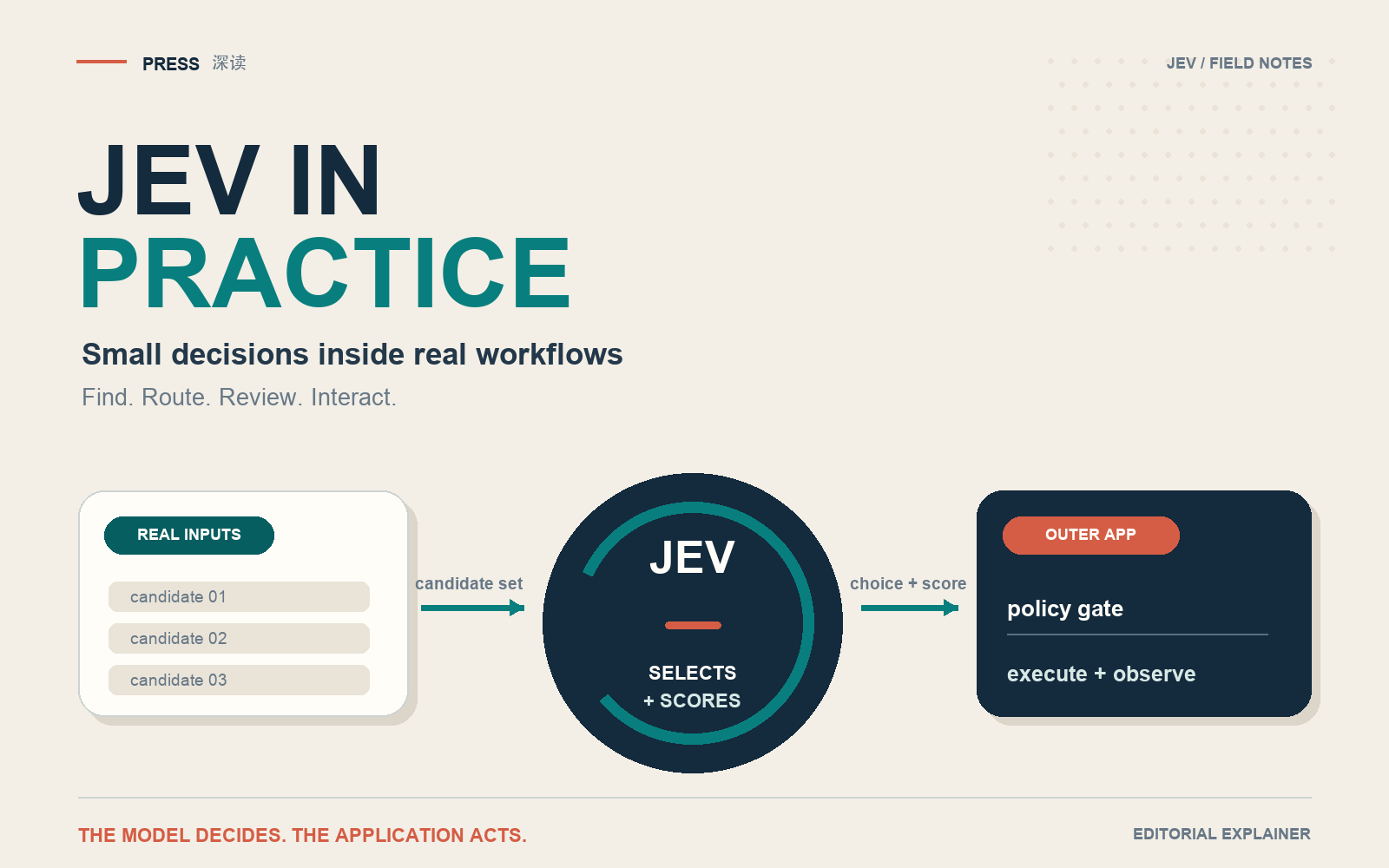
The Jev projects that surfaced on September 20–21 do not look like variations of one AI app. One finds the exact sentence on a web page. Another routes pull requests. Others sit inside Home Assistant, a live sales-call interface, or a Minecraft agent. Their common feature is architectural: Jev usually receives prepared text or structured state, makes a choice, score, or judgment over a bounded set, and hands the result to ordinary software that does the work.
These 24 cases come from public project activity observed on September 20–21, 2026. They range from product integrations to tools in development and demos; not all launched during those two days. Open code around Jev should not be confused with an open-source release of the Jev model itself.
Find the source before generating an answer
The clearest group of applications uses Jev to find the existing item that best matches a user's meaning.
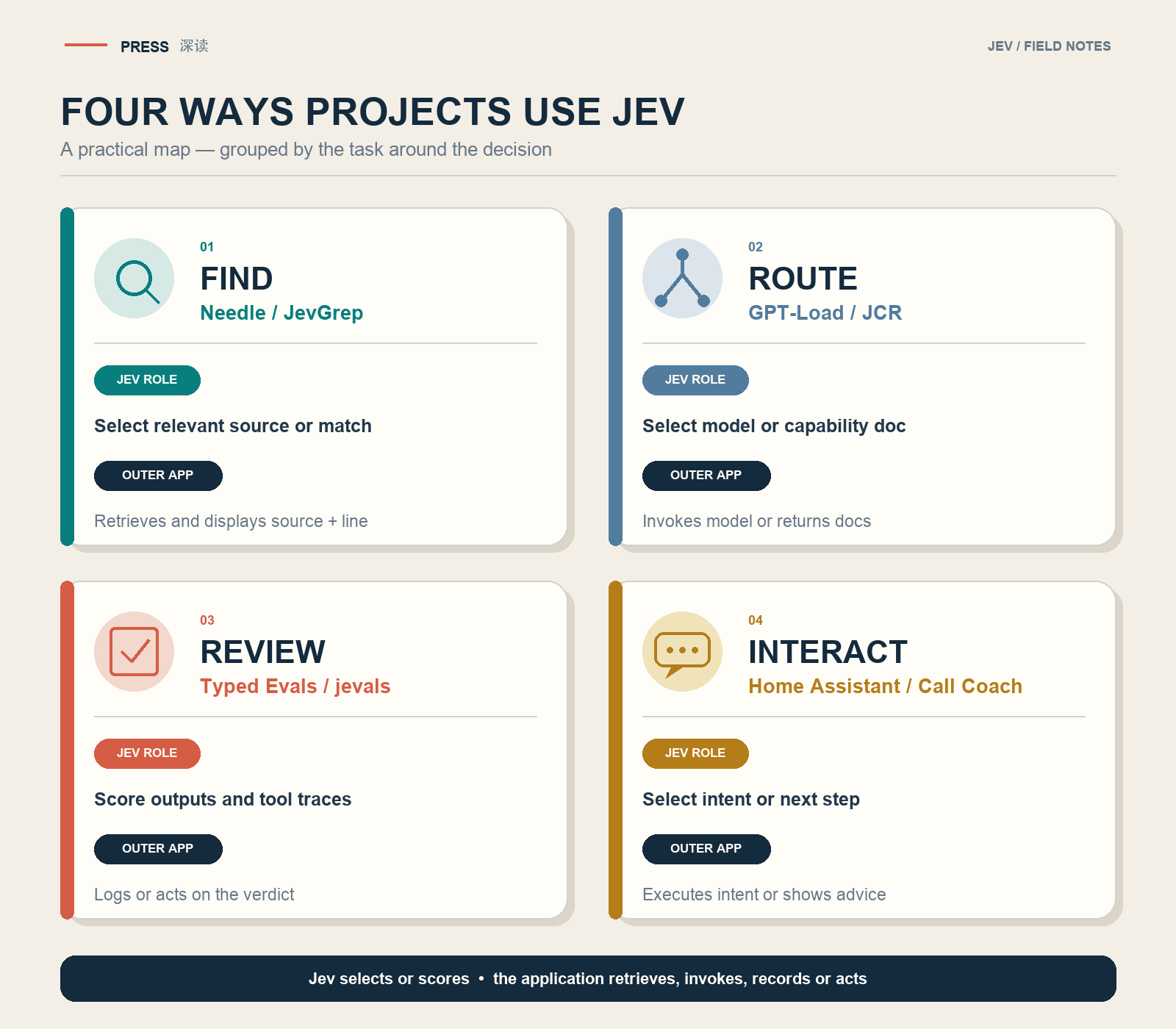
Needle packages that idea as a Chrome extension and a React app. Instead of guessing the wording used on a page, a reader can ask a question such as “What happens if I cancel?” The app turns the page or pasted text into candidate sentences, asks Jev to select and score them, then highlights the matching passages in place. It does not compose a new answer. The result remains the source text, which makes the workflow easier to check on policy pages, help centers, and long articles.
JevGrep applies the same pattern to a codebase. A developer can ask, “Where is session expiry handled?” and receive file paths, line numbers, and original excerpts rather than a generated explanation. It is intended for cases where the behavior is known but the symbol name is not. Its README also makes the limit explicit: if you already know the identifier or literal, conventional text search is usually faster. There is a data boundary too. Eligible source fragments are sent to a remote model, so users need to review exclusions and code-privacy requirements before running it.
The database version is MySQL AILIKE. It puts natural-language comparison inside SQL WHERE and JOIN operations—for example, deciding whether a product row meets a condition or whether two descriptions refer to matching items. An uncached comparison can require a remote call, so the practical pattern is to narrow the rows with normal SQL first, then use semantic judgment on the smaller candidate set.
Several smaller projects use the same structure. A Zillow natural-language filtering demo searches listings by qualities such as architectural style or renovation status that standard filters may not expose. Hazumi filters large Hacker News threads for comments worth reading. LikeThisGame ranks candidates from a pool of games in the same genre before a generative model writes the recommendation copy. Its author says the workflow is used for weekly site updates, but candidate retrieval, ranking, and a popularity penalty changed together, so any improvement cannot be attributed to Jev alone.
The reusable pattern is simple: the candidates already exist, Jev reduces the set, and the interface preserves the original evidence. When errors remain possible, a link back to the sentence, source file, or record is often more useful than a fluent explanation with no inspectable origin.
This product shape also has a hard limit: if the answer never enters the candidate set, a faster judgment cannot find it. A prototype should record “retrieval missed it” separately from “Jev selected the wrong item.” Needle must first obtain the right page text, JevGrep must include the relevant files in its scan, and MySQL AILIKE benefits from deterministic SQL narrowing the rows. Candidate coverage, whether the right item appears near the top, the amount of material sent per judgment, and the user's ability to return to the source are different measurements with different remedies. Replacing the judge does not repair missing retrieval.
Split the front and back of an agent workflow
A second group places Jev before or after the main agent rather than asking it to become the agent.
Before execution, GPT-Load Auto Model classifies the task into a model tier and reasoning level, then records routing latency and cost. The feature has been connected to GPT-Load, but the author labels it experimental, says routing accuracy still needs tuning, and notes that the extra judgment adds latency. The practical value is not a promise to “always select the best model.” It is the opportunity to send different tasks through different cost and latency paths while retaining enough routing data to review the decision later.
JCR targets another source of overhead. It searches a nested capability catalog for the command documentation relevant to the current task and returns that context to the agent. JCR returns instructions; it does not execute the command. The distinction matters. It can reduce the material an agent must explore and carry in its main context without inheriting responsibility for the eventual operation.
Code-review projects turn broad review work into narrower routing decisions. CodeSafe expresses project rules in YAML and checks changes and commit messages against them. jev-auto-approve separately judges whether a pull request is mergeable, whether it has tests, and whether human review is required before deciding whether to approve it. JevPR accepts pull-request webhooks and routes changes to low-risk, standard, or expert review. The latter two are a GitHub Action and a GitHub App under development. These judgments can help organize a review queue, but neither a probability nor an approval rule proves that the code is correct or removes human accountability.
After execution, evaluation libraries reduce an agent trace to explicit checks. Typed Evals evaluates LLM, RAG, and tool-use traces and supports calibration against human labels. jevals can check tool choice, evidential support, scope compliance, and safety risk in one request. It also supports backends other than Jev, so its total usage should not be counted as Jev usage.
The most useful example in this group is a negative result. TrueStandard tried filtering out sentences that did not need factual verification before they reached an expensive pipeline. A simplified harness showed a 26% reduction in cost. In the real pipeline, the reduction was 1.7%, smaller than the roughly 2% run-to-run variation. The routing component was built, but its production switch remained off.
A different part survived. After fetching a citation's page, the system asks whether that source supports the claim as written and displays a probability. The author describes the small live-source test as evidence that the end-to-end wiring works, not as an accuracy result. This distinction is more useful than a striking per-call price comparison. A cheap judgment does not guarantee a cheaper product workflow, especially if the existing system already performs the same step efficiently.
Long-term agent context is also being turned into a filtering problem. PerfectRecall asks Jev to evaluate eligible memories one by one and returns the original evidence to Hermes. The performance figures in its repository come from a frozen predecessor, not a fresh validation of the renamed package. Jev Turn Analysis scores Claude Code or Codex sessions for friction and waste, while another agent CLI produces the final improvement report. Neither project asks Jev to “remember everything” or write the retrospective. It decides which older material deserves the next stage's attention.
Viewed as one chain, these tools occupy three different control points. A router chooses a path before work begins. A reviewer decides whether an action should proceed. An evaluator judges the result afterward. Their failure costs differ: a bad model route may waste money or reduce answer quality; a bad automatic approval may put a risky change into the main branch; a bad offline evaluation first corrupts the metrics used for later tuning. A shared judgment interface does not justify a shared confidence threshold. The closer a decision sits to irreversible execution, the more it needs deterministic rules, human confirmation, and a recoverable fallback.
In real-time products, trace where the data came from
Call Coach is a work-in-progress sales-call demo. The browser first performs speech-to-text. After each transcribed sentence, the server sends text to Jev and receives a suggested next action, a buying stage, and several signals. Local smoothing, stability, and threshold logic then shape what the interface shows, along with a confidence score. Jev does not listen to the raw audio, and the project has not demonstrated an increase in close rate.
Home Assistant TypeSafe evaluates user intent and device candidates in parallel. A high-confidence match goes to Home Assistant's native intent handler; a low-confidence or out-of-domain request goes to a fallback conversation agent. Home Assistant still handles device discovery, permissions, and execution. Jev performs structured intent and candidate selection. The repository provides an integration, but the research did not run it in a real home.
The reading-practice prototype Dasheng follows a similar boundary. ASR produces a transcript first; Jev then judges word correspondence, error category, and semantic deviation. It does not assess acoustic pronunciation, stress, or accent. In the Drape virtual try-on demo, Jev selects clothing from wardrobe candidates using a transcript and the current outfit, while other parts of the system create or switch the visual try-on result. Prominent microphones and images in an interface do not mean Jev natively consumes audio or generates images.
These four examples suggest a useful discipline for system diagrams: do not label an entire arrow “AI.” ASR, candidate retrieval, Jev judgment, confidence fallback, and Home Assistant or front-end execution are separate components. Once they are separated, a team can measure where latency enters, where errors occur, and which component is actually worth replacing.
Real-time interfaces also have to decide whether the judgment from one second ago is still valid. Call Coach keeps smoothing, hysteresis, and minimum-confidence logic locally because a sentence-level output is not automatically a stable recommendation. Smart-home candidates can change when device names overlap, the user has not finished speaking, or a request refers to something outside the exposed device set. A practical interface should show the pending action and ask for clarification under uncertainty rather than using speed to conceal it. That is a product-design principle, not a claim that these projects have passed reliability testing in real environments.
Games and simulation: Jev chooses; the environment acts
The Astra + Jev Minecraft agent separates planning from action selection. Astra or another planning model sets objectives, Jev selects from player actions, and Mineflayer executes through the game interface. The repository describes a successful run and its checks, but at the time of the research, recordings and generated logs were not included in the public repository, so the reported speed could not be independently checked. The project demonstrates a control loop constrained by a game API; it is not general evidence of open-world reliability.
JevUnreal is closer to a game-development building block. Unreal Engine 5.8 Blueprint nodes send game state and a question, then return Yes/No, an option, or a probability. The surrounding Blueprint decides whether an NPC retreats, which line it speaks, or whether difficulty should change. The plugin is under development and its examples were still being assembled. Jev returns the decision; the developer's Blueprint logic changes the game state.
The robotics demos require an even tighter boundary. EmbodiedJev demonstrates an observe–judge–act loop for grasping, stacking, and obstacle crossing in a MuJoCo workbench. RoboJEV first selects an immediate intent, then an XYZ direction and gripper action, which a physics controller executes. Both are simulation projects, and RoboJEV gives Jev structured state. They do not show native visual control, and they do not replace safety and reliability testing on a physical robot.
Games are useful test environments because state, legal actions, and failures can be recorded and often replayed. But selecting an action in a constrained ruleset is far from understanding arbitrary images and acting safely. Perception, state estimation, execution control, and exception recovery remain separate layers. Logging those boundaries is the only way to tell whether a failure came from the plan, Jev's choice, the game interface, or the controller.
Product ideas that follow from these patterns
The following are proposals derived from the structures above. They are not existing Jev capabilities or announced roadmaps for the cited projects.
Evidence-preserving work-log search. Combine Needle's source highlighting with PerfectRecall's return of original evidence for personal tasks, customer-support records, or research notes. A query such as “Which problems keep getting postponed?” should return the original entries and timestamps first. Restrict candidates to the user's material and measure recall and false positives before generating any summary.
A low-risk intent layer for mobile apps. Borrow Home Assistant's structure to choose which screen to open, which local action to offer, or whether the app needs a clarifying question. Low-confidence outputs should stop or fall back. Start with reversible actions and record the candidates, judgment, threshold, and eventual execution result.
A coach after real-time transcription, not a model that supposedly listens. Call Coach and Dasheng show how a mature ASR system can produce text before a decision model answers a narrow question. New products might check omitted support steps, interview-question coverage, or semantic reading errors. Transcription error and judgment error must be evaluated separately rather than combined into one “AI accuracy” figure.
Auditable NPC decisions. Let game rules supply the action candidates, ask Jev only to rank or select them, and keep hard constraints and fallback behavior in the engine. Logs can preserve the state, candidates, probability, and final action for replay. This proposal borrows from JevUnreal and the Minecraft agent; it does not imply that either project already supplies a complete production pipeline.
A pilot that can end within two weeks
Do not begin by “adding Jev everywhere.” Choose one frequent, bounded, reviewable judgment: perhaps selecting three tickets for escalation from a batch of 20, or routing a code change to a standard or expert review queue.
Capture a week of the current baseline first: human outcomes, handling time, downstream cost, and rework. Then freeze the candidate set and question format. Let Jev make the judgment, but do not let it directly execute an irreversible action. Define a confidence threshold and a fallback. At minimum, log an input summary or traceable ID, candidates, output, probability, latency, cost, human overrides, and final outcome. Evaluate both quality and the cost of the whole path. If the measured benefit sits inside normal variation, turn it off as TrueStandard did. If it works only for one class of task, keep only that segment.
Write stop conditions before the pilot starts. Missing a high-risk ticket may pause automatic routing; an unacceptable human-override rate may push the feature back to suggestion-only mode; sending fields outside the agreed data scope should stop it immediately. The business must set those thresholds—none of these demos provides a universal number. The test set also needs ordinary cases, boundary cases, and cases with no valid answer so the system is not evaluated only under the convenient assumption that one candidate must be correct.
Do not compare model prices alone. Include candidate preparation, network waits, retries, human review, downstream generation, and rework, then compare that total with the old process. TrueStandard is instructive because it put the component back into the real pipeline. A judgment may be cheap and still not be worth keeping if it adds a network round trip for every user or makes reviewers spend more time explaining false positives.
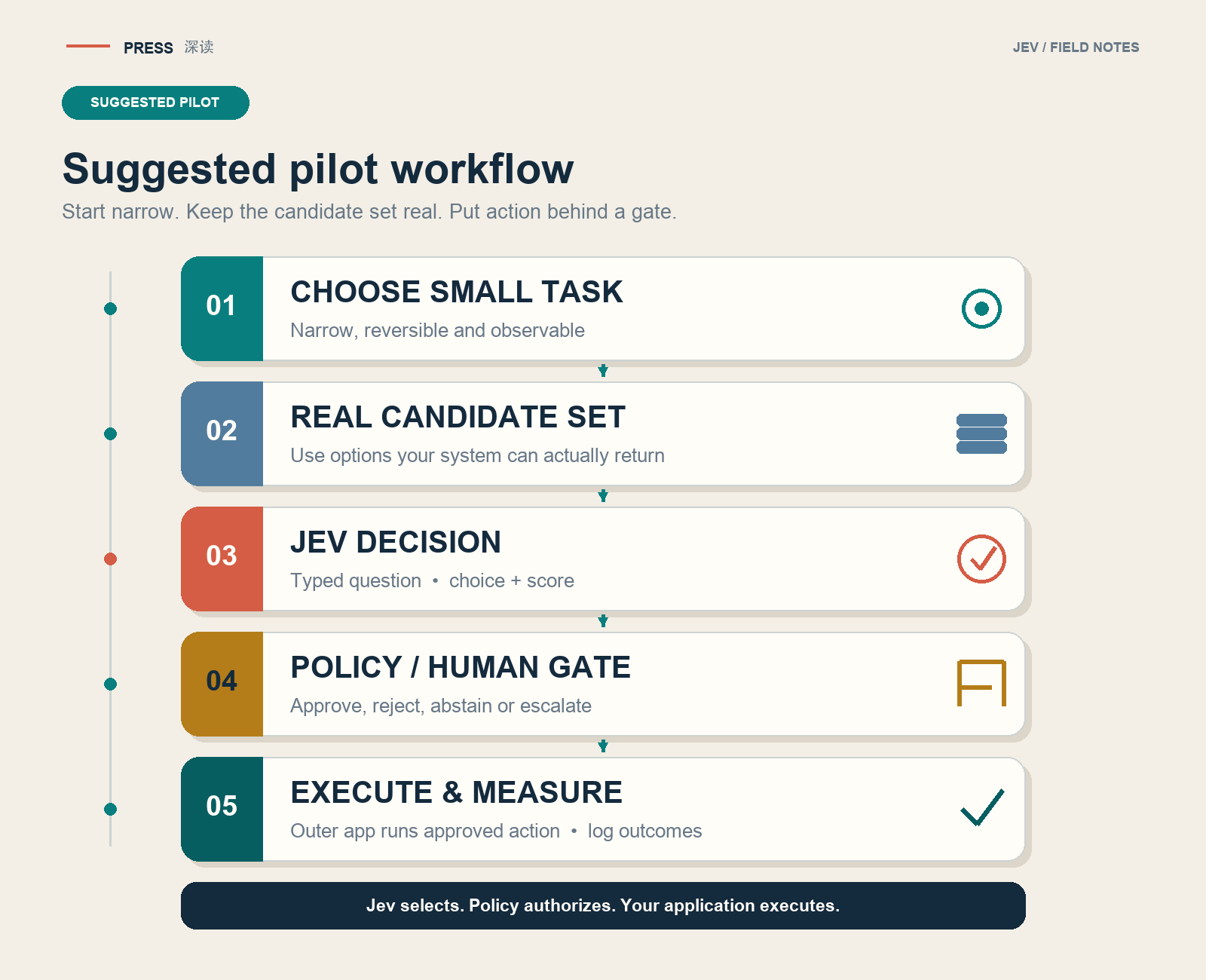
A review needs six questions: Were the candidates complete? Did Jev receive only the data it should see? Can an error fall back safely? Which component executes the action? Can the decision be reconstructed from logs? Did the real baseline improve? Needle's source sentences, JevGrep's excerpts, Home Assistant's native intents, and Minecraft's game interface belong to very different products, but all separate judgment from execution.
The most durable lesson in these 24 cases is not a demo speed. It is an engineering choice: reduce the problem to an inspectable decision, then measure whether that decision deserves a place in the product. TrueStandard kept source-support checking and left an unhelpful routing stage switched off. A pilot that reaches an equally clear “do not ship” has done its job.
More from WayDigital
Continue through other published articles from the same publisher.
Comments
0 public responses
All visitors can read comments. Sign in to join the discussion.
Log in to comment