What You Can Do with Instinct, Manus 2.0 and Meta Muse
Where to start with Instinct, Manus 2.0, Cue and Muse; what happens when you ask them to arrange a trip, handle email or produce a video; and which permissions, costs and data settings deserve a closer look.
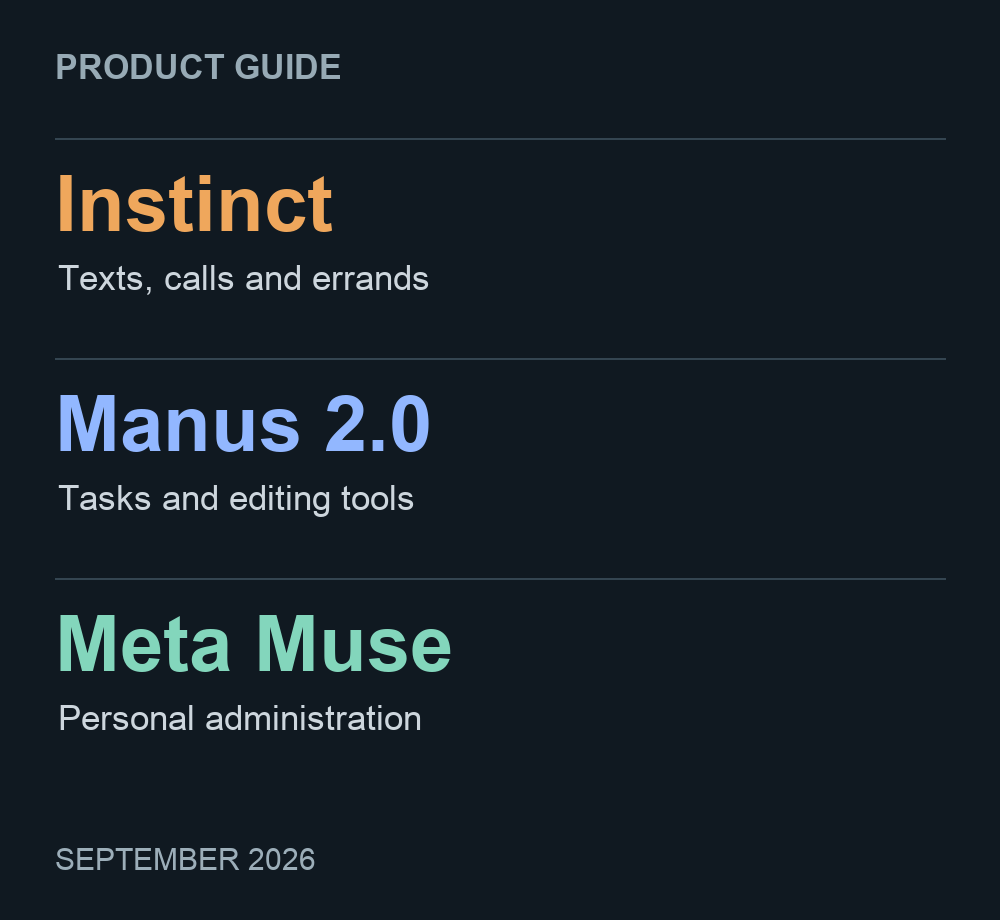
Instinct’s website asks you to start with a text. Manus offers a web workspace and desktop tools. Muse runs in its own apps and can also be reached through WhatsApp. All three accept instructions in ordinary language, but getting started involves different accounts, connections and permissions. The results they are designed to deliver differ too.[1][6][11]
Someone booking a hotel wants fewer calls to make. Someone producing an advertisement wants an editable timeline. A team handling customer email needs to know who approved a message. These are useful starting points for choosing an agent.
Instinct: texts, calls and everyday arrangements
Where to start. The “Text Instinct to get started” button on Instinct’s website leads to a phone-number login, followed by a verification code. The company’s September 28 announcement still describes the product as early access, and its founder says access remains invitation-based. Reaching the login page does not establish that an account is eligible.[1][4][18][21]
Once admitted, users communicate largely through texts, calls and email. Instinct has its own phone and computer; it can contact a business on your behalf or get back in touch with you.[1][4] The claim that there is “no new interface” describes the intended everyday experience. Account administration still has an interface: the privacy policy points to Settings and Workspace for controls and stored material. Its terms cover Mac and mobile apps, but the public evidence does not establish universal availability across operating systems and countries.[2][3]
What it can handle. Published examples include arranging rides, finding a repair service, planning travel and following up on overlooked email. Concierge extends this to calls that are difficult to replace with a booking form: contacting a restaurant, asking about a waitlist or resolving a bill. The Trusted Person Network allows users’ agents to coordinate plans and share files.[1][18]
A complete request might involve research, a call to the provider, a time confirmation, payment and a receipt. Instinct aims to carry work across those steps. How far it can proceed depends on the information and accounts it has been given. Supplying travel dates is a smaller delegation than connecting email, a calendar and a payment method.
That makes it worth investigating for frequent travelers or people spending substantial time arranging services. Its publicly described interface is less suited to inspecting individual video frames or editing a game’s assets. Those jobs benefit from dedicated editing tools.
Manus 2.0: tasks on the web, editing on the desktop
Manus 2.0 was announced on September 28, 2026.[6] The launch includes both additions to Manus and a separate product, Cue. They should not be treated as a single application.
Getting into Manus. Start at the website for web access. The official download page lists macOS, Windows, iOS/iPadOS and Android; the desktop page provides the desktop route. Trying a cloud task does not inherently require granting access to the entire local computer. Local files, authenticated browser sessions and applications involve their own connections and permissions.[6][7][22]
The web and mobile interfaces provide ways to submit work and follow its progress. On the desktop, Manus Studio emphasizes editing alongside the agent. Its published scope includes documents, spreadsheets, PDFs and slides, as well as websites, code, games and video.[6]
For a product advertisement, Video Editor can generate a first cut and place clips, images, text and audio on a timeline. The user can replace assets, adjust the soundtrack and ask Manus to continue from those changes. Alchemy handles more of the initial creative arrangement. Game Dev combines a running preview with asset and code editing and can publish a game to the web. Multiplayer projects needing a persistent server are directed toward a paid Cloud Computer.[6]
Automations handles recurring work with event triggers, including email, Slack messages, calendar events and Notion updates. Cloud Computer supplies a dedicated environment for projects that need to stay running. Cascade is the underlying agent framework for bringing in specialized capabilities; it is not another app the user must locate.[6]
Computer Use addresses local work. In a connected, authorized session, Manus operates permitted files, browser sessions and applications in a separate, visible workspace. One official example is instructing it from a phone to locate and convert a file on a home computer. This is distinct from an ordinary cloud task or simply installing a browser extension.[6][7]
Cue has its own entry point. The Cue website displays a macOS download and mobile access. The launch announcement describes web, desktop and mobile routes, but also says early access requires an invitation and that the iOS app was awaiting review. The announced MEETCUE code was limited, not a promise of continuing eligibility.[6][23]
Cue is closer to a personal assistant. Each agent has a phone number, email address, wallet and computer. It can receive forwarded calls, leave summaries, exchange email and make payments within configured permissions and budgets. Multiple agents can work in a shared conversation. The site lists connections including Gmail, Trip.com, Oura and MyFitnessPal, alongside examples of monitoring, reminders and recurring arrangements.[6][23]
Asking Manus to prepare a report or edit an advertisement is therefore different from having Cue answer calls and manage appointments. A Manus subscription should not be assumed to include unrestricted Cue access or every payment capability.
Muse: an independent app, with a WhatsApp route
The direct web address is muse.ai. Its public sign-in page currently accepts a phone number or email address. Meta’s launch announcement lists iOS, Android, web and WhatsApp. For mobile installation, follow the official site’s store links and check the name “Muse from Meta” and its developer. This is the personal-agent product, not the Muse Spark model or a developer API.[11][24]
Muse initially launched in the US; September 25 reporting also describes availability in Canada. This review did not establish general availability in mainland China or Hong Kong. An accessible website or a field accepting a phone number does not settle account eligibility.[11][15] A Mac client appears in published security research, but that does not establish feature parity with the web and mobile versions—or the availability of a Windows client.[16]
How work is organized. Muse maintains an ongoing main conversation, with separate side chats for projects. Users can adjust proactive behavior, inspect goals, activity and memory, and receive requests for approval. It can continue working while the app is closed.[11][13]
After connecting relevant services, its published uses include scheduling, email, travel planning, shopping comparisons, bills and ongoing follow-up based on preferences. It can browse websites and fill forms, and produce documents, pages and lists. Shopping payments launched with Stripe Link support.[11][13]
The September 24 Connect recap describes additional shopping, payment and work connections. It also previews an agent-owned email address and glasses integration in the following months. Each has its own rollout; a stage demonstration is not evidence that every account has access now.[14]
Muse is worth considering for someone who wants personal and household administration in a continuing conversation. More connections can reduce repeated explanation. They also create more permissions and remembered information to manage.
What happens when you give them the same job?
The comparisons below concern published capabilities, not a controlled success-rate test. Real requests encounter logins, verification codes, availability, regional restrictions and payment rules.
Book a hotel, reserve a table or arrange a repair
Instinct makes these errands central to its offering, with Concierge covering telephone work. Muse combines connected services and browser actions with supported checkout flows. Within the Manus product family, Cue is the closer match: an independent communications identity lets it receive calls and continue an exchange with a provider.[18][11][23]
There is a practical difference between asking for three options, asking the agent to confirm details with a business, and authorizing it to pay. Each requires different permissions and proof of completion. A shortlist is not a reservation; a reassuring status message is not a confirmation number.
Organize email and calendars
All three describe email or scheduling work. Instinct emphasizes follow-up and coordination through its Trusted Person Network. Muse keeps ongoing conversation, goals and approval records within one product. Manus Automations can use a new message or calendar event to initiate subsequent work; Cue has its own email identity.[1][18][11][6]
For a daily digest, read-only access may be enough. Sending a client reply or moving a meeting needs additional authority. Email also receives login codes, so permission to read an inbox can have consequences beyond summarizing messages.
Produce a report, presentation, video or website
Manus documents dedicated deliverables and editing environments: documents and slides, a video timeline, website generation and game development. Its public material also describes web applications with authentication, databases and a backend.[6][22]
Muse can produce documents, web pages and other Artifacts. A technical account of Instinct describes code execution. Neither fact, by itself, establishes the same editing, preview and publishing workflow as Studio.[13][5] If a project will need several revisions, the ability to make changes and export or redeploy the result matters at least as much as the first draft.
Keep watching for a change
Manus explicitly distinguishes event-triggered automation from an always-running Cloud Computer. Instinct describes proactive follow-up; Muse has goals and background work; Cue’s website shows recurring checks and routines.[6][1][13][23]
Specify when monitoring should end: after an appointment is moved, a budget is exhausted or a connection is revoked. An assistant promising to keep an eye on something is not automatically a production service with defined uptime, retries and failure alerts.
Permissions and data settings to inspect
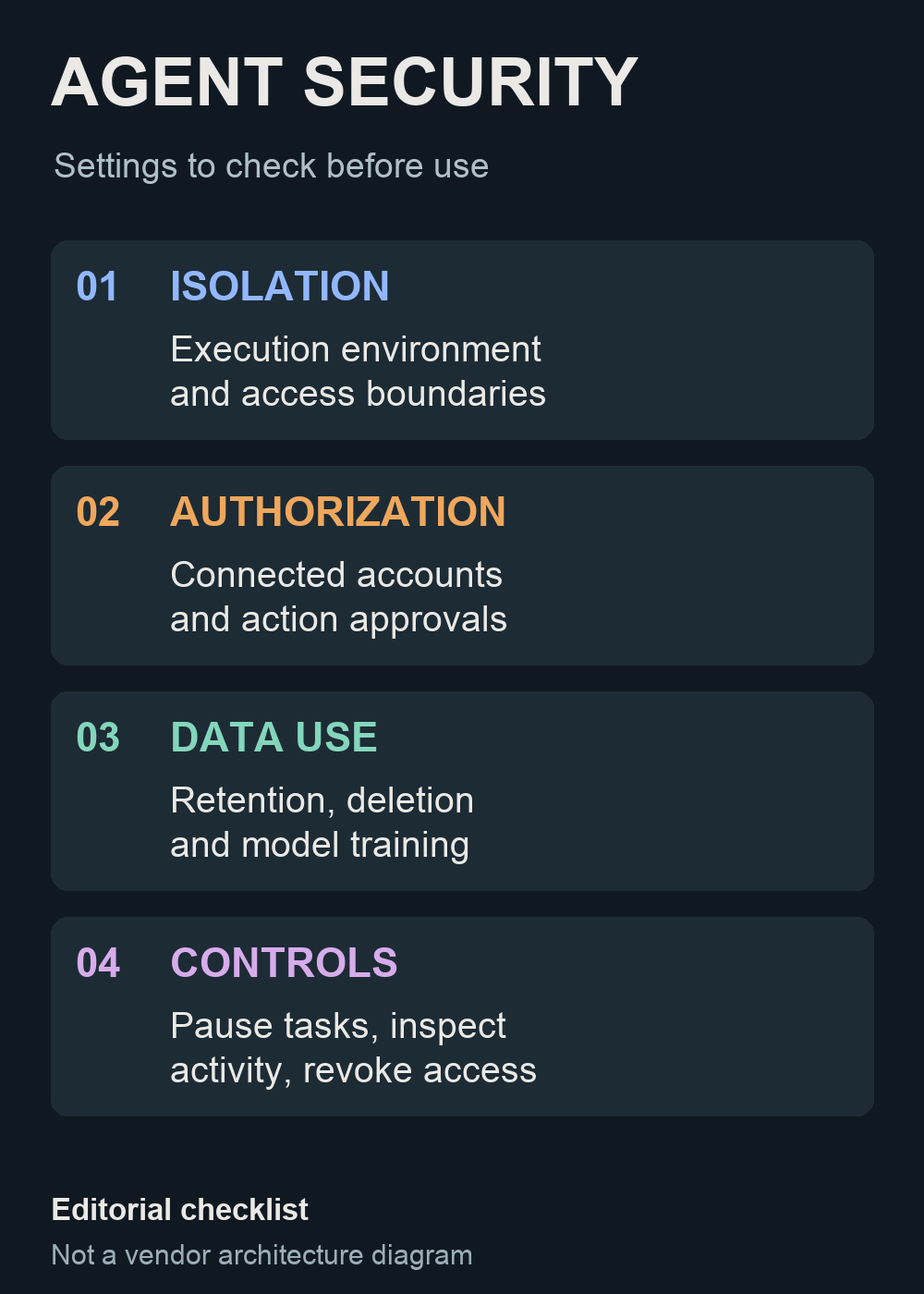
A sandbox primarily constrains the execution environment. Payment approval, training use and retention after cancellation are separate questions.
Instinct. The company describes isolated sandboxes, short-lived local credentials, identity-signed tool execution and hallucination detection.[18] Its privacy policy permits training use of general usage data, with a prospective opt-out and an exception for safety-review data. Google Workspace API data has a separate no-training restriction, and the terms exclude Vault material from training. Disconnecting a service does not automatically delete material already indexed.[2][3]
In his own environment, Rohan Adwankar observed execution sandboxes, Markdown/Git memory, a cloud browser and a credential store. He also described retrieval of one-time codes from a connected inbox.[5] This is a useful technical account of one user’s experience, not an audit of isolation between users. The simplicity of sending a text says little about how many authenticated identities a task might use.
Manus. Browser Operator can use an authenticated local browser session, with relevant data transmitted to servers for processing. Browser sandbox retention is up to seven or 21 days depending on the plan; those periods do not define a universal deletion schedule for conversations, memory and cloud computers. Team workspace owners can access and export members’ session data. The policy covers third-party model processing and the use of aggregated, de-identified or anonymized data for model improvement. A blanket consumer no-training claim would be inaccurate.[7]
The trust center lists SOC 2 Type II and ISO certifications.[19] A prospective team customer should still inspect the scope and whether it covers the intended features. Cue’s payment approvals, credential handling and response to erroneous transactions deserve separate review.
Muse. The main agent runs in a constrained environment, while credentials and Sentinel remain outside it. The agent uses substitute credentials; authorized requests receive the real token at the network boundary. Sentinel can permit, deny or seek approval. Approvals can be scoped to an action, task or time window, rather than requiring a new prompt for every network request.[12][13]
Muse also describes filtering email verification codes and reset links, single-use Link card numbers and protection for qualifying purchases.[12][11] These are concrete controls, but the current Secure VM does not prevent necessary access by Meta. Confidential VM protection addressing that issue remains planned. Interaction traces may be used for training after some personal information is removed, with an opt-out available.[11][12]
Keep the client updated as well. Patrick Wardle’s September not-a-mused report requires an attacker already able to run code as the local user. Manipulation of a dictation endpoint could then redirect input and potentially make use of Muse’s permissions. Meta said it issued a hotfix on September 22. The report concerns a client input path; it is not evidence of a cloud-sandbox escape.[16][17]
Muse provides more implementation detail than its peers in these public materials. That alone cannot establish that it is the safest in practice. Before relying on any of them, locate the actual controls for pausing work, revoking connections, deleting stored information and reviewing activity.
Pricing, users and revenue
The Manus pricing page checked on September 29 lists monthly tiers of $20, $40 and $200, with credit allowances and persistent environments affecting cost. Cue launched as free, invitation-based early access. Muse has a free allowance; TechCrunch’s launch coverage lists Power at $20 a month and Maximum at $100. None of those prices is a guaranteed all-in cost for every region or task.[8][6][20]
Instinct’s founder has described a model of merchant commissions and free access for users.[4] That direction should be distinguished from final service terms and actual charges. It also raises a straightforward question about recommendations: if merchants pay different commissions, how is ranking kept from favoring the more lucrative provider? Subscription and credit-based products have their own questions, including what failed tasks and revisions cost.
Instinct has raised substantial funding but disclosed little comparable operating data. On September 28, it announced a $1 billion Series C at a $10 billion valuation, naming Sequoia, Benchmark and Coatue among participants. It did not disclose current total users or revenue.[18] In an interview released that day, Noah Shinn described roughly $1 billion in annualized transaction volume, about half from travel. That is spending through the platform, not Instinct revenue. His claims that 40% of users share card details within three weeks, retention reaches roughly 80% among users connecting sensitive information, and daily growth runs at roughly 10–11% lack complete samples or measurement windows.[4]
Manus has historical revenue disclosures. On December 17, 2025, the company announced more than $100 million in ARR, over $125 million in total-revenue run rate and millions of users worldwide. Those are not September 2026 live revenue or monthly-active-user figures.[9] Manus announced that it resumed independent operations on September 1, 2026; Meta’s overall scale should not be attributed to it.[10]
Muse has early download estimates, not separately disclosed revenue. TechCrunch’s September 25 report cited Sensor Tower’s estimate of more than 3.4 million downloads through the preceding day, alongside differing estimates from other providers. Downloads do not establish unique, active or paying users.[15]
These disclosures do not support a comparable revenue ranking. Funding is capital raised, transaction volume is spending processed, ARR is annualized recurring revenue, and downloads measure distribution.
Which one is worth trying first?
For repeated travel arrangements and calls to service providers, investigate Instinct and Cue. Instinct emphasizes familiar text and phone interactions; Cue combines independent communications identities with multiple agents in an app. For ongoing personal and household administration, Muse is an option where access is available. For videos, websites, games and work files that need repeated editing, Manus Studio offers the more directly relevant environment to evaluate.
Begin with work that is easy to check and inexpensive to get wrong: extract a reservation from an email, find a few appointment options, or make a report from non-sensitive material. Inspect the result and the amount of clarification and editing required before connecting another account. For spending or outward-facing messages, state the amount, recipient and approval requirements explicitly.
After a week, your own record will be more useful than a demonstration: how many calls it saved, how many errors you corrected and what the work cost. That is a reasonable basis for deciding whether to keep using it.
Sources and public entry points checked through September 29, 2026. Capabilities are drawn from official material and published accounts, not an equal-condition test of all three products. Regional access, invitations, pricing and feature availability depend on the actual account.
Sources
- Instinct — official product overview
- Instinct Privacy Policy — revised August 26, 2026
- Instinct Terms of Service — revised August 26, 2026
- Noah Shinn, Instinct: The Personal Agent — Invest Like the Best, September 28, 2026; Public third-party transcript; operating metrics are founder-reported
- Rohan Adwankar — The box an agent runs in (firsthand technical observations, not an audit)
- Manus 2.0 launch announcement — September 28, 2026
- Manus Privacy Policy — updated September 28, 2026
- Manus pricing — viewed September 29, 2026
- Manus Update: $100M ARR, $125M revenue run-rate — December 17, 2025
- Manus Resumes Independent Operations — September 1, 2026
- Meta — Introducing Muse — September 8, 2026
- Meta AI Research — How We Built Safety Into Muse — September 8, 2026
- Meta product design — How We Designed Muse — September 2026
- Meta — The Biggest News From Connect 2026 — September 24, 2026
- TechCrunch — Meta is putting its muscle behind Muse as the AI app takes off — September 25, 2026
- Patrick Wardle — not-a-mused, original local-client security proof of concept
- The Register — Meta Muse AI app flaw lets local malware redirect dictation traffic — September 21, updated September 22, 2026
- Instinct / Business Wire — $1B Series C at $10B valuation — September 28, 2026
- Manus Trust Center — public security and compliance disclosures
- TechCrunch — Meta debuts its Muse AI agent. Will consumers trust it? — September 8, 2026
- Instinct — phone-number sign-in, checked September 29, 2026
- Manus — official downloads and platform list
- Cue — official access, identities, connectors and examples
- Muse — official sign-in, checked September 29, 2026
More from WayDigital
Continue through other published articles from the same publisher.
Comments
0 public responses
All visitors can read comments. Sign in to join the discussion.
Log in to comment