When AI Takes Over the Work, Who Keeps Your Cat Company?
General-purpose agents are taking on more tasks. A smaller team can build around something else: the relationship between a person and a real pet. Nuzzle brings playful sounds, games and pet-photo creation together; its lasting value will depend on whether owners keep coming back.
When AI Takes Over the Work, Who Keeps Your Cat Company?
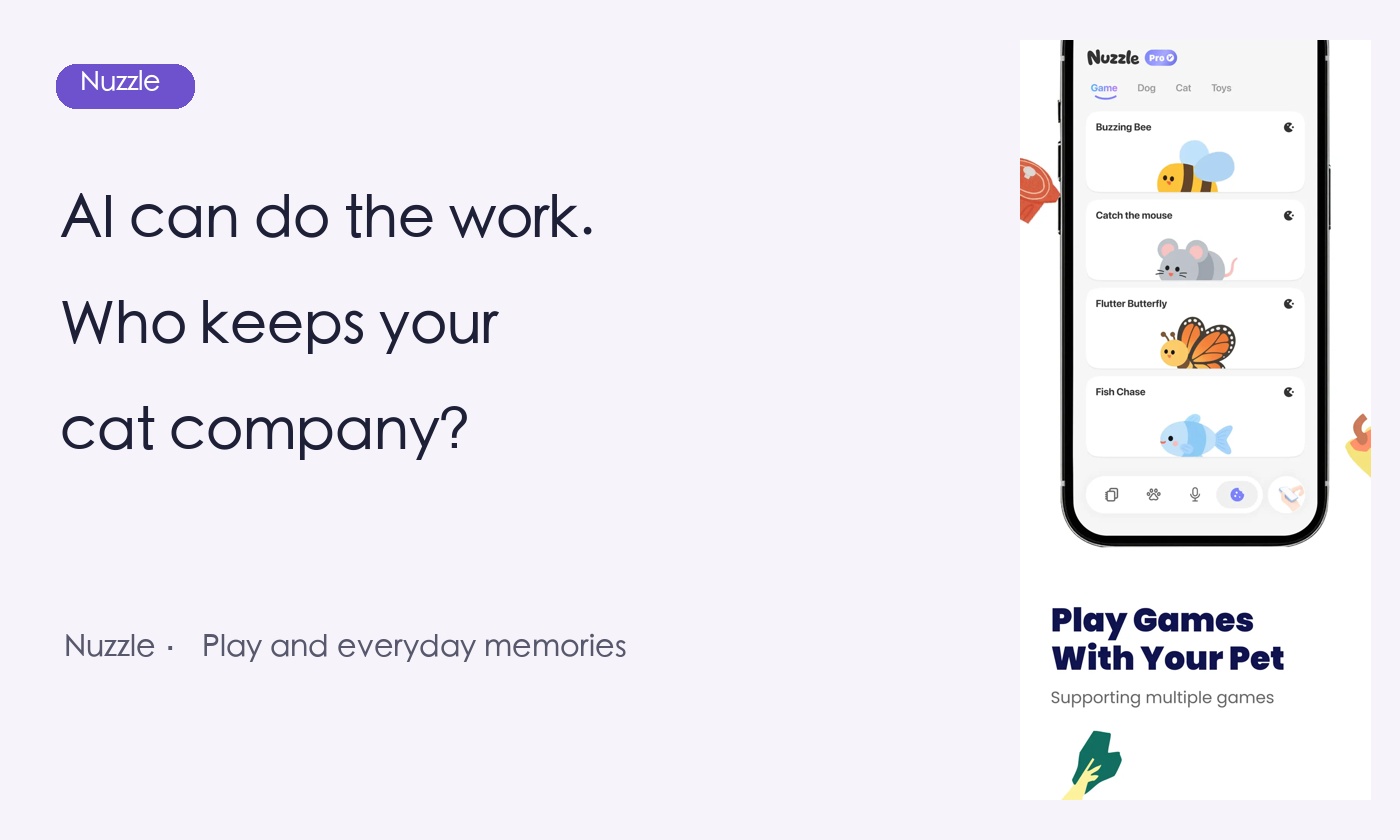
Nuzzle has two recording buttons: one for you, one for your pet. Elsewhere in the app are small games and tools that turn pet photos into stickers. The unit of attention is modest—a meow, a photograph, a few minutes together.[1]
Beside the latest AI announcements, that can look almost quaint. Other products promise autonomous coding, cloud computers and agents that keep working through the night. This one is trying to make you take another look at your cat.
There is a serious business question in that contrast. While model companies compete to take on more of our work, a smaller team can choose to build around a relationship that already exists. The software doesn't have to replace either participant to earn a place in it.
The assistant is moving into everything
On September 8, 2026, Meta introduced Muse, a personal agent that, according to its announcement, can accept requests through its app or WhatsApp, work on a dedicated virtual computer and seek permission before sensitive actions such as sending an email or making a purchase.[2]
Manus 2.0, announced on September 28, expanded in two directions. Manus Studio brings together work on documents, code, video and games. Cue is a separate personal-agent app, with identities and computing environments for its agents.[3]
On October 7, OpenAI announced GPT-6 and Intelligent UI in ChatGPT, combining text, visuals and interactive elements in answers. Its ongoing-work agents, called dots, had already appeared in the September 29 release notes. Presenting an answer more usefully and continuing to act on someone's behalf are related developments, but they aren't the same capability.[4]
On the work side, Claude Code connects bug fixing, testing and pull requests into a workflow, while Codex is expanding cloud-based coding tasks that can continue running away from a user's computer.[4][5] The distinction between a work agent and a personal agent is becoming less useful as a product boundary. An expense claim and a holiday booking may require much the same machinery: browsing, memory, permission and execution.
That creates a distribution problem for startups as well as a technical one. Features that once justified a separate app can become another option inside an assistant people already use. An app built around a slightly better prompt has to explain why it deserves another download, another visit and another subscription.
Companionship isn't the only way out. Specialized software, professional services and industry-specific workflows still offer opportunities. But a team that doesn't want to compete to do every task for everyone needs a reason for users to care that isn't measured entirely by task completion.
A faster workday isn't necessarily a shorter one
The appealing version of the story goes like this: AI does the work, people recover their time, and more of that time goes to family and pets. The unresolved question is who gets to keep the savings.
The NBER working-paper version of Generative AI at Work studied 5,179 customer-support agents. Access to an AI assistant increased issues resolved per hour by about 14% on average, with larger gains for newer and lower-skilled workers. That is a finding about output per working hour. It doesn't establish that people went home earlier.[6]
An employer could use the gain to reduce hours or take on more work. A founder could finish sooner or launch another project. A pet-companionship business shouldn't depend on a prediction that everyone is about to have abundant leisure.
There is a more immediate product hypothesis to test. An owner may care deeply about an animal without having the energy to invent a new activity every evening. A phone may hold hundreds of pet pictures without offering a collection the owner wants to revisit. Neither observation proves demand for a particular app. Both describe a plausible reason to try one.
The American Pet Products Association reported $152 billion in total US pet-industry expenditure for calendar 2024 and said 94 million US households owned a pet in its 2025 industry release.[7] Those figures establish the scale of the broader category. They don't measure the market for pet apps, much less willingness to subscribe to an entertainment product.
The useful question is smaller: after the novelty of the first session wears off, what is worth keeping?
Pets don't write prompts
Most AI software assumes a human can specify a goal, inspect the result and ask for a correction. A cat or dog can't participate on those terms.
An AI product for real pets therefore has at least two participants: the person operating the phone and paying for it, and the animal affected by its sounds, images and activities. A funny reaction for the owner isn't automatically a good experience for the pet. Shares and screen time can't be the only measures of success.
Sound features should be designed for brief, supervised interaction, with room for the animal to disengage. Replaying a sound just to provoke a better clip is the wrong incentive. Screen games should not be treated as substitutes for walks, physical toys or everyday care. These are design boundaries, not claims that an app produces a particular health benefit.
This gives real-pet products a different aim from a virtual chat companion. A virtual companion generally benefits when a person stays in the conversation. A product built around a real animal can succeed by returning the person's attention to that animal. The interaction should be able to continue after the phone is put down.
Nuzzle starts with curiosity. The lasting value may be memory.
Listed in the US App Store as Nuzzle: Cat & Dog Chat, Nuzzle is developed by KVIDU PTE. LTD. Its store description includes playful text generated from cat and dog recordings, human recordings converted into pet sounds, a sound library, interactive games, AI wallpapers and short videos, and photo-based mood stickers saved into a pet album.[1]
That is a specific entry point rather than a miniature general-purpose agent. The owner already cares about the subject. Recording a sound, choosing a photograph or trying a game gives that interest something easy to do.
“Translation” is an effective invitation to experiment, but curiosity alone is a fragile foundation for repeat use. Photos and an album suggest a different possibility. A model can generate similar cute content for many people. The animal in a particular photograph belongs to a particular household. Much of the reason to save the result comes from that relationship, not the model.
An owner might start with an existing photo and make a sticker or wallpaper, or briefly try a game when the pet is willing to participate. These are suggested uses based on the listed features, not independently tested outcomes. The owner can decide whether an image is more enjoyable. An app-generated sentence cannot, by itself, establish that the animal is happier.
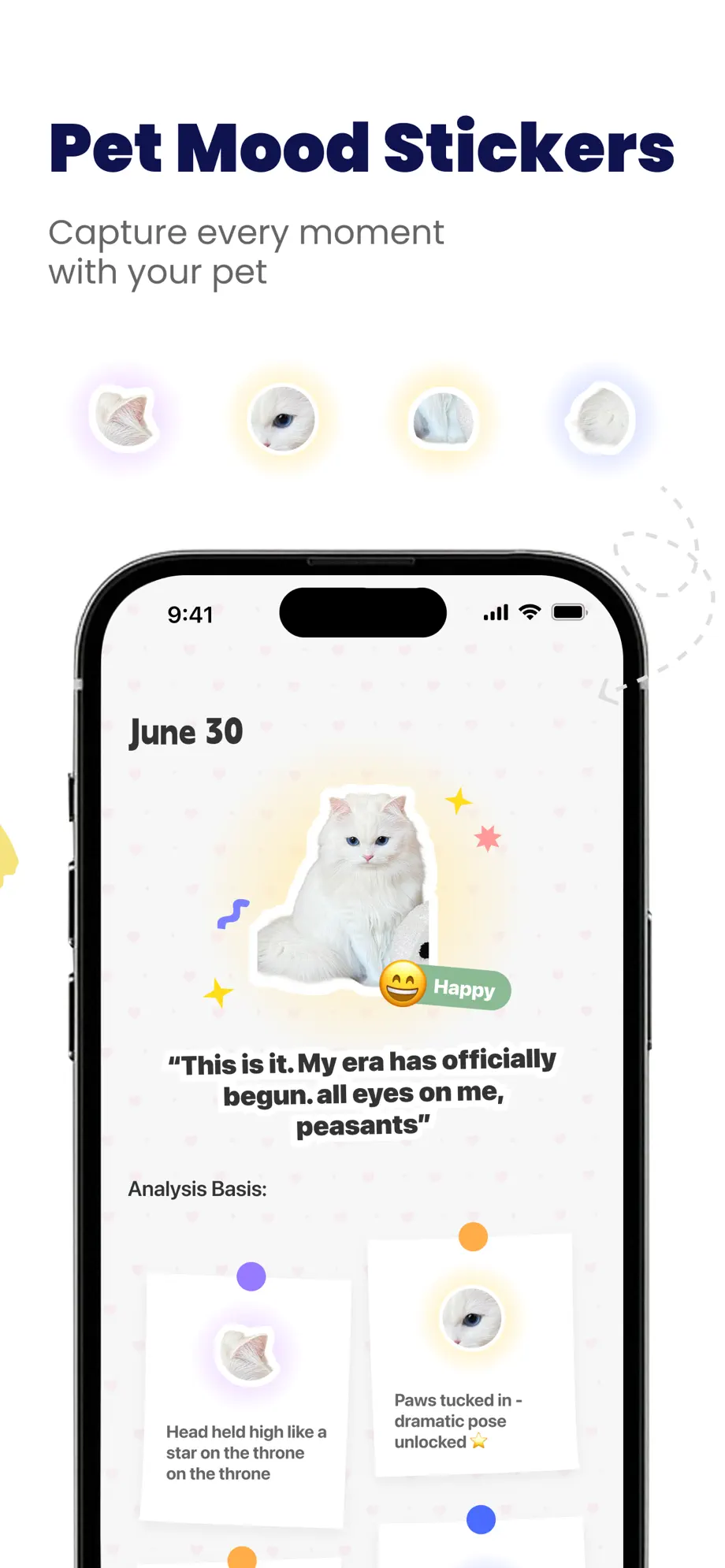
For Nuzzle, the longer-term hypothesis worth testing is whether people will keep collecting moments involving the same pet. A recording can prompt an initial visit. An album can preserve the ordinary days. Wallpapers and sharing can bring those moments back into daily life.
If that habit develops, the product has a more concrete source of value than access to a particular model. But the habit is still a hypothesis. The album is a listed feature; sustained attachment to it has to be demonstrated through repeat use, retention and actual feedback.
Keep the promise honest
Nuzzle's App Store description explicitly says it is an entertainment product and does not provide actual, scientific translation of animal language.[1] That distinction belongs next to the appealing features, not behind them.
Classifying a sound, inferring a possible context and generating an amusing line of dialogue are different activities. A screen displaying “I missed you” doesn't prove that those words were contained in a bark. A “happy” label beside a photograph isn't a validated emotional diagnosis.
There is genuine research in animal acoustics. The 2024 paper Towards Dog Bark Decoding investigated applying representations learned from human speech to dog vocalizations. Its tasks included individual-dog recognition, breed and sex classification, and context classification. The contribution was evidence that these representations can help with defined classification tasks—not sentence-by-sentence translation of a dog's meaning.[8]
Acknowledging that boundary leaves plenty of room for fun. Giving a pet photograph an imagined voice can be a creative activity. The problem begins when creative output is presented as certain knowledge about the animal.
Persistent unusual behavior or signs of illness should not be interpreted through an entertainment app's output; owners should seek veterinary help. Encouraging closer attention to a pet is a defensible product goal. Claiming to replace professional judgment is another matter entirely.
What a small team can actually build
Model capability can be purchased. Trust has to survive repeated use.
One revealing question is what brings someone back to Nuzzle. If every session is another test of whether the app can truly translate a bark, the product remains tied to an expectation it cannot scientifically promise to meet. If people return to collect photos of the same animal, create something new or find an activity both participants enjoy, the reason to use it is on firmer ground.
The business model should follow that reason. Nuzzle is free to download and offers in-app purchases; its listing says a subscription unlocks all features. Prices, trial eligibility and renewal terms should be checked on the purchase screen for the user's region. Free installation doesn't mean unrestricted use.[1] Clear subscription terms help people judge the experience on its merits.
Pet photos and recordings also deserve care. A good product should make it understandable what is saved, what must be uploaded and how to delete it. That is a standard to work toward, not a claim that every part of Nuzzle's privacy implementation has been independently audited.
Nuzzle is worth considering as a single place to try several lightweight forms of interaction and pet-photo creation. Its App Store page is the place to check the features and terms before deciding whether to download or subscribe.
Whether it becomes a lasting product won't be decided on an AGI leaderboard. Better evidence would be an owner returning a week later to add one more photograph of the same cat.
Product disclosure: This feature includes promotion of Nuzzle. Product details come from its public App Store description; this is not an independent hands-on review. Sources checked on October 8, 2026.
Sources
- Nuzzle: Cat & Dog Chat — App Store
- Meta: Introducing Muse, September 8, 2026
- Manus: Introducing Manus 2.0, September 28, 2026
- OpenAI: ChatGPT release notes, September 29 and October 7, 2026 entries
- Anthropic: Claude Code
- Brynjolfsson, Li and Raymond: Generative AI at Work, NBER working paper, November 2023 revision
- APPA: 2025 State of the Industry Report release
- Abzaliev et al.: Towards Dog Bark Decoding, LREC-COLING 2024
More from WayDigital
Continue through other published articles from the same publisher.
Comments
0 public responses
All visitors can read comments. Sign in to join the discussion.
Log in to comment