When Intelligence Becomes Rent, Companies Start Taking the Model Back
Refusals, token bills, and enterprise data flows are not separate problems. They are a question of who controls the means of producing intelligence—and why open models give buyers a real alternative.
When Intelligence Becomes Rent, Companies Start Taking the Model Back
It is one in the morning. An engineering lead is still chasing a production problem. The coding assistant has offered half a useful path, then refuses the next request. Or it keeps talking but silently hands the work to a weaker model. The invoice will still arrive. The deadline will still be theirs.
That is more than an annoying product failure. A company does not buy an AI model for a clever exchange of messages. It buys a production dependency that will seep into engineering, support, analysis, compliance, and decisions. If that dependency can redraw its own boundaries at the moment of use, the customer has not really bought capability. It has bought a revocable permission slip.
Microsoft CEO Satya Nadella recently made that tension unusually visible when he criticized limits on Anthropic's top-end model as “editorially controlled.” Palantir CEO Alex Karp has attacked the industry’s habit of turning ever-growing token consumption into the business model. Their politics and incentives are not the same. Their complaint is. The bill is only the most obvious cost of handing a black-box model a place inside the company.

The second payment does not show up on the invoice
The first payment is easy to count: subscriptions, API usage, overage charges, enterprise seats, cloud commitments. Procurement can put all of that in a spreadsheet.
The second payment is buried in use. To make an AI system useful, teams feed it product documents, old tickets, code, customer feedback, internal vocabulary, review comments, and thousands of corrections. The most valuable material is often not the original document. It is the accumulated judgment in sentences like: this answer is wrong for our customers; this workflow breaks our controls; this code will fail in our environment.
Nadella calls this the reverse information paradox. The old fear was that an information buyer would take the information and stop paying. The new fear is that the buyer must keep revealing proprietary knowledge to make rented intelligence work. A company pays for the model, then uses its own experience to make that model better at understanding the company.
A contract that says “customer data is not used for training” matters. It is not the end of the conversation. A buyer still needs to know what happens to prompts, tool traces, memory, failure cases, evaluation records, and human feedback. How long are they retained? Who can access them? Can they be exported? When a supplier changes, can the customer take its context, test set, and workflow with it?
Without clear answers, a narrow no-training promise can leave the hard part untouched.
Guardrails are not the problem. Invisible guardrails are.
Some limits are necessary. A model should not behave like an indifferent printer around dangerous biology, destructive cyber activity, or illegal conduct. Calling every refusal censorship is neither accurate nor serious.
The enterprise problem begins when a critical service changes its behavior opaquely. A request that worked yesterday does not work today. A model falls back without a clear explanation. A risk classifier catches ordinary research, clinical work, or engineering. The customer cannot reproduce the issue, appeal it, or build a reliable fallback.
Companies do not fear rules. They fear rules without boundaries, logs, versions, or alternatives. A credible enterprise model service should tell the customer which version processed a request, whether a restriction was triggered, whether capability changed, whether the job can go to another model, and whether data stayed in its promised security domain.
That is not a concession on safety. It is what safety looks like when it is treated as engineering. Aircraft have checklists. Payment systems have risk records. Enterprise software has change logs. Models that want to sit in the same workflows should accept the same standard.
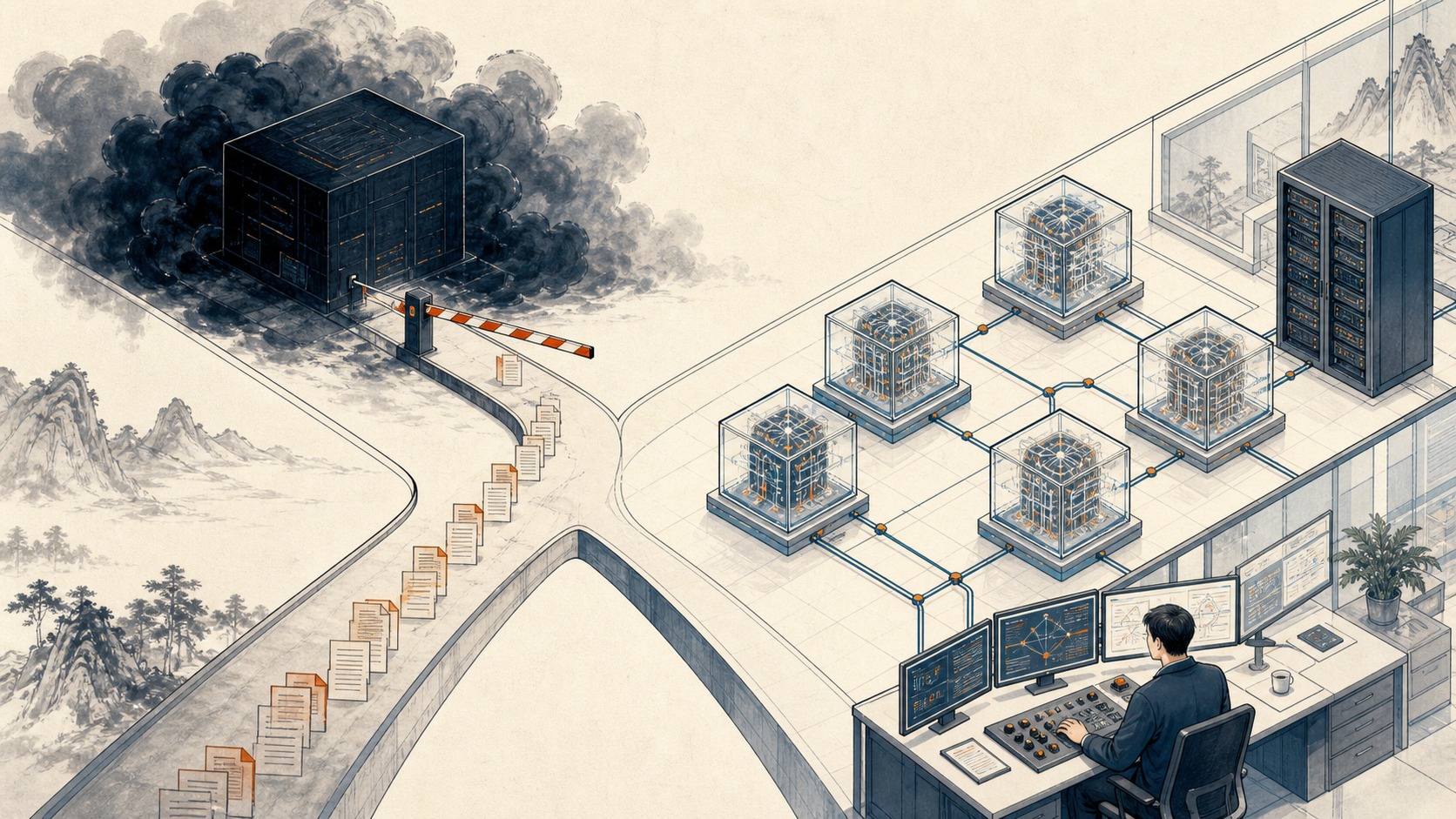
The fight over token prices is really a fight over control
Usage pricing is not inherently wrong. Cloud computing, telecommunications, and payments all charge by use. The problem appears when one supplier defines the meter, decides which use is allowed, and owns the switching cost.
At first, the model writes summaries, fills tests, and searches documents. A few months later it is connected to the knowledge base, the code agent, the support system, and the company’s institutional language. By then, changing vendors is not an API-key swap. It means rebuilding context, evaluations, access controls, prompt patterns, tool chains, and habits.
That is why the phrase “token capital” has bite. The party that owns the weights, inference infrastructure, user interaction, and learning loop is not merely selling compute. It is shaping how other organizations produce intelligence. If that power stays permanently concentrated in a tiny group of firms, customers do not get a simple technology upgrade. They enter a new landlord relationship.
Closed frontier models may still be the best choice for difficult reasoning, long-horizon coding, or demanding multimodal work. Plenty of organizations will gladly pay for that. The mistake is not using them. The mistake is placing every workflow, every data stream, and every future option behind one provider’s gate.
The practical answer is a portfolio. Use premium closed models where their edge is genuine and the stakes justify the cost. Let lower-cost or privately deployable models handle high-volume, repeatable, verifiable work. Keep core data, evaluations, and routing logic in the buyer’s hands. Model routing should belong to the customer, not only to the vendor.
Open weights are valuable because they return a choice
This is where Chinese open and open-weight model releases deserve to be taken seriously. Qwen, DeepSeek, GLM, Kimi, MiniMax, and others have lowered the barrier to obtaining, testing, adapting, and deploying capable models. Their licenses, training-data disclosures, and commercial conditions differ. “Open weights” is not a synonym for fully open source. But these releases change something important: access to capability no longer has to be rented from two or three overseas labs through a single interface.
The first gain is technical. A small company can deploy a model in its own cloud, its own data center, or a compliant regional environment. A research group can reproduce a result. A developer can measure performance instead of accepting a vendor’s benchmark slide. An industry customer can test several models side by side and let measured outcomes, rather than brand volume, decide where a task goes.
The second gain is economic. Open models are not costless. Deployment, operations, GPUs, and governance all cost money. But the cost moves from an opaque bill that can rise at a supplier’s discretion into an engineering problem that can be estimated, compared, and optimized. For routine work, “good enough, controllable, replaceable” often beats “always best, available only on rent.”
There is also a larger question of distribution. Large models were not created from a vacuum. They absorbed decades of human language, code, papers, books, and public web material. Copyright disputes around training make the point sharply: this is not simply the private invention of any one company. If model capability draws heavily from social knowledge, the gains should not return only as expensive interfaces controlled by a few platforms.
That does not make every training practice legitimate. It does not exempt open models from copyright, privacy, safety, or misuse obligations. If anything, an open path needs clearer licenses, more traceable data governance, stronger safety tooling, and accessible evaluation. Openness does not mean no rules. It means the rules cannot live only inside one company’s dashboard.

“From people, for people” needs a concrete meaning
Releasing weights does not automatically make a company charitable. Firms still compete and expect returns. The useful test is not whether a company claims moral purity. It is whether more people gain practical choices: Can they download? Deploy? Adapt? Move? Can they use the technology without handing over every operational secret?
That is a more concrete version of “from people, for people” in AI. Human knowledge contributed to training. Public education trained researchers. Developers supplied code and evaluations. Demand paid for infrastructure. A healthy return path is not to lock all capability behind a few price sheets and require the world to keep contributing its data and fees. It is to let universities, startups, hospitals, manufacturers, and individual developers use, change, and test models within clear responsibilities.
For China, pushing open and open-weight models outward has value beyond market share. It gives global users a real option when budgets are tight, data is sensitive, languages are complex, or dependence on one provider is unacceptable. Distributed capability is more meaningful than a slogan about access.
Ask harder questions before buying the next model
The next procurement review should spend less time on a leaderboard rank and more time on questions that are harder for vendors to answer:
- • When the model refuses, falls back, or changes, can we see the reason and version?
- • Who owns our prompts, tool traces, memory, and corrections, and can we export them completely?
- • If price, rate limits, or policy changes, how quickly can the business move?
- • Which jobs truly need a premium closed model, and which can run locally or on an open model?
- • Do we own the evaluation set, access system, and model router, or have we outsourced judgment to a supplier?
Those questions will not make a company use less AI. They will make it use AI with fewer blind spots. The best model is not the one that turns every organization into a passive consumer. It is the one that leaves people able to judge, migrate, and build again.
Once intelligence is locked inside a meter, openness stops being a romantic accessory. It becomes one condition for competitive markets, organizational agency, and wider access to the technology’s gains. The contest is not over whose chat window sounds most impressive. It is over who gets to turn intelligence into a tool of their own.
Comments
0 public responses
All visitors can read comments. Sign in to join the discussion.
Log in to comment