When Model Weights Cross Borders: Two AI Routes Are Taking Shape
The debate around Chinese open-weight models in the U.S. and the signal from Shanghai’s WAIC reveal two competing ways to distribute AI capability.
When Model Weights Cross Borders: Two AI Routes Are Taking Shape
At Shanghai's WAIC, the queue started early. Inside, the striking thing was not simply another parameter count or robot demo. It was a proposition: AI should not be reserved for the small group of companies that can afford the highest-priced API.
At almost the same moment, a debate resurfaced in Washington over tighter controls on Chinese open models. Kimi K3 has become a useful focal point: when an open-weight model gets close enough to the frontier, the question is no longer simply whether it works. It is who loses volume, margins, and pricing power if it does.
Put those two developments together and the AI contest looks less like a single race. The United States still holds extraordinary advantages in frontier closed models, chips, cloud platforms, and research institutions. China is putting more of its chips on open weights, lower-cost deployment, vertical adoption, and broad distribution. The two approaches overlap, but they are beginning to pull the global ecosystem toward different operating systems.
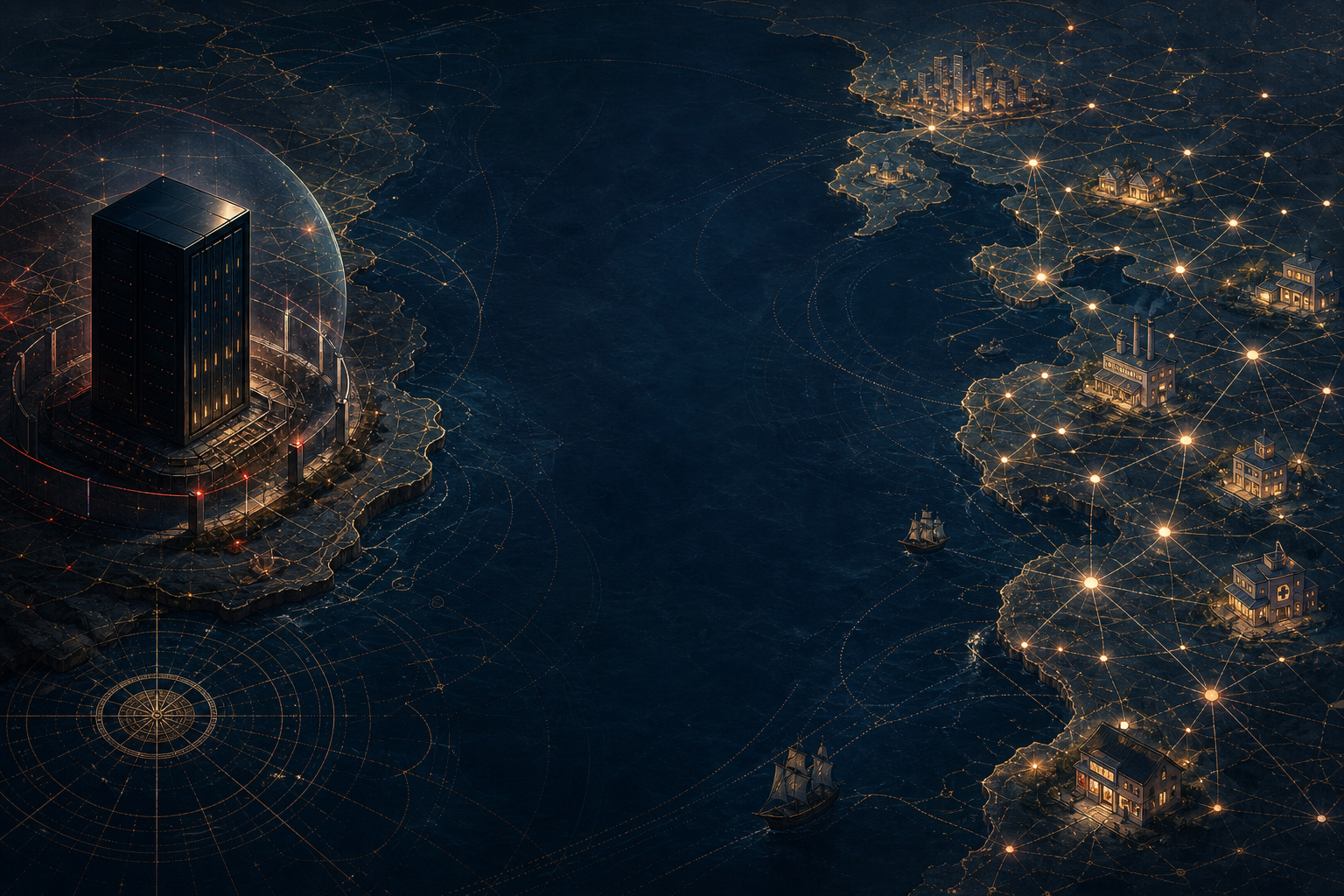
“Ban Chinese models” is not an accurate description—at least not yet
The public reporting describes an internal U.S. policy discussion, not an enacted blanket prohibition on every Chinese open model. That distinction matters.
Washington has many ways to make a model harder to use: entity-list designations, procurement rules, security reviews in sensitive sectors, compliance duties for cloud providers and contractors, and formal risk warnings to businesses. Such measures could meaningfully exclude certain models from parts of the U.S. market—especially government, defense-adjacent, financial, and other high-sensitivity environments.
But a widely distributed weight file is not a hosted service. Regulators can target the commercial doorway of a provider: its cloud access, payments, servers, and customers. It is far harder to control a model that has already been downloaded, mirrored, quantized, fine-tuned, and operated in many private environments. GPU shipments can be stopped at a border. Model weights, once embedded in developer and enterprise toolchains, travel through a much more diffuse network.
That is why the conversation has intensified around models such as Kimi K3. Capability parity is only the beginning. The more consequential change is substitutability.
The security case is real. So is the commercial pressure.
It would be careless to dismiss every concern as protectionism. Any company that sends source code, customer records, research files, or operational data to an external model needs to consider data exposure, supply-chain risk, auditability, incident response, and dependency. With open weights, the question also becomes: who deployed the model, in which environment, and with what modifications? Governments and critical-infrastructure operators have legitimate reasons to set boundaries.
The complication is that security and industrial interest are now tightly entangled.
The most expensive closed models do not sell tokens alone. They sell continual updates, enterprise support, accountability, connectors, and deeply integrated workflows. Yet for many coding, support, document, knowledge-retrieval, and domain-reasoning jobs, buyers do not need the absolute strongest model on every benchmark. They need a model that is capable enough, fast enough, deployable inside their data perimeter, and not ruinous to run.
Once an open model narrows the performance gap to an acceptable range, a tenfold cost difference becomes a boardroom issue. Application platforms can route tasks across models. Cloud providers can offer managed versions. Companies can run a model locally and tune it for their own workflows. Closed labs retain important advantages—particularly at the frontier, in reliability engineering, safety operations, and product quality—but their price premium is no longer self-justifying.
Any U.S. policy tightening would likely be argued in the language of security. It could also, in practice, protect the price band of domestic closed-model services. Both statements can be true. The danger is turning “security” into a label broad enough to avoid clear limits, evidence, or review.
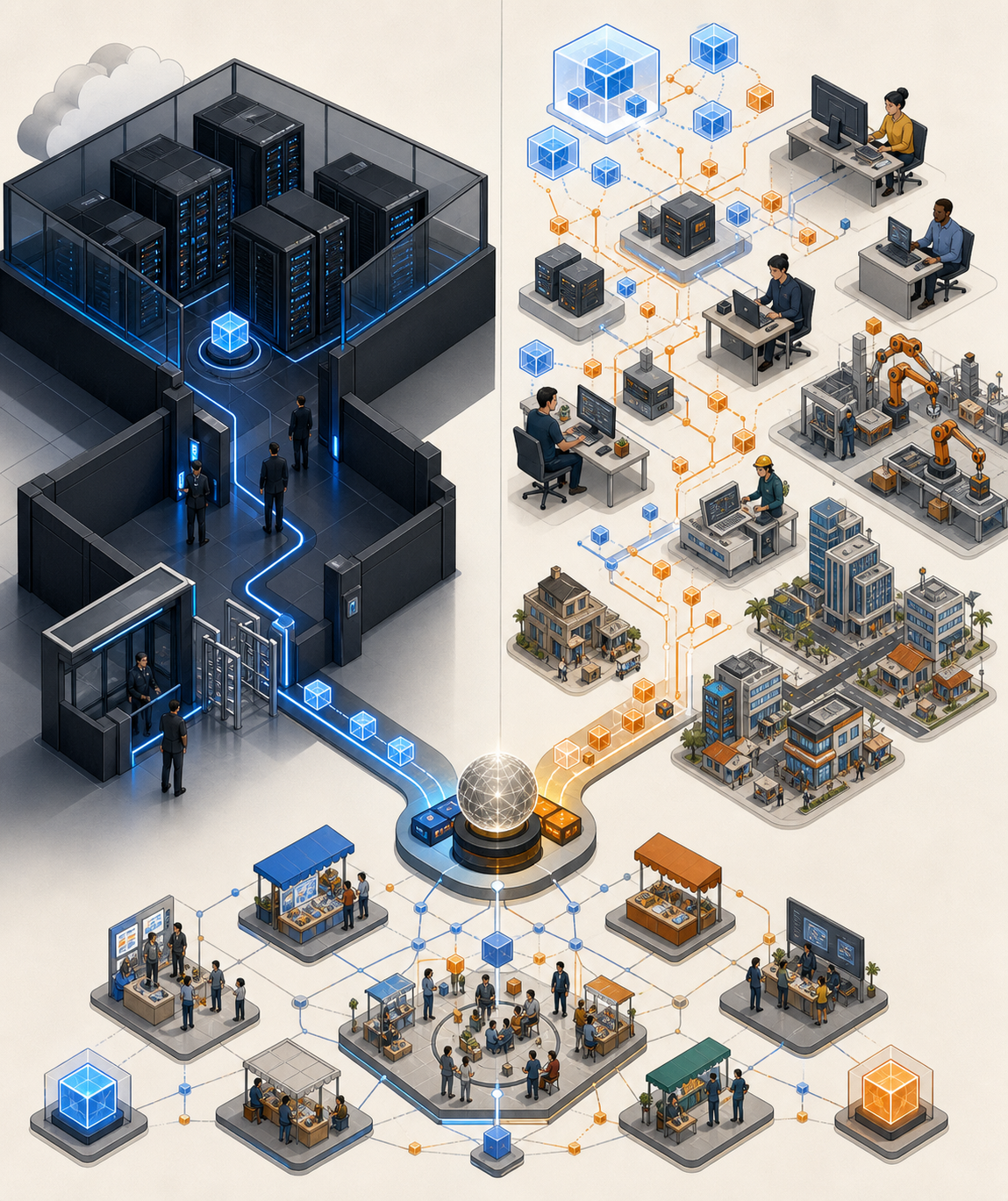
Shanghai's answer: do not just sell a model; bring capability to the worksite
The energy around WAIC and the launch of the World AI Cooperation Organization (WAICO) point in the same direction: China is competing not just for a leaderboard position, but for the on-ramp through which AI reaches more countries and more industries.
That strategy is bigger than open weights. It combines models, compute, agent platforms, vertical solutions, devices, and localized services. For companies in Southeast Asia, Africa, Latin America, and parts of Europe, the scarce resource is not always another eloquent chatbot. It may be an AI stack that runs within local-language, budget, connectivity, and data-governance constraints.
That is what makes the WAIC floor more interesting than a parameter chart. Robots moving materials, agents entering enterprise services, devices becoming model endpoints—none of this alone proves technological supremacy. It does create the conditions for diffusion. The vendor that can turn a model into fewer factory stoppages, less duplicate paperwork in a clinic, or a shorter cross-border sales cycle is more likely to build a lasting technical relationship.
Open weights are not a romantic slogan in this story. They are a way into a market: local cloud providers can deploy them, integrators can adapt them, and companies can keep data within their own boundaries. The hard work begins afterward. Licenses must be clear; patches must be maintained; compute must be affordable; developers need support. Openness is not the act of releasing weights. It is the creation of a durable ecosystem around them.
The gunpowder analogy matters—if we do not flatten history
It is tempting to compare AI with gunpowder. The comparison has force. Both amplify human power: they can be used for protection and production, but also for intrusion, exploitation, and attack. Models can assist doctors, teachers, and engineers; they can also be misused for vulnerability discovery, fraud automation, and manipulation at scale. Safety is not an optional add-on.
But the deeper lesson from the history of gunpowder is not that technology should be permanently locked behind national walls. Technologies travel through trade, talent, papers, software, hardware, and commercial demand. Total containment often shifts competition into substitutes, grey channels, and more distributed ecosystems. The painful lesson of late Qing China was not that gunpowder reached Europe. It was that an institutional system failed to keep learning, absorbing, and remaking technology.
The United States is not becoming a closed empire, and it would be careless to describe an ongoing policy debate in those terms. Still, the directional parallel is worth noticing. When a leading power increasingly treats technical advantage as a privilege to be sealed away, it may preserve revenue and control for a time. It may also push developers, use cases, and future industrial networks elsewhere.

The real contest is over who enables more people to build
America's closed-model route will not disappear. Frontier training requires capital, chips, talent, and formidable execution. Enterprises will continue to pay for reliability, security, and leading-edge capability. China's open route offers no automatic victory either. Open models must keep improving, carry their share of safety responsibility, and earn trust through governance and service in international markets.
But the measuring stick is changing. We used to watch a model launch and ask only: who is number one? The more durable questions are now different. Can the model be deployed across countries? Can developers adapt it? Can smaller businesses afford it? Does it generate value inside real workflows?
The crowd in Shanghai and the anxiety around open models in Washington are both signals of that shift. A model is no longer merely a laboratory trophy. It is becoming infrastructure. One side may want to control the gates more tightly; the other may want to pave more roads. History does not automatically reward either. But once a technology genuinely enters society, the system that tends to matter most is not the one with the tallest wall. It is the one that gives more people a working connection.
Comments
0 public responses
All visitors can read comments. Sign in to join the discussion.
Log in to comment