CXMT at RMB 3.5 Trillion: The DRAM Catch-Up, AI Cycle and Supply-Chain Re-rating Behind China’s Biggest Semiconductor Bet
CXMT’s debut valuation prices a scarce Chinese DRAM platform, an AI memory upcycle and strategic supply-chain value—not proof that it has overtaken the global memory leaders.
CXMT at RMB 3.5 Trillion: The DRAM Catch-Up, AI Cycle and Supply-Chain Re-rating Behind China’s Biggest Semiconductor Bet
On July 27, ChangXin Memory Technologies (CXMT) was briefly valued at roughly RMB 3.5 trillion on its first day of STAR Market trading. The number looks startling: how can a Chinese DRAM producer be priced at the scale of the world’s largest semiconductor franchises? The answer is not that CXMT has already surpassed Samsung, SK hynix or Micron across memory technology. It has not. The market is pricing three options at once: a scarce Chinese DRAM platform, an AI-driven memory upcycle, and a strategic domestic-supply-chain asset.

That is why a one-day share-price move is an inadequate way to analyze CXMT. It is neither an Intel-like general-compute business nor, yet, an HBM leader. It is a DRAM manufacturer that has moved into DDR5 and LPDDR5X production, occupies a singular position in China’s substitution drive, and has seen years of future capacity, qualification and policy support capitalized into its market value.
First, the facts that should not be blurred
The company is ChangXin Memory Technologies, or CXMT—not “Changxin Technology” as a generic technology label. CNBC reported on July 27 that the Shanghai listing was priced at RMB 8.66 per share and raised RMB 57.92 billion; the stock was then trading around RMB 52, implying a market capitalization of about RMB 3.5 trillion. That is a gain of roughly 500%. Such a first-day move reflects a constrained free float and concentrated demand as much as it reflects a change in operating fundamentals.
The valuation scale matters. Reuters, citing the prospectus, reported 2025 revenue of RMB 61.8 billion. At a RMB 3.5 trillion market value, the trailing price-to-sales multiple is about 56.6x. The prospectus expected RMB 110–120 billion of revenue in the first half of 2026. Even if that figure is mechanically annualized—which is not a forecast in a notoriously cyclical DRAM market—the resulting sales multiple remains about 14.6–15.9x.
It is fair to describe an Intel comparison as a date-specific market-capitalization event. It is not evidence that CXMT has exceeded Intel in revenue, technology breadth, profitability or operating capability. Market capitalization is marginal share price multiplied by all shares outstanding; on an IPO debut, it can amplify expectations unusually quickly.
What CXMT makes: mainstream next-generation DRAM, not public HBM leadership
CXMT’s public catalogue lists DDR4, DDR5, LPDDR4X and LPDDR5/5X. Its DDR5 product page lists up to 8,000Mbps and 16Gb/24Gb die densities. Its LPDDR5X page lists up to 10,667Mbps and 12Gb/16Gb die densities. The company says the 8,533Mbps and 9,600Mbps LPDDR5X products entered mass production in May 2025; the 10,667Mbps product was available for customer sampling.
Those facts support two conclusions that are both important. CXMT is no longer simply a domestic DDR4 substitute: it has entered the DDR5/LPDDR5X generation needed in modern phones, notebooks and servers, with specifications in a global mainstream range. But its public catalogue does not list HBM. HBM is not ordinary DRAM stacked higher. It combines process control, TSV and advanced packaging, thermal management, test, accelerator-platform co-validation and long customer-qualification cycles. SK hynix, Samsung and Micron have multiple generations of production, major accelerator-customer validation and ecosystem integration there. Reuters likewise identifies HBM as an area where CXMT remains behind the leading three suppliers.
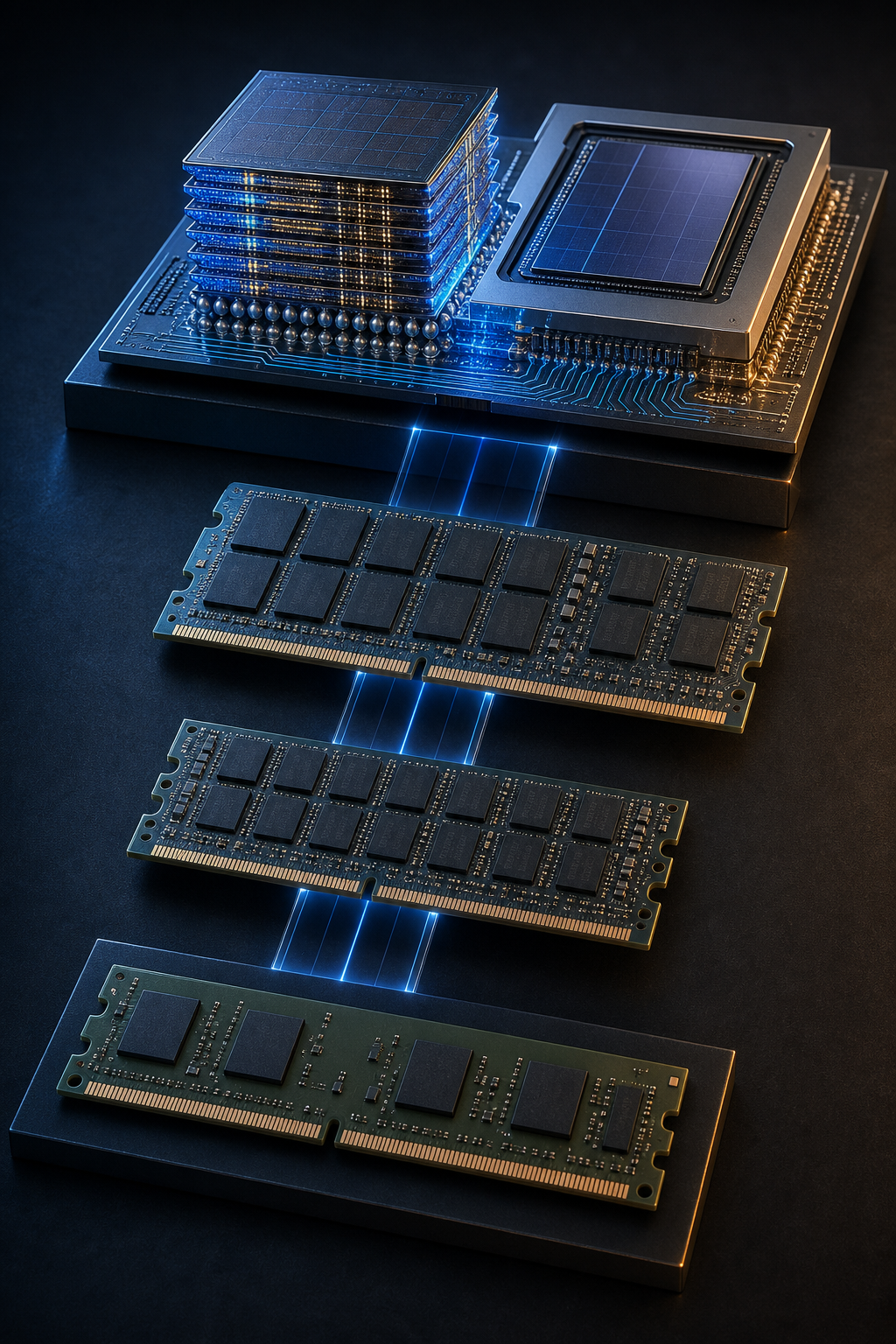
Process-node comparisons also require restraint. DRAM companies commonly use 1x, 1y, 1z, 1α and 1β generation labels; these cannot be converted mechanically into a single nanometer ranking across companies. CXMT does not disclose a directly comparable production node on the cited public product pages. Product generation, speed, density, production status, HBM capability and customer qualification are more defensible comparisons than an unverified “XXnm” claim.
Head-to-head with Samsung, SK hynix and Micron: CXMT’s edge is availability in China, not full-line technological supremacy
- Products and technology: Samsung, SK hynix and Micron span advanced DDR5, LPDDR5X, server DRAM, graphics memory and HBM, supported by mature global qualification. SK hynix has said its HBM3E can process up to 1.15TB per second. These high-value AI-memory products are where the leaders’ profit pools and barriers are deepest. CXMT’s DDR5/LPDDR5X progress is consequential, but it is not equivalent to HBM competitiveness.
- Manufacturing and yield: The incumbents’ advantage is cumulative: process iteration, equipment integration, defect control, packaging, test and reliable high-volume delivery. CXMT’s advantage is the speed with which a focused, well-capitalized new platform can ramp capacity. The decisive operating metrics are not launch-event specifications but good-die output, yield, power distribution, field reliability and returns at a comparable specification. They are not comprehensively public.
- Customers and supply chain: Chinese phone, PC, server, cloud and AI companies have a reason to reduce geopolitical supply-chain exposure. CXMT can offer shorter logistics, less cross-border compliance uncertainty and local engineering engagement. For buyers with domestic-supply-chain requirements, that is a procurement constraint, not patriotic theater. The reverse is also true: overseas flagship customers still demand long reliability qualification, compatibility, batch consistency and global support.
- Price: No public source provides CXMT, Samsung, SK hynix and Micron’s transaction price for an identical DRAM part, capacity, package and contract term. DRAM pricing is shaped by contract versus spot exposure, capacity, package, power bin, yield, purchase commitments and the supply-demand cycle. It is not sound to write that CXMT is automatically cheaper. In mature DDR4 and some Chinese DDR5/LPDDR5X programs, local supply, settlement, logistics and strategic procurement could produce a lower total cost of ownership. In HBM, global flagship phones and the highest-end server DRAM, the leaders’ performance, certification and scale may outweigh that advantage.
Apple’s reported CXMT testing: significant, but not a confirmed volume win
On July 8, CNBC relayed a Financial Times report that Apple had begun testing CXMT DRAM for devices sold in China and was lobbying the U.S. government for broader permission to use its products. The report cited people familiar with the matter; Apple and CXMT did not immediately respond. It should therefore be described as reported testing and lobbying, not as a confirmed mass-adoption program.
Even testing has three implications. First, Apple needs more than low component prices: it needs stable supply, quality and leverage from a multi-supplier base. Local sourcing can also reduce China-market friction. Second, qualification is long; testing does not equal design-in, and a China-specific design-in would not equal deployment in global models. Third, a broader Apple adoption would most immediately improve CXMT’s quality credential and capacity utilization. It would not automatically make CXMT a substitute for the leaders in HBM or the whole global DRAM market.
Are the U.S. and South Korea “protecting” their memory champions?
The U.S. policy mix does alter the competitive field. Export controls on advanced semiconductor manufacturing equipment and related technology can make it harder for Chinese producers to advance at the leading edge and in HBM. Reuters reported that the U.S. Department of Defense added CXMT to its Chinese Military Company list in June and that an interagency committee had approved—but had not implemented—its addition to the Entity List. In parallel, the CHIPS and Science Act uses subsidies and tax incentives to expand domestic manufacturing, with Micron a major beneficiary. The precise description is not a special price-protection rule for Micron: the U.S. is supporting domestic supply while using technology controls to reshape the boundary of competition.
South Korea likewise treats memory as a strategic industry, and Samsung and SK hynix benefit from a supportive industrial ecosystem. Yet their central moat is still decades of technology, customer relationships and scale, not one protective policy document. For CXMT, the practical external constraints are equipment access, the HBM ecosystem, global qualification and the next downturn in memory pricing.
Why list now?
The timing stacks several favorable forces: AI has lifted memory demand and prices; CXMT began pushing LPDDR5X into production; China’s drive for supply-chain resilience intensified; the company needs large capital for capacity, technology upgrades and R&D; and the Apple-testing report created a narrative of global-customer progress. The prospectus says IPO proceeds will mainly support memory-wafer production and R&D. For CXMT, the listing converts a favorable cycle, strategic-asset status and a capital-market window into long-duration funding.
For investors, that is also the warning. A cyclical manufacturer is often awarded its highest multiple when its earnings look strongest and supply is tightest. The valuation is not simply buying 2026 revenue. It is buying the proposition that CXMT can extend its 7.67% 2025 global DRAM share, keep advancing product generations and turn domestic demand into durable, profitable global competitiveness.
How to think about valuation: not one target, but three conditions that must be met
This is not a price target or investment advice. It is a scenario framework built from publicly reported revenue and the roughly RMB 3.5 trillion debut valuation.
- Manufacturing reversion: DRAM prices ease, margins normalize and advanced-equipment or qualification progress disappoints. If investors begin to value CXMT primarily as a cyclical memory manufacturer rather than a scarce strategic platform, its current high-growth premium must compress materially.
- Execution case: DDR5 and LPDDR5X ship at volume with stable yields; Chinese phone, PC, server and cloud customers produce repeatable orders; and 2026’s strong revenue converts into earnings that survive the second half and later years. In this case, RMB 3.5 trillion is not “cheap”; it is an advance price for high share, high-quality capacity and a long favorable cycle.
- Upside case: Customers such as Apple move demonstrably from testing to volume qualification; domestic AI infrastructure lifts the product mix; market share continues toward the media-cited 15% 2028 expectation; and CXMT shows a credible HBM or critical advanced-packaging path. Only if those conditions arrive in sequence can today’s valuation migrate from sentiment-driven scarcity to a platform supported by fundamentals.
Will every Chinese company buy CXMT memory? No. Procurement is segmented by product, reliability, qualification, cost, supply, customer geography and regulation. Categories most sensitive to supply security, local service and policy alignment are likely to lift domestic content first. Globalized, high-end and certification-heavy products will retain multi-sourcing for a long time. CXMT’s real test is not replacing all imported DRAM overnight. It is becoming the default qualified supplier in each segment it earns.
Conclusion: a long-term entry ticket to China’s DRAM industry, not a certificate that CXMT has already won it
CXMT matters because China now has a platform capable of competing in mainstream DRAM generations, production scale and public-capital markets. Its limitations are equally visible: advanced HBM, frontier manufacturing and the global customer ecosystem remain works in progress. The RMB 3.5 trillion valuation compresses both realities into one price: it rewards strategic scarcity while borrowing heavily against execution. The figures worth watching next are not a single day’s ranking, but DDR5/LPDDR5X volume and yield, verified long-term customer adoption, and whether CXMT can cross the HBM and advanced-packaging threshold.
Sources and methodology
- CNBC, July 27, 2026: IPO pricing and proceeds, first-day price and market value, market share, earnings and market commentary.
- Reuters via Yahoo Finance, July 15, 2026: 2025 revenue, 2026H1 outlook, shareholder structure, HBM gap, export-control and regulatory risk.
- CXMT product page: public DDR5 and LPDDR5X specifications.
- CXMT, October 28, 2025: LPDDR5X mass-production and sampling status.
- CNBC relaying Financial Times, July 8, 2026: reported Apple testing and lobbying.
- SK hynix, August 21, 2023: HBM3E technical context used to distinguish HBM from conventional DRAM.
Disclosure: This is industry and valuation research, not a recommendation to buy or sell securities. Apple adoption, regulatory-list developments and future market-share figures that are not confirmed by CXMT are treated as reports or scenarios, not established facts.
Comments
0 public responses
All visitors can read comments. Sign in to join the discussion.
Log in to comment