From Ford’s Assembly Line to an AI Control Layer
AI may first change not a single job, but the cost of handoffs, waiting, and lost context between functions.
From Ford’s Assembly Line to an AI Control Layer: Why Organizations May Move from Division to Integration
For a century, businesses got better by breaking complex work apart. Over the next decade, the scarce capability may be putting it back together.
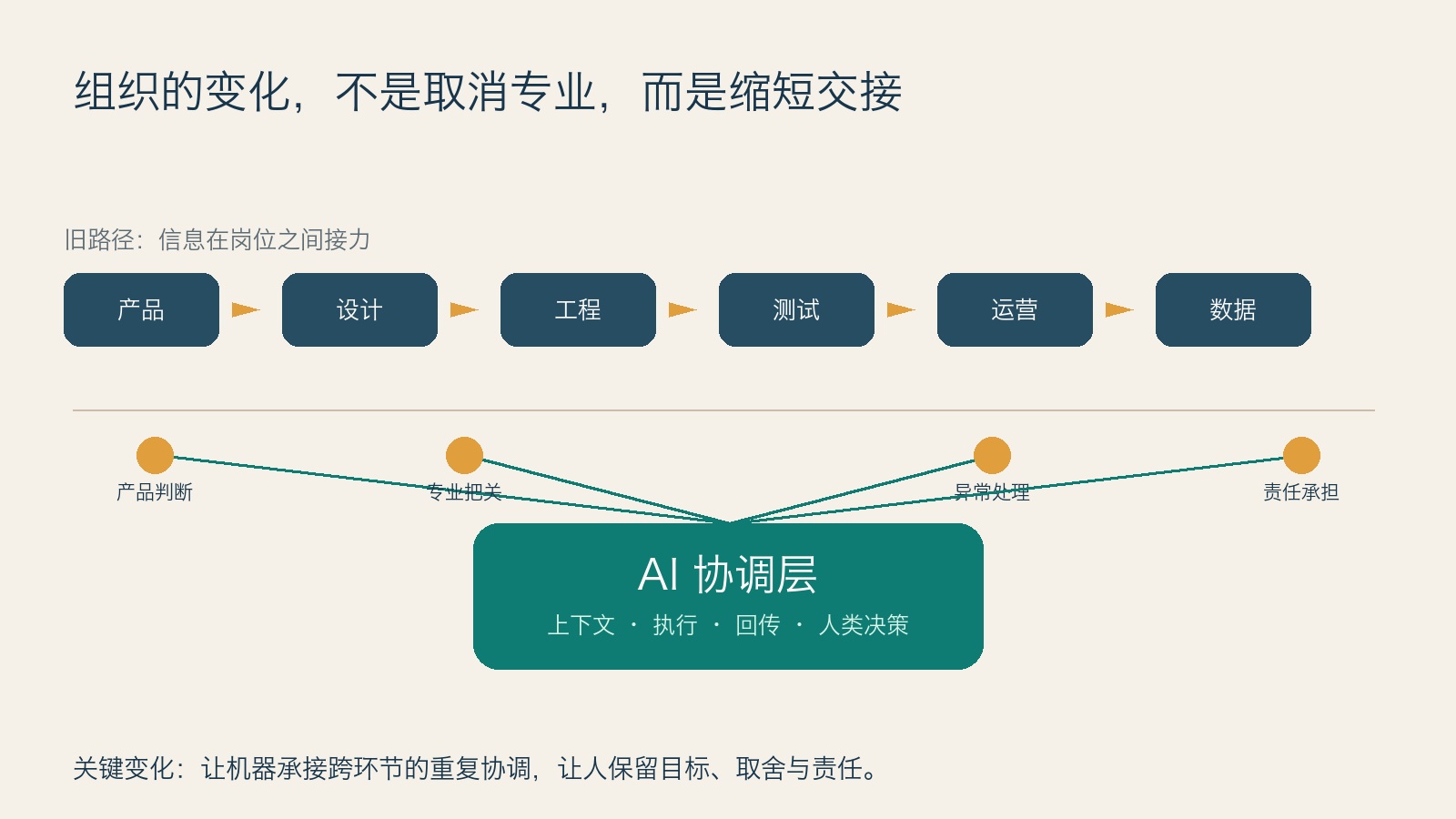
Before an internet product ships, it usually runs a familiar gauntlet: requirements, research, interaction design, visual design, technical review, development, testing, approval, release, instrumentation, analytics, and a retrospective that eventually returns to the product manager.
Every handoff makes sense. Every handoff also waits for the last one to explain itself.
The assembly line was an honest answer to human limits
Ford-style production was not an obsolete management obsession. It was an honest response to human limits. No one person could remember every part, master every process, and design, build, inspect, and sell a car in one working day. So organizations sliced complexity into trainable, handoff-friendly, measurable tasks.
Division of labor produced more than speed. It created scale, consistency, and clear responsibility. Product, design, engineering, monetization, customer service, and data teams still solve the same underlying problem: how do finite people, with finite attention, build something much larger than any one person can hold in their head?
But specialization also piles up coordination cost. A user need is compressed into a document. A design intent gets rewritten by a schedule. A data finding crosses several teams before it reaches the person who asked the original question. In large organizations, the costly thing is often not labor hours. It is lost context.
AI changes the handoff before it changes the job
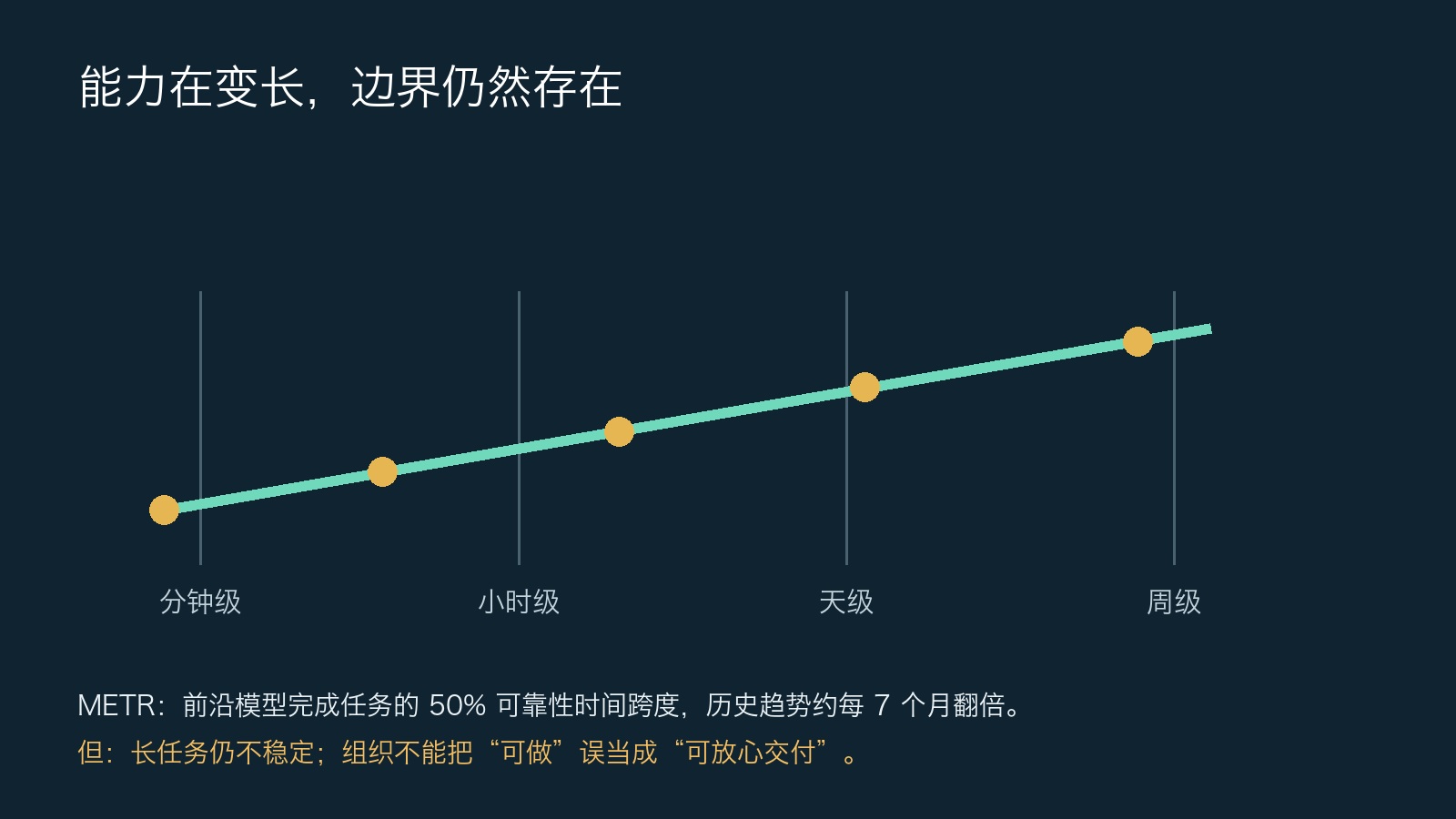
Calling AI an all-knowing god misses the more consequential shift. Today’s models make mistakes, drop constraints, and stumble on long chains of work. They are nowhere near ready to carry a company’s responsibility on their own. METR’s research makes the limit plain: success falls sharply as tasks get longer, even as the historical 50%-reliability task horizon for frontier agents has roughly doubled every seven months.
That is precisely why AI can reshape organizations before it becomes a universal employee. It can already serve as a low-cost, always-on coordination layer with a durable working context. It can hold research, competitor analysis, historical feedback, and product data together; turn a product goal into design options, engineering tasks, and test cases; then trace a post-launch metric back to a release and an assumption.
Work that once demanded a dozen meetings, dozens of messages, and several rounds of “let me sync with the other side” can begin to live in one auditable context chain. AI’s value is not flattening expertise. It is reducing the friction of carrying information between experts.
The evidence is visible at the capability layer, not at the finish line
This is not just a thought experiment. Stanford’s 2025 AI Index reports that 78% of organizations said they were using AI in 2024, up from 55% a year earlier; 71% reported using generative AI in at least one business function. Adoption does not prove a successful redesign. It does show that general-purpose models are moving beyond technical teams into marketing, service, product, and operations—the functions built around handoffs.
Microsoft’s 2025 Work Trend Index, a survey of 31,000 knowledge workers in 31 countries, sees the same direction: 81% of leaders expect to integrate agents moderately or extensively into their AI strategy in the next 12 to 18 months. It is a vendor survey and deserves that discount. Still, its operating picture is concrete: humans set direction, agents run an end-to-end process, and people resolve exceptions.
China adds scale to the pressure. CNNIC reported that China had 249 million users of generative-AI products by the end of 2024. Large-scale use does not automatically create productivity. But when the tools reach everyday work, the competitive question shifts from “Do we have a model?” to “Can we connect one to real workflows, permissions, and data?”
Integration does not mean one AI replaces the company
The more accurate claim is not that division of labor ends. It is that organizations may move from serial roles to a small human team plus an AI coordination layer.
A small team still needs a product leader to frame the problem and make tradeoffs; a commercial leader to judge pricing, channels, and customer commitments; a design leader to protect the experience and brand; and engineering leadership accountable for safety, quality, and release outcomes. The change is that those people spend less time translating intent from one function to the next, and more time talking directly with a shared AI work layer.
- Product: maintains goals, boundaries, priorities, and acceptance criteria—not merely a PRD.
- Commercial: writes revenue, cost, acquisition, and retention constraints directly into product decisions rather than waiting for a report.
- Design: maintains interaction rules, content states, and implementation fidelity instead of handing off a static screen.
- AI coordination: decomposes work, retrieves knowledge, drafts options, calls tools, runs tests, summarizes exceptions, and preserves the trail.
- Humans: set direction, approve critical actions, handle exceptions, and remain accountable to customers, employees, and regulators.
The shorter path saves more than headcount. It saves latency. In uncertain products, fast iteration, and businesses where data needs to return to the decision room immediately, removing a cross-functional handoff means one less queue and one less chance for the original signal to be distorted.
The organization at risk is the one that mistakes workflow for a department boundary
Integration has hard prerequisites. A company cannot throw scattered files, chat histories, and private know-how into a chatbot and expect a control layer to emerge. Without clear permissions, data boundaries, evaluation sets, audit trails, rollback paths, and human approval, AI only amplifies confusion faster.
The World Economic Forum’s Future of Jobs Report 2025 makes the broader point: structural change through 2030 will create and displace large numbers of roles at the same time, while the skill mix shifts. AI may reduce middle-layer transmission, but it does not erase trust, accountability, local knowledge, or conflicts of interest. In highly regulated, physical, or high-risk work, the person who makes the final call cannot disappear.
The early winners, then, may not be the companies that cut the most people. They may be the ones that redesign work first: humans judge, AI connects, and outcomes can be reviewed. They will turn the context now scattered across meetings, spreadsheets, documents, and departments into callable organizational memory. They will turn vague collaboration into task packages with inputs, constraints, acceptance tests, and rollback plans.
The next factory is not just a line
Ford’s assembly line arranged human hands in sequence. The more interesting AI-era structure may be a network: goals, customer feedback, design, code, testing, cost, and operational data moving through a shared context.
That will not turn every company into three people and a model overnight. Nor will it make expertise less valuable. It will concentrate expertise at the points that matter most: deciding what is worth doing, recognizing what must not be done, and taking responsibility when a system produces an answer that looks persuasive.
Industrial organizations used division of labor to cut complex problems down to human size. The next generation will try to gather the context that division scattered. The companies that learn to do that are not simply using AI to go faster. They are rewriting their production function.
Sources
- Stanford HAI, AI Index Report 2025: https://hai.stanford.edu/ai-index/2025-ai-index-report
- METR, Measuring AI Ability to Complete Long Tasks (March 19, 2025): https://metr.org/blog/2025-03-19-measuring-ai-ability-to-complete-long-tasks/
- Microsoft, 2025 Work Trend Index: https://www.microsoft.com/en-us/worklab/work-trend-index/2025-the-year-the-frontier-firm-is-born
- CNNIC, The 55th Statistical Report on China’s Internet Development (2025): https://www.cnnic.cn/n4/2025/0117/c88-11250.html
- World Economic Forum, Future of Jobs Report 2025: https://www.weforum.org/publications/the-future-of-jobs-report-2025/
Comments
0 public responses
All visitors can read comments. Sign in to join the discussion.
Log in to comment