In the AI Era, the Valuable Hire Is the Generalist Who Can Run Agents
AI can execute more work, but it still does not know whether the output is right. The scarce person gathers context, judges the logic, and owns the business result.
In the AI Era, the Valuable Hire Is the Generalist Who Can Run Agents

The awkward moment in a meeting is no longer “who can build this feature?”
It is more often this: the model has produced three plans in ten minutes. The code runs. The interface looks plausible. The slide deck sounds confident. And still nobody wants to approve it, because everyone in the room knows the same thing: the model does not know whether it is right.
That is the real talent shift. The scarce person is not the one who can manually type the most code. It is the person who can gather the right context, direct the agents, spot bad logic, and take responsibility for the result.
Manual execution is no longer the moat
For years, companies solved bottlenecks by adding people to functions. More engineers. More marketers. More product managers. More handoffs. Each role optimized its own corner.
AI is lowering the cost of many local execution tasks. Stanford HAI’s 2025 AI Index reports that 78% of organizations used AI in 2024, up from 55% a year earlier. The World Economic Forum’s Future of Jobs Report 2025 says employers expect 39% of core skills to change by 2030.
That does not make people less important. It changes which part of the person matters. The valuable work moves from doing every step by hand to deciding what should be built, what counts as done, where the risks are, and whether the output can survive contact with customers.
AI’s biggest weakness is missing context
A model treats a request as if the world is clean. A real company is not clean.
Real companies have legacy code, customer promises, channel constraints, brand voice, pricing history, regulatory boundaries, support tickets, a founder’s latest direction, and a large customer whose edge case cannot be broken. If you do not provide that context, the agent builds on empty ground. The building may look elegant. The foundation may sit on top of someone else’s pipes.
The first new human skill is context engineering. Not “write a longer prompt.” Real context engineering means turning scattered company knowledge into an executable work package:
- What outcome are we trying to create?
- What inputs does the agent need: code, meeting notes, customer feedback, competitors, data?
- What constraints are real: budget, time, compliance, stack, brand, permissions?
- What is the acceptance test: runs, reads well, converts, explains itself, rolls back?
- Where must a human approve the next move?
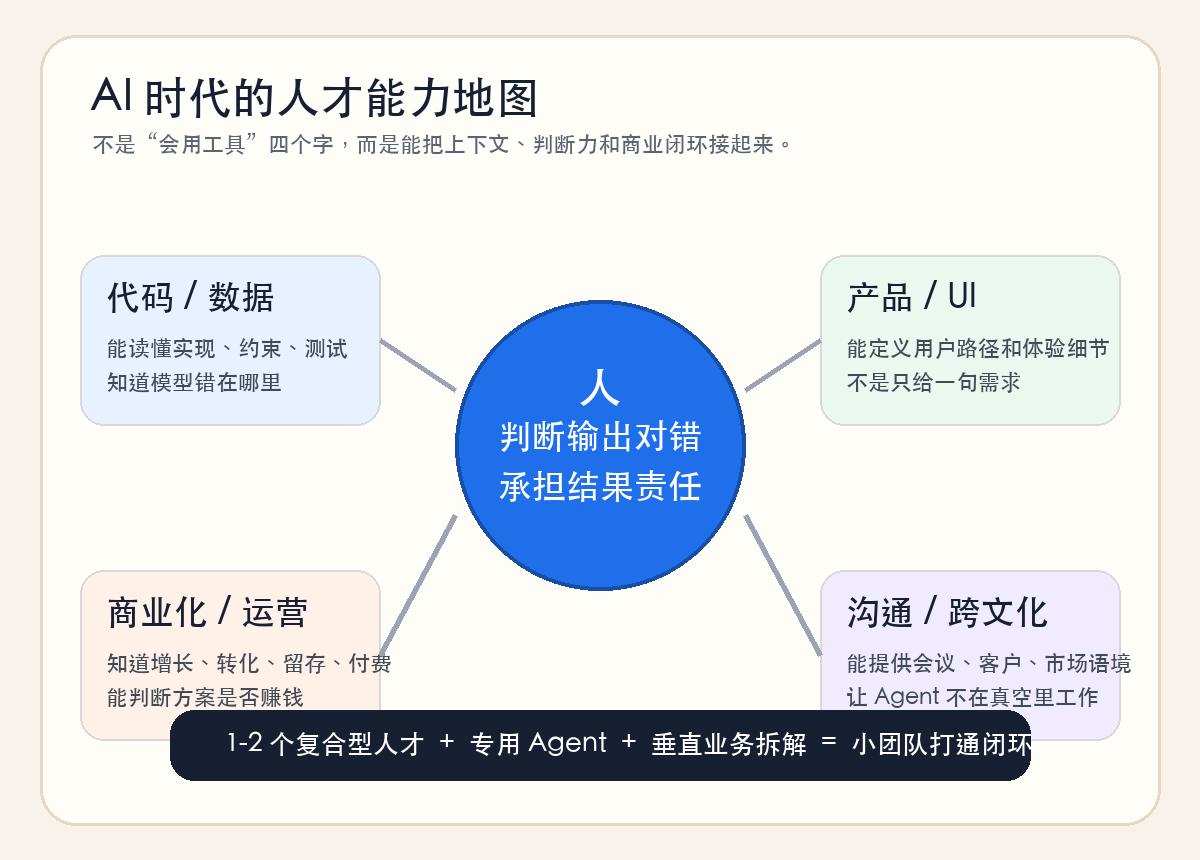
The future looks more generalist than specialist
The WEF list of rising skills includes AI and big data, but it also includes creative thinking, resilience, flexibility, curiosity, lifelong learning, leadership, and social influence. Microsoft’s 2025 Work Trend Index describes the emerging firm as human-led and AI-operated: agents take on more workflows, while humans handle direction, judgment, and relationships.
That runs against the old instinct. Many people assume that as AI gets stronger, humans should become narrower specialists. The opposite is becoming more useful. The more agents can handle local tasks, the more humans have to cross the gaps between those tasks.
A programmer who only understands code becomes vulnerable. Agent-written code is no longer surprising. The valuable programmer knows whether the feature fits the business model, whether it will hurt retention, whether it will raise support costs, whether the checkout flow now leaks users.
A product or operations person who only knows messaging and campaigns also becomes vulnerable. Agents can draft plans, produce assets, segment audiences, and write scripts. The valuable operator understands enough technology to know what can be automated, what needs a data change, and what is only a cosmetic layer over the same broken process.
The new profile is a person who can connect the loop: code, UI, product, monetization, operations, human behavior, and cross-cultural language. Nobody has to be perfect at every layer. But a complete blind spot in any one of them becomes expensive.
Roles will move toward the middle
Programmers need to move upward
Taking tickets and writing functions is not enough. Programmers need to understand revenue models, user journeys, channel costs, customer commitments, and experience details. That is how they move from code labor to agent-enabled outcome owners.
Product and operations people need to move downward
Writing requirements, reading dashboards, and running campaigns is no longer enough. Product and operations people need technical literacy: APIs, data models, permissions, event tracking, automation pipelines, model behavior. They do not need to become full-time engineers. They do need to speak to engineering systems and agents without hand-waving.
Managers need to redesign the work
The manager’s job is not to tell everyone to “use AI.” It is to break the business into vertical, testable work: one goal, one data set, one toolchain, one acceptance standard, one accountable owner. Too many middle steps turn agents into another reporting layer.
Public Chinese media reports recently summarized a ByteDance company letter from Liang Rubo as a push to seek efficiency from the organization itself. That is the useful management idea here. AI-era efficiency is not only fewer meetings. It is fewer handoffs, less empty coordination, and fewer layers that report risk without owning results.
1–2 people plus agents is an operating model, not just headcount cutting
Microsoft’s report says 81% of leaders expect agents to be moderately or extensively integrated into company AI strategy within 12–18 months, and 82% say this is a pivotal year to rethink strategy and operations. The important part is not the survey number alone. It is the shape of the company: less fixed function stacking, more goal-based teams; less human handling of every action, more human direction with agent execution and human review.
A traditional project might line up product, design, frontend, backend, data, operations, ads, and support. In the new mode, one or two strong generalists can coordinate agents to prototype, code, create assets, analyze data, draft support responses, and review conversion. Not every business process works this way. More vertical processes will.
The catch is simple. A weak person plus agents produces garbage faster. A strong person plus agents turns individual judgment into a small operating system.
Train judgment, not tool memorization
Many companies turn AI training into tool demos. A chat tool today, an image tool tomorrow, a spreadsheet automator next week. It feels active and leaves little behind.
The training that matters is more durable:
- Context skill: turning scattered information into executable work packages.
- Judgment skill: finding logical, product, commercial, and cultural errors in model output.
- Loop-closing skill: moving from request to release, data, review, and iteration instead of stopping at “nice plan.”
The AI era does not need a tiny priesthood of “AI experts.” It needs people who can stand close to the business, understand enough technology, read users, break work into tasks, and approve results. We used to call these people strong operators. Now they look more like one-person teams with agents attached.
The busiest person in the room may not be the fastest typist. It may be the person asking, again and again: Do we have enough context? Is this logic true? Can this ship? Who owns the result?
Sources
- World Economic Forum, Future of Jobs Report 2025: based on more than 1,000 employers covering over 14 million workers; employers expect 39% of core skills to change by 2030.
- WEF skills summary: AI and big data, technological literacy, creative thinking, resilience, lifelong learning, leadership, and social influence are rising skills.
- Microsoft 2025 Work Trend Index: 31,000 workers across 31 countries; 82% of leaders say this is a pivotal year to rethink strategy and operations, and 81% expect agents to be moderately or extensively integrated into AI strategy in the next 12–18 months.
- Stanford HAI 2025 AI Index: 78% of organizations reported using AI in 2024, up from 55% the year before; demanding benchmarks including SWE-bench improved sharply.
Comments
0 public responses
All visitors can read comments. Sign in to join the discussion.
Log in to comment