Qwen-Audio-3.0-Realtime: Voice Agents Are Learning to Listen While They Work
Alibaba’s new realtime voice family brings interruption handling, tool use, and live conversation together. It shares GPT-Live’s user-facing ambition, but public evidence does not show identical underlying architecture.
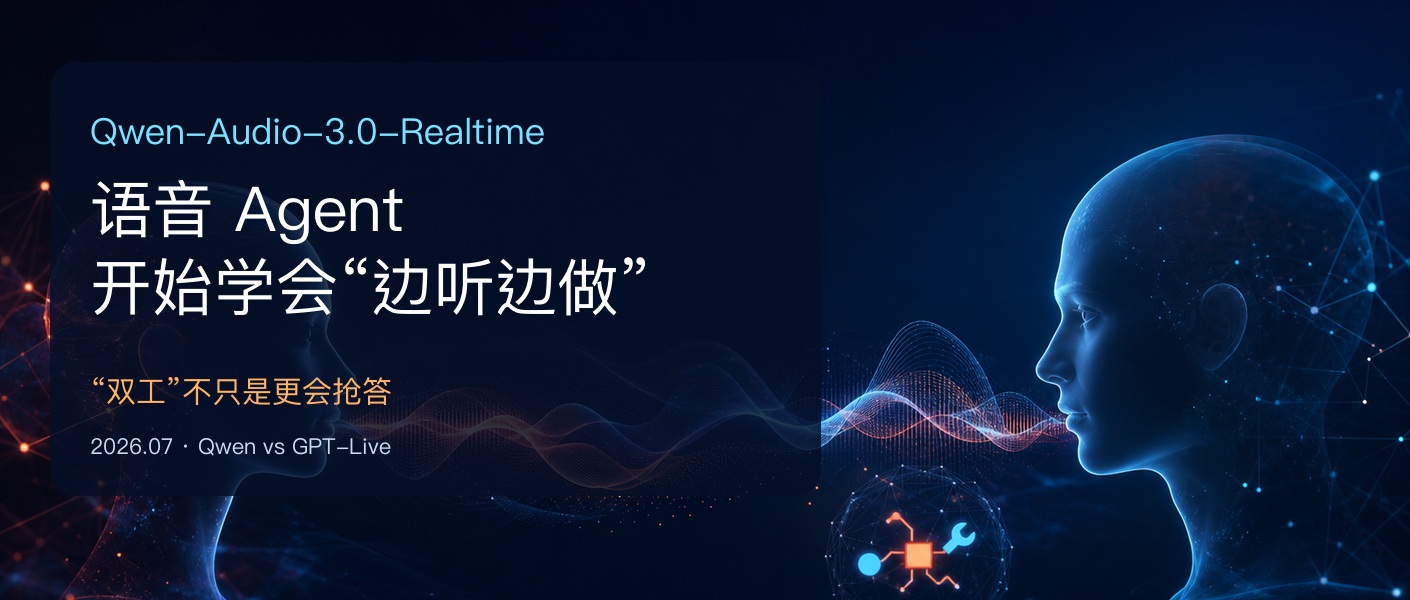
On a commute, a user says into their earbuds: “Move it to the afternoon—wait, not today. Friday.”
That is exactly the sentence old voice assistants hate. They either execute the first half too early or mistake a tiny pause for the end of a turn. The problem is not merely that a voice sounds synthetic. It is that the system does not know when to stay quiet, and cannot keep listening while it is already talking.
Alibaba released Qwen-Audio-3.0-Realtime on July 15. The important part is not another speech-synthesis upgrade. The new family brings realtime conversation, agentic tool use, paralinguistic understanding, and interruption handling into one product path: listen, decide whether to act, call a service, retain the result, and return to the conversation without making the user stare at a loading screen.
The precise verdict is this: the public description places Qwen-Audio-3.0-Realtime in the same “listen while speaking, interruptible” interaction race as GPT-Live; public Qwen materials do not yet disclose a model architecture explicitly called full-duplex in the way OpenAI does. It is reasonable to compare the intended experience. It is not yet rigorous to claim a proven identity of underlying implementation.
What Alibaba actually shipped
Public reporting describes a Plus and a Flash variant: Plus for stronger reasoning and harder tasks, Flash for faster everyday responses. Alibaba Cloud’s Model Studio speech-to-speech documentation already lists qwen-audio-3.0-realtime-plus and qwen-audio-3.0-realtime-flash, both accessed through WebSocket. That matters: this is not only a consumer demo; it has entered an integration surface for developers.
Alibaba’s launch messaging organizes the upgrade around four lines: reasoning, agent tool calls, empathetic conversation, and duplex interaction. The reported details include Plus scores of 92.5 with standard prompts and 90.5 with colloquial prompts on the VoiceBench voice-QA benchmark; use of maps, APIs, and knowledge bases; recognition of cues such as laughter and sighs; and the ability to talk while listening and be interrupted. Those scores and experience claims currently come primarily through launch reporting. Teams should still validate on their own accents, noisy audio, tools, and task distribution.
Three selection cards that matter more than a giant comparison table
- You need voice connected to business systems. Qwen’s interesting claim is not just that it chats more smoothly. It is the realtime WebSocket path plus Function Calling. Model Studio explicitly says Qwen-Audio Realtime supports Function Calling, and currently presents Plus for semantic-VAD voice-assistant/customer-service scenarios with Function Calling. Maps, tickets, CRM, inventory, and a company knowledge base are the real test.
- You need hands-free or companion-like conversation. Interruptions, pauses, tone, and paralinguistic signals determine whether a person treats an assistant as something they can naturally interject into. Do not only measure average latency. Record 30 seconds of actual dialogue and deliberately add corrections, silence, coughs, and another person speaking nearby.
- You want an experience “like GPT-Live.” Separate product surface from developer surface first. GPT-Live is a consumer ChatGPT voice experience. Qwen-Audio-3.0-Realtime is a callable model interface. Both target continuous interaction, but they give builders different control, tool connections, and rollout paths.
Is it full-duplex in the same way as GPT-Live?
At the interaction level, it is close. At the architecture level, do not draw an equals sign.
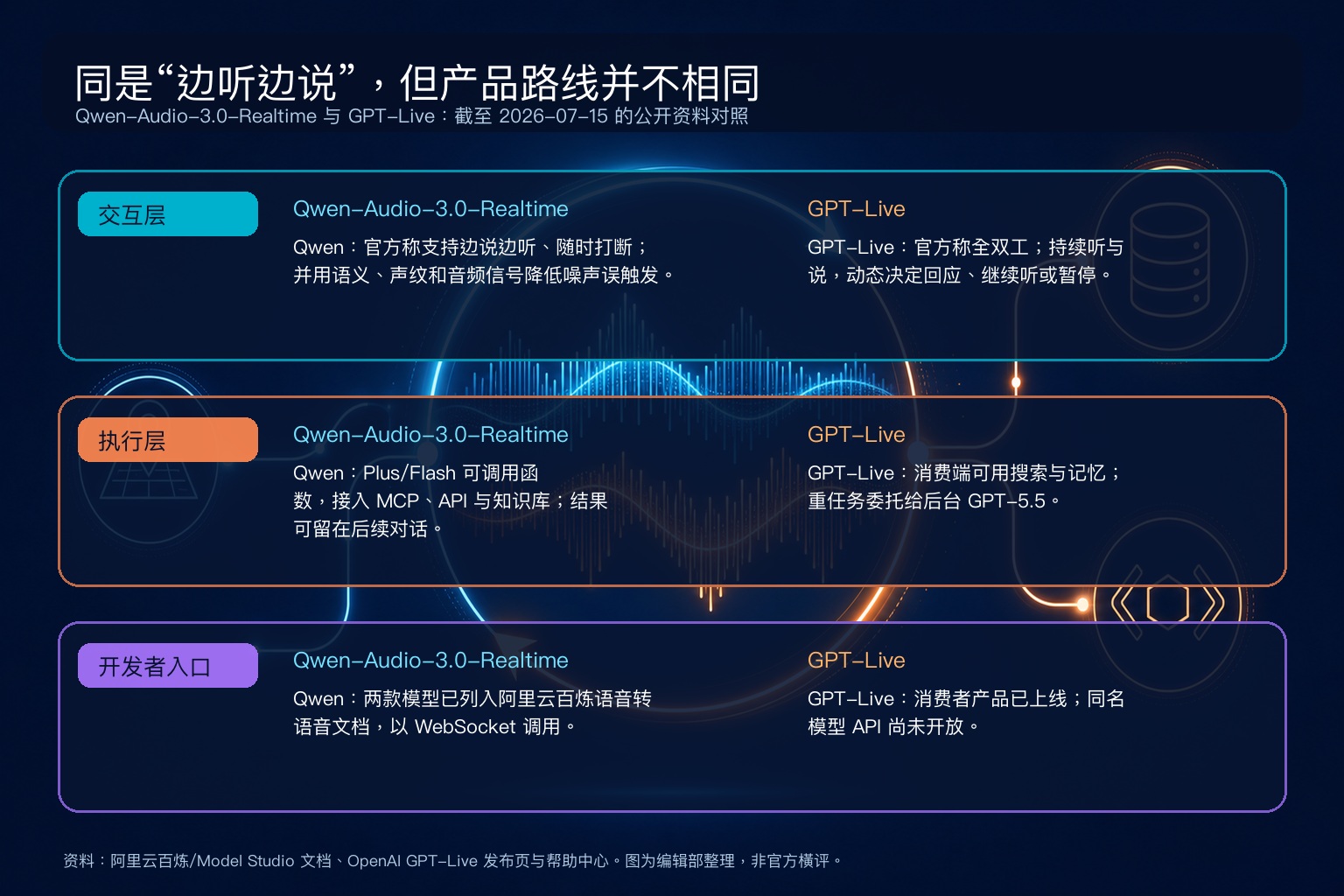
OpenAI is unambiguous about GPT-Live: GPT-Live-1 and GPT-Live-1 mini are full-duplex models that can continuously listen and respond, deciding in the moment whether to speak, keep listening, pause, or interrupt. GPT-Live can also delegate search, deeper reasoning, and longer-running work to a background model while maintaining the foreground conversation. OpenAI’s help center explicitly says that Live can listen and speak at the same time.
On the Qwen side, the public release description says “talk while listening” and “interrupt at any time,” and says the system combines audio, semantics, and voiceprint signals to reduce accidental triggers from background noise. Model Studio provides the more operational entry point: realtime speech models run through WebSocket; semantic VAD can filter irrelevant backchannels and noise; and Qwen-Audio Realtime supports function calls. That is enough to establish that Qwen is attacking the same user problem—who should speak, when should the system stop, and what should it do after it understands you?
But “full-duplex” is too often used as a universal marketing adjective. It can refer to at least three different things:
- Bidirectional streaming. Audio travels upstream and downstream at the same time. WebRTC and WebSocket can both carry continuous streams; that alone does not create natural dialogue.
- Concurrent interaction decisions. While audio is playing, the system still understands new user speech and decides whether to continue, pause, yield, or give a small acknowledgment. GPT-Live explicitly describes this behavior; Qwen’s release claims point to a closely related experience.
- Native full-duplex model design. How overlapping input and output audio are represented, trained, and resolved on a shared timeline. This is the strongest technical claim. The publicly discoverable Qwen-Audio-3.0-Realtime materials do not currently expose enough architecture detail to confirm it.
The useful developer conclusion is not a binary yes/no: treat it as a duplex voice-agent path worth an immediate proof of concept; do not turn “the same as GPT-Live” into an asserted fact about the model internals.
The more valuable change: voice is no longer merely I/O
Earlier voice products often chained together speech-to-text, an LLM, and text-to-speech. When any stage hesitated, the user heard an awkward gap.
This generation changes the question. The frontend must keep conversational rhythm while the system does work in the background. Qwen’s tool calling and GPT-Live’s delegation are not the same product design, but they meet the same commercial need. Support has to look up an order. Sales has to read CRM. A tutor has to query a problem bank. A travel assistant has to find a route. The user should not have to hand their attention back to a screen because an API needs a few seconds.
That distinction also exposes a common trap. An assistant that says “I’m checking” in a lovely voice is not automatically a reliable agent. A production version needs:
- explicit tool permissions and confirmations, particularly for payments, changes, deletions, and sending messages;
- recoverable task state, so a mid-sentence interruption does not erase what the system already found;
- a separate record of tool results and spoken answers for audit and review;
- stress tests for wake words, interruptions, nearby voices, and noise—not just first-packet latency in a quiet conference room.
A seven-day validation plan
If you are building customer support, education, in-car software, earbuds, tours, or interactive characters, do not wait for a leaderboard declaring a winner. Run the same script for one week:
- Twenty real conversations: every one includes a correction, an interruption, and a one-to-three-second pause.
- Three noise conditions: office chatter, road noise, television in the background. Record false wakeups and false interruptions.
- Five tool tasks: order lookup, knowledge retrieval, maps, CRM writeback, and human handoff. Measure tool success and recovery.
- Two latency metrics that cannot be skipped: time from user stop to first meaningful audio, and time to stop or redirect after a user cuts in.
- Score “likeable” separately from “reliable”: tone naturalness, task completion, hallucinated actions, and sensitive-action confirmation should not be blended into one vanity score.
A VoiceBench score is a signal. Whether users will speak to the product for ten minutes—and trust it to look up a real order—is the product score.
What public comparison material exists—and what does not
As of this article’s research cut-off, July 15, 2026, primary material is available through Alibaba Cloud Model Studio’s model/capability documentation and OpenAI’s GPT-Live release and help pages. We did not find an official Alibaba or OpenAI comparison image, common benchmark chart, or head-to-head demo video specifically for Qwen-Audio-3.0-Realtime versus GPT-Live. Third-party comparisons of GPT-Live and Gemini Live exist, but they are not a substitute for Qwen testing.
The capability map in this article is an editorial synthesis of public material, clearly labeled as not an official benchmark. Its job is to help a team decide which proof of concept to build first—not to declare a winner for either company.
The next voice interface will not win by filling every second with better speech. It will win by hearing a correction, taking the right action, and staying quiet when silence is the more intelligent response. Qwen-Audio-3.0-Realtime is worth watching because it puts all three on the same product sheet.
Sources
- Alibaba Cloud Model Studio: speech-to-speech models and access
- Alibaba Cloud Model Studio: Qwen-Omni Realtime events and session parameters
- NetEase Tech launch report, including VoiceBench and feature details
- OpenAI: Introducing GPT-Live
- OpenAI Help: ChatGPT Voice and Live availability/limits
- OpenAI: GPT-Live system card
Comments
0 public responses
All visitors can read comments. Sign in to join the discussion.
Log in to comment