Why Carmakers Want Control of Batteries—and Why China Is Looking Beyond Cars
Carmakers are moving battery design and validation in-house without necessarily owning cell factories. China’s new industrial plan broadens the contest to storage systems, multiple battery technologies, AI-assisted engineering, and tighter governance.
In September 2026, Li Auto brought its in-house battery program into public view. On September 21, company president Ma Donghui explained how the work would be divided: Li Auto would develop the cells and contract battery companies to manufacture them, while developing and producing the battery packs itself.[1]
A week later, China’s Ministry of Industry and Information Technology and six other departments released the 15th Five-Year Plan for the Development of the New Battery Industry. The document, dated September 14 and published on September 28, brings battery-system integration, artificial intelligence, energy-storage applications, and industry governance into a single policy framework.[2]
Taken together, the two developments point to a shift in how the battery industry divides responsibility. Carmakers want a role earlier in the battery-design process, while the Chinese government wants the country’s existing industrial strengths to extend into more technologies and applications. Ownership of the factory, the technology, and the operating data may ultimately rest with different parties.
In-house development starts with control over the specification
The battery a vehicle needs is defined by far more than capacity. Carmakers must decide how much space the chassis can allocate to the pack, how much power is permissible at low temperatures, how heat should be controlled during fast charging, and how protection strategies should change as the battery ages. Cell design, thermal management, and control software all meet at boundaries that have to be set together.
Li Auto’s case for in-house development is built around connecting those decisions. In an interview published by The Economic Observer on September 24, company executives discussed linking production data, vehicle performance, and after-sales responsibility, while relying on manufacturing partners’ accumulated process and management expertise to make the cells. Ma also acknowledged that in-house development may not be cheaper than external procurement: R&D spending is itself a cost.[1]
That gives “making your own battery” a more precise meaning. A carmaker can define the material system, cell structure, and validation requirements, then outsource manufacturing to a specialist. It can invest in a cell factory within its corporate group. Or it can retain control of the pack and battery-management system while jointly developing cells with a supplier. All three approaches may be described at a product launch as “in-house development,” even though they entail very different capital commitments and divisions of responsibility.
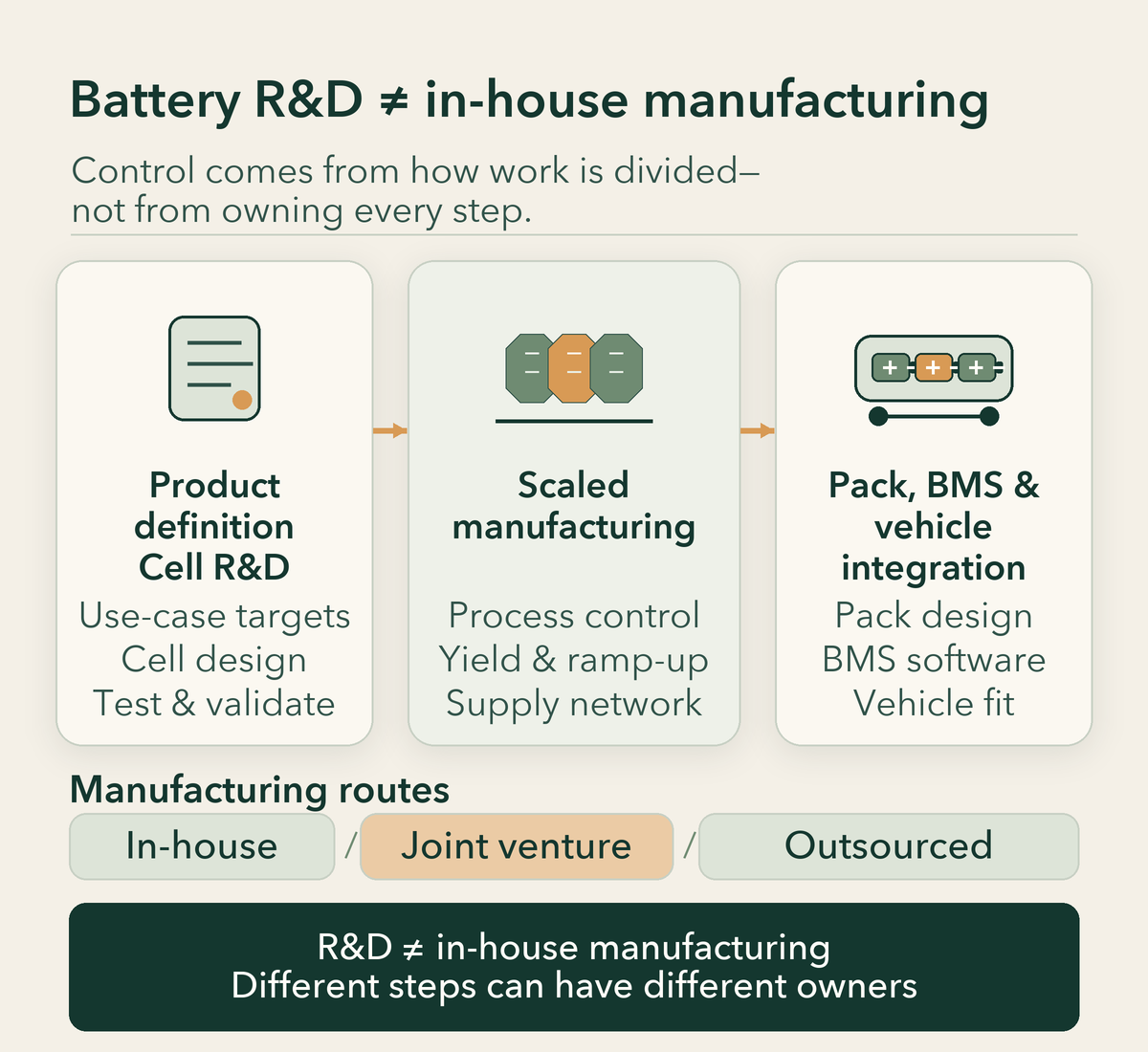
Cell development, mass manufacturing, and vehicle integration may sit within one company or be divided among several partners.
Commercially, the more control a carmaker has over specification and validation, the better placed it is to compare supplier proposals, arrange alternative sources, and decide when a technology is ready for a vehicle. That is an assessment of industrial organization. It does not show that any particular company has already reduced its costs, and it cannot establish that a given vehicle is safer.
Safety faces a separate test: whether mass production remains consistent, whether control strategies cover low temperatures, degradation, and abnormal operating conditions, and whether a problem can be traced to a specific batch and handled promptly. Moving a supplier’s function onto a carmaker’s organization chart does not complete any of that work automatically.
Carmakers are moving closer to cell development, but not all need their own factories
NIO offers another example of internal research coexisting with collaboration. In its March 2024 announcement of a long-life battery development partnership with CATL, NIO described capabilities spanning material synthesis, cell trial production, system assembly, and validation. Having its own research organization did not prevent it from tackling a particular technical challenge with a partner.[3]
Geely and GAC have taken more asset-intensive paths. Xinhua’s 2024 report on Zeekr’s electric-powertrain factory documented its Golden Brick Battery manufacturing operations. Geely introduced the Aegis Short Blade Battery that same year. GAC’s Yinpai plant began production in 2023, taking the group into both cell and battery-pack manufacturing. These investments predate the new plan released in September; they were not launched in response to it.[4][5][6]
GAC did not bring every activity inside the group. In a 2022 report by the 21st Century Business Herald, Aion management described a battery strategy that included both in-house production and outsourced manufacturing.[7] A carmaker can build a factory while retaining external supply. Internal production can build technical expertise and provide a cost benchmark, while external supply preserves product choice and capacity flexibility. Whether the combination works depends on sales volume, manufacturing efficiency, and management—not on how often a company uses the word “independent” at a launch event.
The most useful questions about an in-house battery program are therefore specific: How deep does the R&D go? Who is responsible for volume production? Which capabilities have been validated in vehicles delivered to customers? Announcing a technical route and consistently manufacturing millions of cells to the same performance standard are different achievements.
CATL is dealing with customers that understand batteries better
CATL’s own announcements contain facts often left out of narratives about carmakers moving away from the battery supplier. Li Auto signed a five-year comprehensive strategic cooperation agreement with CATL in September 2025. Geely deepened its strategic cooperation with CATL in July 2025. In January 2026, NIO established a five-year cooperation arrangement with CATL, with priorities including long-life batteries, battery-swap compatibility, and shared network resources.[8][9][10]
These announcements do not guarantee CATL’s future share of orders. They do show that in-house development and supplier cooperation can continue at the same time.
For specialist battery companies, the change is that customers no longer ask only about capacity, price, and delivery. Carmakers with their own R&D capabilities will demand deeper data collaboration and clearer technical interfaces, and they will be better equipped to evaluate a supplier’s proposal. Battery companies must demonstrate manufacturing efficiency and show that collaboration creates value for the vehicle that the carmaker could not readily obtain through independent development.
The industry is therefore unlikely to split neatly into winning carmakers and losing battery manufacturers. Some carmakers will expand internal production, some will increase outsourced manufacturing, and others will continue joint development. Suppliers may still win orders, but the authority to define the product, the available margin, and the allocation of responsibility behind those orders will change. Assessing that shift requires vehicle-program nominations, procurement shares, and long-term quality data. A single cooperation agreement or in-house development announcement cannot substitute for them.
Why pursue more battery technologies when industry leaders already exist?
The scale achieved by CATL, BYD, and other companies does not mean the industry has exhausted its technical choices. The plan released on September 28 keeps lithium-ion batteries at the center of the industry while calling for sodium-ion, flow-battery, and other technologies to develop alongside them, with further work on all-solid-state and other advanced systems.[2]
Two questions need to be kept separate: whether the number of companies increases, and whether technical capability improves. Another factory producing a similar product may not solve a new problem. A technology that can serve different operating conditions, lower system costs, or reduce resource constraints may still merit preservation and validation even before it reaches large scale.
Vehicles and power grids also ask different things of batteries. A vehicle must fit weight and volume into limited chassis space while withstanding crashes, fast charging, and temperature changes. An energy-storage project must calculate duration, service life, efficiency, maintenance, and safety costs against its operating task. A ranking based only on cell-level energy density cannot make the decision for both types of customer.
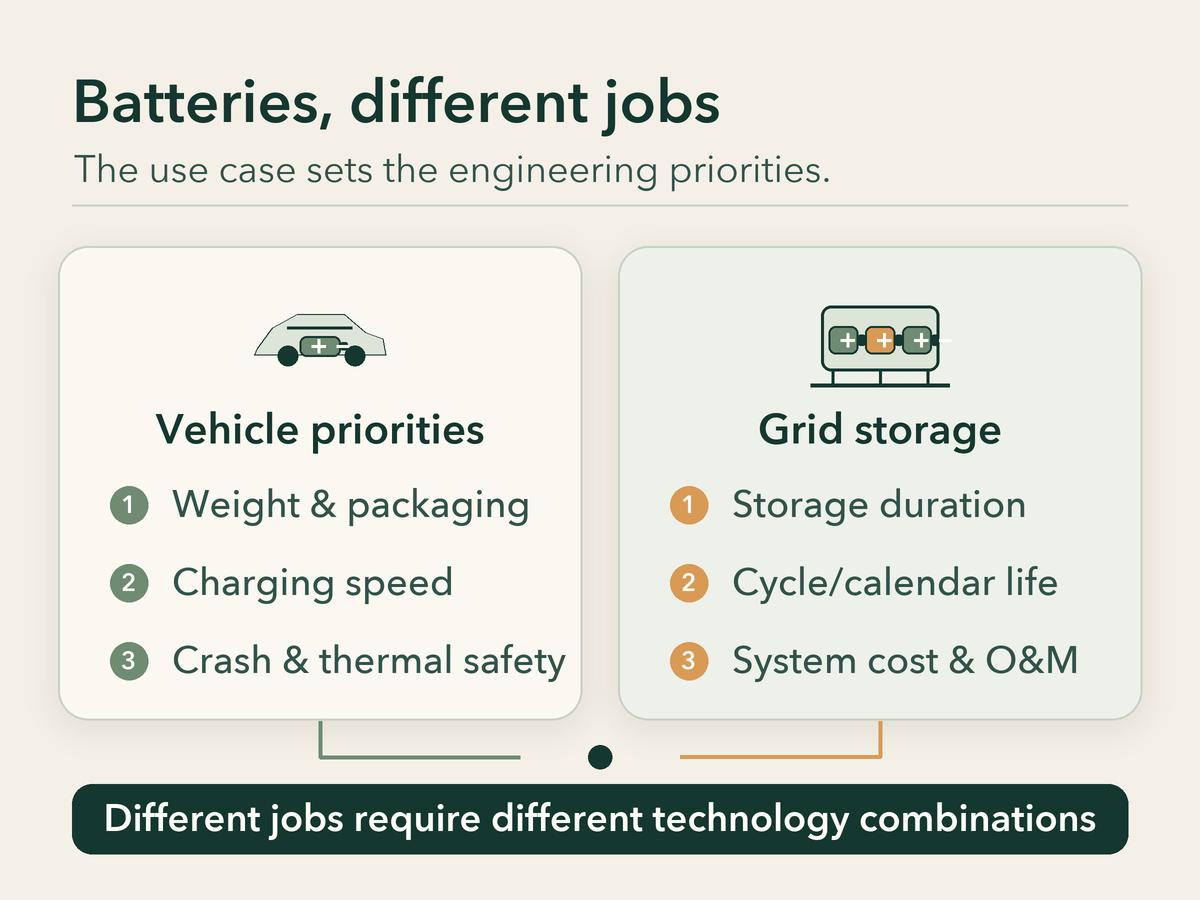
Vehicles and power grids operate under different conditions, so battery systems must be chosen for the task they are expected to perform.
This is the practical value of technological diversity: it preserves options for different tasks instead of declaring in advance that one battery can serve every market. The plan’s support for frontier technologies does not mean those technologies are already mature, already inexpensive, or certain to replace existing lithium-ion products.
The next stage of green power depends on the economics of the whole system
Consolidating China’s advantages in new-energy industries is an important purpose of the plan, but the object of that effort now extends beyond traction-battery sales. The ministry’s official interpretation identifies power generation, power grids, industrial parks, and data centers as areas for expanded energy-storage use. It also emphasizes integration between new battery technologies, clean energy, and the equipment that consumes it.[11]
For these users, purchasing a cabinet of batteries is only the beginning of a project. The ability of storage to perform reliably depends on when it charges and discharges, how it coordinates with other equipment, and how the system is isolated and restored after a fault. Lower cell prices matter, but the project ultimately pays for an entire system and bears its operating risks.
An energy-storage business should therefore be evaluated by the usable capability it delivers, rather than only by the number of batteries it sells. How long can the system sustain its output under the agreed operating conditions? How are degradation and efficiency incorporated into project returns? What does the warranty cover? Who bears the cost of downtime and maintenance? Attractive equipment specifications cannot produce a reliable return calculation when operating rules and actual use conditions remain unclear.
If battery manufacturers, system integrators, and operators can build verifiable capabilities across these areas, China’s existing manufacturing strengths may become a more durable industrial advantage. Selling more cells and mastering a reliable, long-lived storage system involve different technical capabilities and commercial relationships.
AI can strengthen engineering judgment; it cannot sign off on safety
The plan assigns artificial intelligence a role in system integration and decision support. Treating that as simply adding a chatbot to a battery would miss the point.[2]
The more consequential issue is how operating information shapes engineering decisions. Sensor collection, state estimation, anomaly detection, and control actions must form a trustworthy chain. Even if a model identifies a risk, poor data quality or an alert that fails to trigger an effective response would make it impossible to claim improved vehicle safety on the strength of a single prediction.
Policy direction and engineering acceptance also have to be distinguished. The plan encourages the use of AI; it does not establish that any company’s model is already reliable. A real project must still define the operating conditions in which the model applies, its false-positive and false-negative performance, the protections used under abnormal conditions, and the process for revalidation after software updates. These are engineering questions for evaluating a system. They are not algorithm-governance rules that the plan has already specified one by one.
Greater access to battery data does give carmakers more scope to coordinate hardware and software. Whether that opportunity produces better safety performance requires evidence accumulated over time. Combining the labels “in-house” and “AI” does not remove the need to prove manufacturing quality, test validation, and service life.
What matters most comes after mass production
The plan contains another signal that deserves attention. The ministry’s official interpretation explicitly mentions structural imbalances between supply and demand, capacity-warning mechanisms, product-quality supervision, and rules for price competition.[11] Support for innovation and constraints on unproductive expansion appear together.
For carmakers, the test is whether R&D programs reach vehicles on schedule, deliver consistently, and receive adequate warranty and after-sales support. For battery suppliers, it is whether they can continue winning sound orders on the strength of manufacturing, technology, and service as more customers develop batteries themselves. For energy-storage projects, actual operating performance and long-term responsibility matter more than announced investment totals.
Car buyers do not need to choose an industrial strategy on behalf of automakers. More useful questions concern the battery version installed in a specific model, the warranty terms, the conditions governing low-temperature use and fast charging, and who bears full responsibility when a fault occurs.
“In-house development” can show what a company wants to control. Degradation, repairs, and operating records after years of deliveries will show what it has actually mastered.
Sources
Information is current through September 28, 2026. Company disclosures are used to establish publicly stated strategies, not as independent performance assessments. The industry analysis and recommendations in this article are derived from those facts.
[1] The Economic Observer, Pu Zhenyu, “Li Auto President Ma Donghui on In-House Battery Development: It Is Not About Cost, Nor Is It a ‘Last-Minute Scramble,’” September 24, 2026; interview conducted on September 21.
[2] Ministry of Industry and Information Technology and six other departments, 15th Five-Year Plan for the Development of the New Battery Industry, MIIT Joint Planning [2026] No. 220, published September 28, 2026.
[3] NIO, “NIO Joins Hands With CATL in Innovation of Long-Life Batteries,” March 14, 2024.
[4] Xinhua, “Inside Zeekr’s Electric-Powertrain Factory: Exploring Golden Brick Battery Technology,” October 24, 2024.
[5] Geely Auto, Aegis Short Blade Battery technology launch, June 27, 2024.
[6] Securities Times, on-site report on the start of production at Yinpai Battery’s intelligent ecosystem factory, December 12, 2023.
[7] 21st Century Business Herald, Song Doudou, “Unwilling to Work for Battery Makers: GAC Establishes Its Own Battery Company,” August 25, 2022.
[8] CATL, “Li Auto and CATL Reach Comprehensive Strategic Cooperation,” September 19, 2025; agreement signed September 18.
[9] CATL, “CATL and Geely Deepen Strategic Cooperation,” July 4, 2025.
[10] CATL, “Long-Life Batteries + Battery-Swap Network: CATL and NIO Sign Five-Year Strategic Cooperation Agreement,” January 6, 2026.
[11] Ministry of Industry and Information Technology, official interpretation of the 15th Five-Year Plan for the Development of the New Battery Industry, September 28, 2026.
More from WayDigital
Continue through other published articles from the same publisher.
Comments
0 public responses
All visitors can read comments. Sign in to join the discussion.
Log in to comment